
Published 2026-10-10 · DIYCarPlay Engineering Team
How to Add CarPlay to a Toyota Land Cruiser 150 Series or Prado Without Replacing the Factory Screen
Yes — a plug-and-play CarPlay decoder module adds wireless Apple CarPlay to a Toyota Land Cruiser 150 Series, also sold as the Prado, between 2009 and 2023 while keeping the factory screen, head unit and steering controls. No screen replacement, no cutting of factory wiring.
A CarPlay retrofit module is an add-on interface that brings Apple CarPlay to a head unit which was never built with it. Instead of replacing the factory display, the module reads what the car already outputs and reproduces the phone interface on that same panel. On a Land Cruiser 150 the original screen, the original head unit, the steering-wheel buttons, the climate controls and the factory reversing camera all stay in the car.
That distinction matters on this particular vehicle. The 150 Series is sold worldwide under the Land Cruiser name in some markets and the Prado name in others, and the same generation carries different factory infotainment depending on trim. A module that suits a GX will not necessarily suit a VX. Matching the generation and the trim is the whole job.
Which Land Cruiser 150 generations need a retrofit module
The 150 Series ran from 2009 to 2023 across three interior generations. None of them offered wireless CarPlay from the factory, even after the later facelifts. What changes between them is the dashboard layout, the connector behind the head unit and the amplifier arrangement.
| Build years | Typical trim | Factory infotainment | What a retrofit module adds |
|---|---|---|---|
| 2009–2013 | GX, GXL | Display Audio with Entune, physical shortcut keys below the panel | Wireless CarPlay on the original screen, original reverse camera retained |
| 2014–2017 | GX, GXL | Refreshed centre stack, updated climate control panel | Wireless CarPlay, original USB input and steering controls retained |
| 2018–2023 | GX, GXL | Facelift dashboard, new display assembly | Wireless CarPlay on the facelift panel |
| 2014–2023 | VX, Kakadu, Altitude | JBL amplified system, some with multi-angle camera | Check the build plate before ordering — the amplified variants need a different connection |
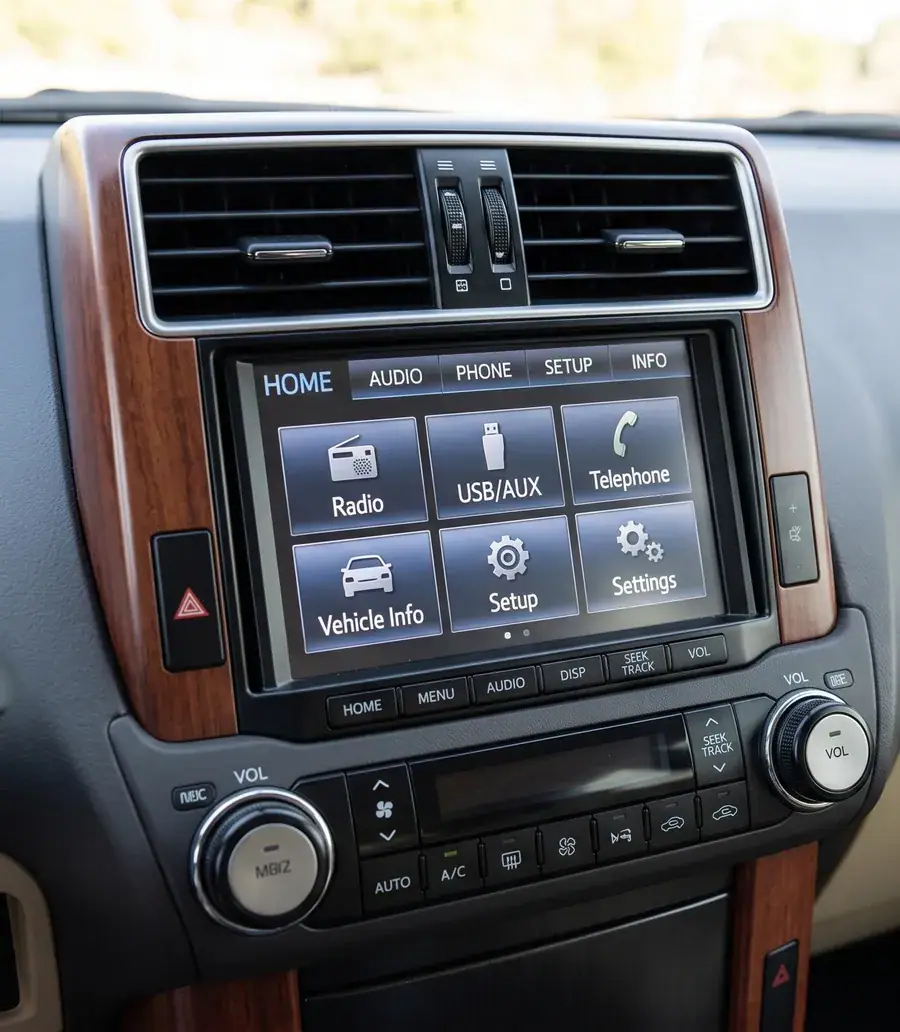
The trim split above is the single most common source of a wrong-parts return. Higher trims add a factory amplifier, and an amplified system needs the audio path rerouted rather than tapped. The model year alone is not enough information — the build plate on the body shell is.
What the module actually connects to
A retrofit module for this platform is a small Linux-embedded board with a plug-and-play harness, a 5GHz WiFi antenna and a microphone lead. It taps the vehicle-side video output behind the head unit and the CAN-bus for button events, then presents a CarPlay image to the factory panel. Audio returns through the factory amplifier, so the speaker system in the car is the one that plays music and calls.
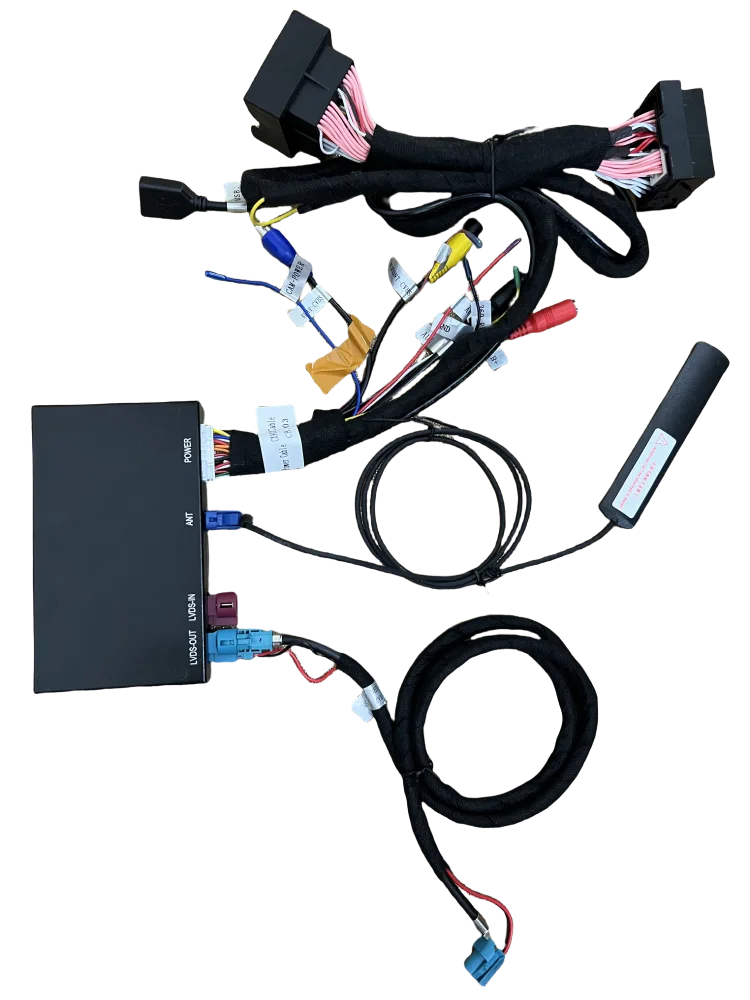
The board runs embedded Linux rather than a phone-style operating system, on an automotive-grade Sunplus chipset. That combination matters for longevity. Android-based head units accumulate background processes and cache over years, and a unit fitted in 2016 can feel slow by 2023. A Linux-embedded module performs the same work indefinitely because it does not carry an application ecosystem in the first place. Apple lists the general compatibility expectations for CarPlay on its official CarPlay support page, and the module-side behaviour follows those same conventions.
Coverage is quoted across 300+ vehicle models and series rather than as a module count, because the unit that matters is the one matched to a specific head unit generation rather than the size of any catalogue.
What stays on the car after the install
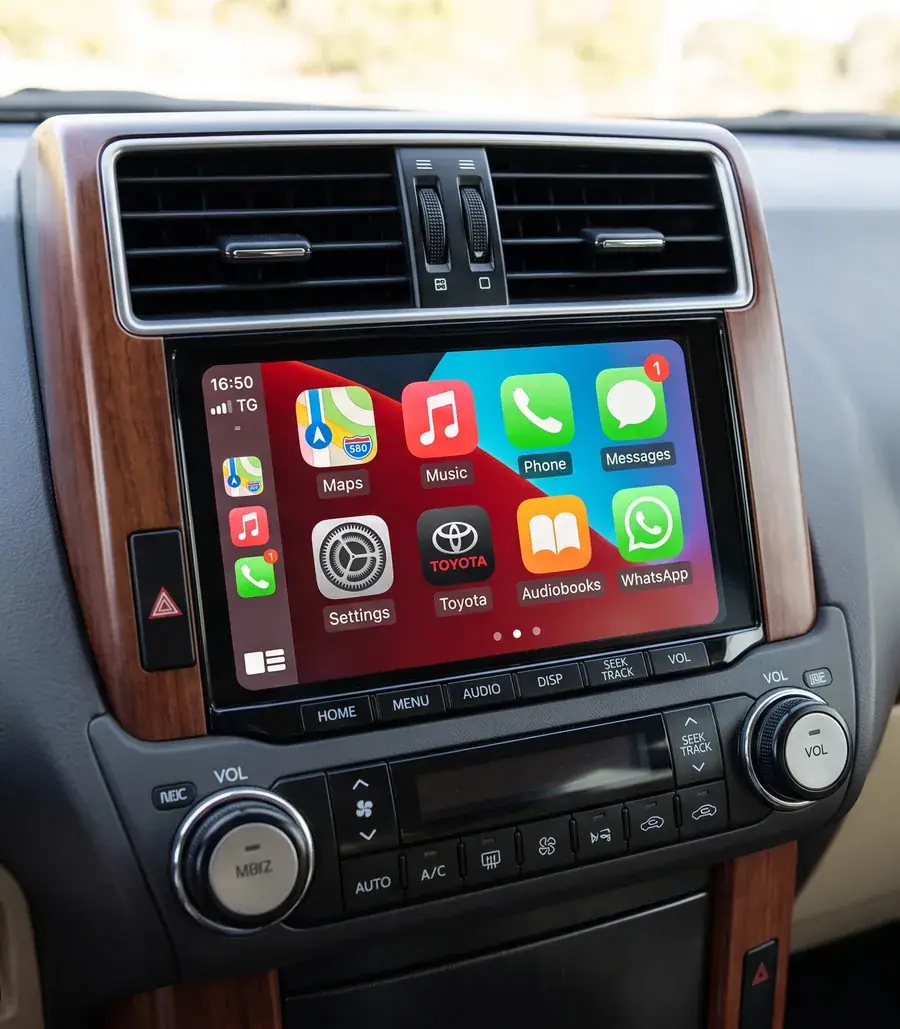
Nothing on the dashboard is exchanged. The screen keeps its original resolution and brightness, the wood trim and centre console are untouched, and the car still starts and operates normally with the factory system. CarPlay runs alongside the original interface and switches on demand, which means the factory navigation, radio and vehicle settings remain available whenever they are wanted.
- Screen and head unit: original panel retained, no fascia modification, no dashboard trim damage.
- Steering-wheel controls: volume, track skip and voice commands continue to work through the CAN-bus connection.
- Reversing camera: the factory camera path stays live, so the original camera keeps working.
- Audio: playback stays on the factory amplifier and factory speakers, including any factory EQ settings.
- Warranty position: nothing in the cabin is permanently altered, which is the usual argument for this approach over cutting the harness.
One honest limitation belongs here. On a 2018–2023 facelift car that already carries a factory camera system, the camera trigger has to be confirmed against the specific trim before an order is placed. Guessing at that one point is what turns a two-hour install into a return shipment.
Why the 5GHz dual-band link matters on this vehicle
The module transmits on both 2.4GHz and 5GHz. In practice the phone holds the Bluetooth handshake and the picture and audio stream travel over 5GHz, which is the band least crowded by the other wireless equipment in a car. A factory reversing camera, a dash recorder, tyre sensors and a passenger laptop all compete for 2.4GHz space. Routing the CarPlay stream onto 5GHz keeps navigation crisp and audio steady when those devices are active.
The second issue is antenna placement. A large body-on-frame vehicle with a dash full of metal and glass is not a friendly environment for a 2.4GHz link, particularly in underground car parks and rural areas. The external antenna supplied in the kit exists for that reason, and mounting it behind the head unit rather than inside the cabin wall is what holds the connection steady.
Ordering terms for workshops and resellers
For an installer fitting a handful of vehicles, stock is available from 10 pcs with mixed models allowed in one order. Private label starts at 500 pcs per model, and full OEM firmware customisation starts at 1000 pcs per model. Sample units ship in 7–15 days by DHL or FedEx, and large-volume production runs 15–20 days at 500 pcs or above. Quotations go out within 12 hours. Terms are 30% deposit with the balance against a copy of the bill of lading, settled by T/T or PayPal, and a sample fee is deductible from the first large-volume order. The full terms are on the wholesale page.
Common questions
Does the 2021 Land Cruiser already have CarPlay?
The 300 Series, launched in 2021, does ship with CarPlay and Android Auto as standard on most trims, paired with a larger centre display. The retrofit question applies to the 150 Series, which ran until 2023. A 300 Series owner normally has no need for a module.
Can the original screen show both CarPlay and the factory menu?
Yes. The module runs alongside the original system rather than replacing it. The factory radio, navigation and vehicle settings stay available and the interface switches between them on demand.
Will the factory reversing camera still work?
Yes, on the configurations where the camera trigger is present on the head unit. That includes the standard GX and GXL layouts. Amplified and multi-angle camera trims need checking against the build plate first.
Is the factory screen good enough for CarPlay video?
The 150 Series panels are the limiting factor, not the module. The screen keeps its original resolution, and the output is already scaled to fit it. A car with a factory 9-inch or 12.3-inch panel shows noticeably more interface than an earlier car with a smaller one.
Does fitting a module affect the air-conditioning or the climate controls?
No. The climate panel on a 150 Series is a separate assembly from the head unit and is not opened during the install. The rotary knobs, the seat heating buttons and the multi-terrain controls all remain as they were.
How long does the installation take?
Roughly two hours on a GX or GXL. The centre console trim is released, the head unit connectors are reached and the harness is plugged in. No factory wiring is cut, and the original head unit stays in the car.
Send a photograph of the centre stack, the build plate and the head-unit part number, and a fitment confirmation plus a quotation come back within 12 hours. Request a quote for Land Cruiser 150 modules, or ask for the sample terms first.
Need the Module From This Guide?
Wholesale from 10 pcs (mixed models OK), samples in 7–15 days (DHL/FedEx express). Fitment confirmation within 12 hours.
Request Pricing Check FitmentRelated Resources
- CarPlay Collections — browse by marque family (German, British, Italian, Japanese, luxury)
- CarPlay Fitment Checker — find the module for your car
- CarPlay Decoder FAQ — 34 answers on compatibility, install and wholesale
- CarPlay Retrofit Buying Guide — platform identification & selection
- Wholesale, Private Label & OEM Program — MOQ, lead times, payment terms
- All installation & technical guides