Published 2026-10-09 · DIYCarPlay Engineering Team
How to Add Wireless CarPlay to a 10th-Gen Honda Accord Without Replacing the Factory Screen
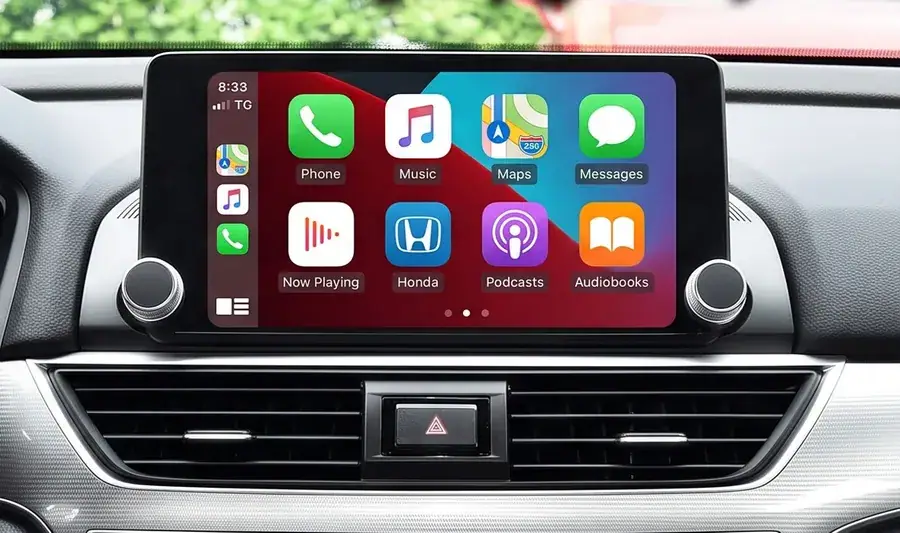
Yes — a plug-and-play decoder module adds wireless CarPlay to a tenth-generation Honda Accord and keeps the factory screen, the physical knobs and the reversing camera. Most 2018–2020 cars already have wired CarPlay, so the real upgrade is wireless, not missing software.
A CarPlay retrofit module is a small box with a vehicle-specific wiring harness. It sits behind the factory head unit, reads what the car already provides on the factory display link, and presents a CarPlay interface on the original screen. Nothing is cut, nothing is swapped. The dashboard trim goes back on, the harness plugs into the connector that was already there, and the car keeps every function it had before.
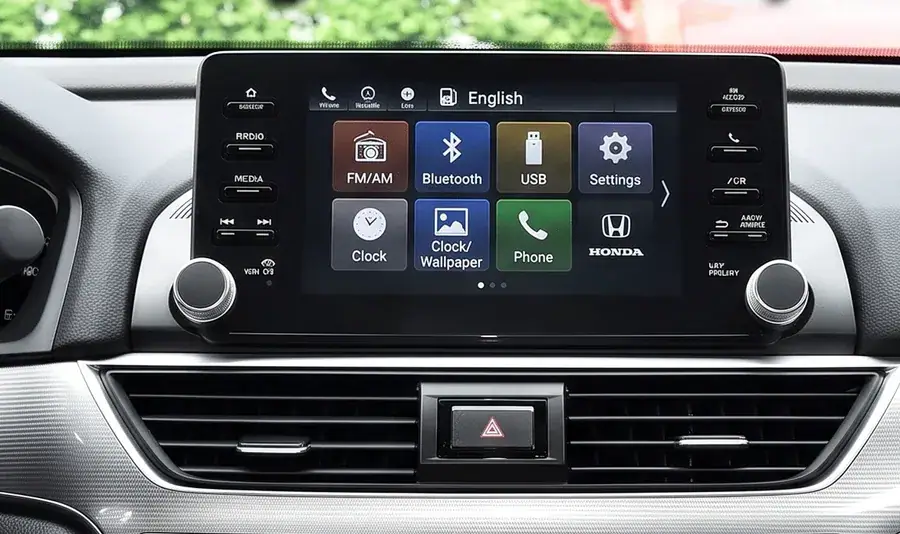
For the tenth-generation Accord the important detail is that the factory system is already capable of CarPlay. Honda offered the 8-inch Display Audio touchscreen with Apple CarPlay and Android Auto from the 2018 model year on Sport, EX, EX-L and Touring trims. The 2021 model year made the 8-inch screen and smartphone integration standard across the gasoline range. In other words, a used Accord that needs no modification at all is the most common case, and any honest guide should say so before selling anything.
Which tenth-generation Accord actually needs the module
Three configurations matter, and they are easy to confuse from a distance because the dashboard looks identical across most trims. The 7-inch driver information display in front of the driver is the same 7-inch TFT unit on every tenth-generation Accord. It is the centre stack that changes.
| Model year and trim | Centre screen | Factory smartphone integration | What the module changes |
|---|---|---|---|
| 2018–2020 LX | 7-inch Display Audio, hard buttons and knobs | Not equipped | Adds CarPlay and Android Auto on the factory screen |
| 2018–2020 Sport, EX, EX-L, Touring | 8-inch Display Audio touchscreen | Wired Apple CarPlay and Android Auto | Removes the USB cable requirement and adds wireless |
| 2021–2022 gasoline range | 8-inch Display Audio touchscreen | Standard, wireless on higher trims | Adds wireless where the trim does not have it |
| Hybrid versions | 8-inch Display Audio touchscreen | Standard from 2018 | Wireless convenience only; the hybrid layout has its own centre-stack connector |
That table is the reason fitment questions are answered before anything is quoted. The full platform list sits on the vehicle compatibility page, and the Honda-specific unit is documented separately under the Honda decoder range. Both list 300+ vehicle models & series across 2006–2025, and both are organised by head-unit generation rather than by trim badge.
Why wired CarPlay is the thing worth replacing
The factory 8-inch system already runs smartphone integration well. The complaint from owners is rarely the interface. It is the cable. A wired link needs a charge-and-data USB port every time the car is used, and the tenth-generation Accord has factory USB-A ports rather than USB-C, so the cable has to stay in the console. It also means audio routes through the phone first, which is where an incoming call and a navigation instruction start competing for the same audio path.
The tenth-generation Display Audio system is built on a Honda-developed operating layer that sits on top of Android, and Honda has released updates over the years through USB, Wi-Fi and, on Touring, cellular. That platform work is the factory side of the car. A retrofit module does not attempt to replace it; it sits beside it and only takes over the display when a phone is paired.
What physically happens during the install
On a tenth-generation Accord the centre stack is reached from the cabin rather than from the glovebox. The trim panel around the Display Audio unit releases from its clips, and the head unit sits behind it with its connectors facing the driver. Two lower screws and the side clips come out, the panel moves forward, and the factory display link and speaker harness are exposed.
The harness then does three things at once: it taps the factory display link for video and touch, it takes power from the head unit connector so no extra supply has to be run into the fuse box, and it picks up the reverse trigger so the factory camera still takes priority when the car is put into reverse. Audio is handled by muting the factory source and driving the vehicle amplifier input, which keeps the factory amplifier in circuit. That is the difference between a clean install and one where the factory premium audio stops working.
The physical knobs on either side of the screen and the steering-wheel controls stay in circuit, because the head unit still believes it is talking to its original display. The multi-angle rearview camera with dynamic guidelines is untouched. Nothing on the CAN bus is reprogrammed, so the car keeps its Honda Sensing behaviour, its parking sensors and its throttle-by-wire logic exactly as delivered.
Wireless on 5GHz, and what the link actually does
The module runs Linux on an automotive-grade Sunplus chipset rather than a phone-derived platform. That choice matters in a car that is ten years old and parked in summer heat: Linux does not accumulate the app cache that makes an aftermarket head unit sluggish after a year of daily use, and an automotive-grade part is specified for the temperature swings a cabin actually sees.
Both 2.4GHz and 5GHz bands are used. The 2.4GHz band reaches further but sits in the same crowded spectrum as a car park full of phones and any nearby access point, which is the usual source of a link that drops mid-drive. The 5GHz band is shorter-range but far cleaner, so video stays stable in exactly the multi-storey car park where the 2.4GHz link struggles. The antenna is mounted behind the head unit with the cable kept away from the display link and the climate-control motor, since a cable run parallel to the LVDS line is what picks up noise on the video side.
Apple's own support page sets out what CarPlay does on the vehicle side, including how a phone connects and what appears on the display: Apple CarPlay compatibility and connection details.
What a workshop or importer gets
Stock is available from 10 pcs and mixed head-unit generations can be combined in one shipment, which matters for a distributor who is not sure which platform will sell fastest in a given region. Private label starts at 500 pcs per model, and full OEM firmware programmes start at 1000 pcs per model. Samples take 7–15 days by DHL or FedEx; a volume production run of 500 pcs or more takes 15–20 days. A quotation is normally returned within 12 hours.
Payment is T/T with 30% deposit and 70% against a copy of the bill of lading, or PayPal. Sample cost is deductible from the first large-volume order rather than being treated as a separate charge. Full terms are on the wholesale terms page.
Common questions about the Accord retrofit
Does a tenth-generation Accord already have CarPlay?
Most do. From 2018 the 8-inch Display Audio system on Sport and above carries Apple CarPlay and Android Auto, and from 2021 it is standard across the gasoline range. The 2018–2020 LX with its 7-inch screen is the version that has none. Checking the centre stack before ordering takes about ten seconds.
Will the factory screen and the physical knobs still work?
Yes. The screen stays, the volume and tuning knobs on either side stay, and the steering-wheel controls stay connected. The head unit continues to drive its own display hardware; the module is added in parallel, not substituted for it.
Does the reversing camera still come on screen?
Yes. The reverse trigger is read from the factory harness, so the multi-angle camera image takes priority over any video the module is showing when the gear selector is moved into reverse, and the factory dynamic guidelines behave normally.
What happens to the factory premium audio?
It keeps working. The install routes through the vehicle amplifier rather than bypassing it, so the 450-watt ten-speaker system on EX-L and Touring trim stays in use and the factory equalisation settings are still applied.
Does this change the car warranty position?
Any aftermarket electronics work does. What can be stated precisely is the scope: the harness plugs into existing connectors, no CAN bus programming is involved, and the factory wiring loom is not cut or modified. A workshop that needs a specific answer for a specific market should raise it with the vehicle importer directly.
Is replacing the screen a simpler route?
It is a different product rather than a simpler version of this one. Fitting an aftermarket integrated-display head unit means replacing the screen, losing the factory camera and climate integration unless extra adapters are added, and introducing a phone-derived platform that accumulates app cache over time. The retrofit module approach keeps the original screen and the original system, and adds wireless CarPlay to them.
How long does the installation take?
Two to three hours on a tenth-generation Accord for a technician who has done the platform before. The trim disassembly is the slow part; the harness connections themselves are plug-and-play.
Checking fitment before ordering
The quickest way to sort out whether a specific Accord needs anything is to read the model year off the door jamb label, note which screen is in the centre stack, and match that against the table above. For a mixed fleet or a wholesale enquiry, the quickest route is to send the platform list with the quantities. Vehicle-by-vehicle fitment confirmation, sample arrangements and the quotation are handled directly on the contact page.
Need the Module From This Guide?
Wholesale from 10 pcs (mixed models OK), samples in 7–15 days (DHL/FedEx express). Fitment confirmation within 12 hours.
Request Pricing Check FitmentRelated Resources
- CarPlay Collections — browse by marque family (German, British, Italian, Japanese, luxury)
- CarPlay Fitment Checker — find the module for your car
- CarPlay Decoder FAQ — 34 answers on compatibility, install and wholesale
- CarPlay Retrofit Buying Guide — platform identification & selection
- Wholesale, Private Label & OEM Program — MOQ, lead times, payment terms
- All installation & technical guides