
Published 2026-10-29 · DIYCarPlay Engineering Team · 12 min read
Three Documents Before the Order: How to Settle a CarPlay Platform Code From the VIN, the Build Plate and the Parts Catalogue

Why the Model Year on the Paperwork Is the Weakest of Three Clues
A wholesale order for a CarPlay retrofit module is settled on paper long before anyone touches a dashboard. The buyer sends a list of target vehicles, the supplier answers with a platform code, and a pallet of modules leaves the factory against that list. Three pieces of documentation sit between those two points: the vehicle identification number on the registration, the build plate on the door frame, and the parts catalogue entry for the head unit itself. Each one narrows the answer, and each one fails in a different way.
The model year is the weakest of the three, and the reason is regulatory rather than technical. In North America the tenth character of the VIN encodes the model year under a scheme set out in ISO 3779 and made mandatory by the United States regulator. The code runs A for 1980 or 2010, then through the alphabet skipping I, O, Q, U and Z, and uses the digits 1 through 9 for 2001 to 2009 before the cycle restarts. Outside North America that same position is frequently left as 0, U or Z, or is used for something else entirely, because the year-placement rule is a North American requirement rather than a global one. A buyer sourcing for European, British, Japanese and Australian markets is therefore looking at cars whose tenth character frequently tells them nothing at all.
That is not a hypothetical edge case for this catalogue. German-built BMW, Mercedes-Benz, Audi, Volkswagen, Porsche and Volvo cars make up the bulk of what a decoder supplier ships, and their VINs are exactly the ones that skip the North American year code. Some European manufacturers place the year elsewhere in the string, and some reuse the position for body style or plant data. The result is a hard limit on what a VIN can settle: the character identifies the market and the model family, and it narrows the build window when the maker encodes one, but it does not by itself settle which head unit sits in the dash.
Clue One: The Build Plate Settles the Production Month
The single most useful document on a car for fitment purposes is the least glamorous one. On the driver's side door frame or B-pillar sits a certification label carrying a month and year in MM/YY format, along with the VIN and usually a trim and tyre specification. That date is the factory's own statement about when the car was completed, and it is the only one of the three clues that resolves mid-year changes.
Model year and production month are different facts, and the gap between them is where mistakes start. Manufacturers routinely begin building next year's models several months before the calendar year turns, so a car completed in October can carry the following year's model year, and for several months after a new generation launches, cars sold under one model year can be two different machines. A generation change that lands halfway through a year leaves a window in which a model-year figure is genuinely ambiguous. The build plate closes that window because it names the month rather than the season.
Two details matter for anyone building a sourcing list from these plates. First, the label takes priority over any online decoder when the two disagree, because it is the document the factory certified. Second, where the plate has been replaced, damaged or lost, a factory build record obtained from the manufacturer or an authorised dealer is the next authority, and component date stamps are only supporting evidence rather than proof, since parts and stock move between vehicles.
Clue Two: The Parts Catalogue Is the Only Source That Names the Hardware
The build plate tells a buyer when the car was made. It does not say what is in the dashboard. For that, the factory parts catalogue is the document that answers the question directly, and the head unit entry in it carries the two things a buyer actually needs: the part number of the unit fitted to that car, and the date range in which that number was produced.
BMW's electronic parts catalogue is the clearest example. Head units are listed with a supersession chain: a number such as 65129327320 runs from July 2013 to August 2017, and it is followed by a list of successor numbers each with its own production window, several of which the catalogue marks as exchangeable retrospectively. The Mercedes-Benz catalogue behaves the same way. A single entry for one C-Class head unit names at least six further revision numbers that fit the same vehicle range and differ by production date, software pre-load or regional variant, and the catalogue entry states plainly that the correct revision has to be confirmed from the number printed on the unit or from a VIN-based parts lookup.
Two practical consequences follow for a wholesale buyer. A single year range in a compatibility list is too coarse, because the factory moved to a new head unit number inside that range, and the replacement chain in the catalogue is the document that marks where the boundary sits. The second consequence is about evidence: a screenshot of a menu inside the car, a photograph of the screen, and a parts-catalogue number can be cross-checked against one another, and where all three agree the platform code is settled without anyone removing a dashboard.
Clue Three: The VIN as a Cross-Check, Not as the Answer
Read on its own, the VIN is a weak identifier for a European car and a strong one for a North American car. Read as a cross-check against a build plate and a catalogue number, it becomes the piece that catches a mis-typed build month or a car that has been reassembled.
Three checks earn their place in a sourcing workflow. The WMI characters in positions one to three confirm the manufacturer and the country of build, which settles whether the North American year code in position ten can be relied on at all; if the first character is in the S to Z range the car is European and the tenth character needs no weight. The seventh character settles which side of the thirty-year cycle the tenth character belongs to, since a numeric seventh character means the year code runs in the 1980 to 2009 range and an alphabetic one means 2010 to 2039. The ninth character is a check digit on North American cars and is frequently absent or meaningless on European ones, so a failed checksum on a European VIN is not evidence of anything and should not be used to reject a build.
What the VIN cannot do is resolve the head unit. A correct VIN narrows the vehicle to the model, market, plant and production sequence, and it is the key that unlocks a factory build record and the correct parts-catalogue branch. The head unit itself is identified by the number printed on the unit or by the catalogue entry reached through that branch.
| Document | What it actually settles | Where it fails |
|---|---|---|
| Model year on registration or VIN position 10 | North American cars only: the model year, in a thirty-year code cycle | European and many other VINs carry 0, U or Z in that position, or use it for another attribute |
| Build plate on the door frame | Production month and year, the factory's own certification | Missing or replaced on some cars; still a date rather than a hardware identification |
| Factory build record | Exact specification including the head unit number and option codes | Takes time to obtain and needs the manufacturer or an authorised dealer |
| Parts catalogue head unit entry | Part number, supersession chain and production window per revision | Needs the correct catalogue branch, which is reached through the VIN or the model |
| Photograph of the factory screen | Layout, controls and screen size of the head unit in the car | Cannot be read from a photograph of the exterior or the vehicle listing |
Why This Matters More to a Buyer Than to an Installer
An installer who picks the wrong harness finds out in the parking bay and swaps the part. A wholesale buyer who picks the wrong platform code finds out after the container has been loaded, the freight has been paid and the customer has installed the modules in twenty cars. The cost lands in the return shipment, the scrapped inventory and the damaged relationship, and it is the kind of error that is invisible in the order until the last carton is opened.
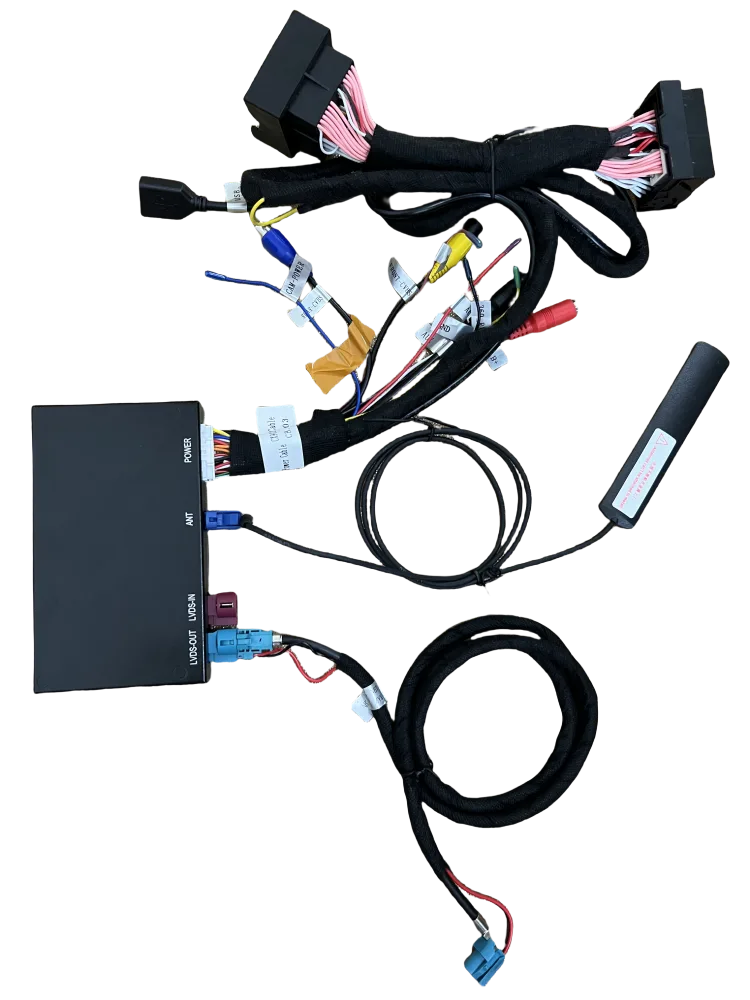
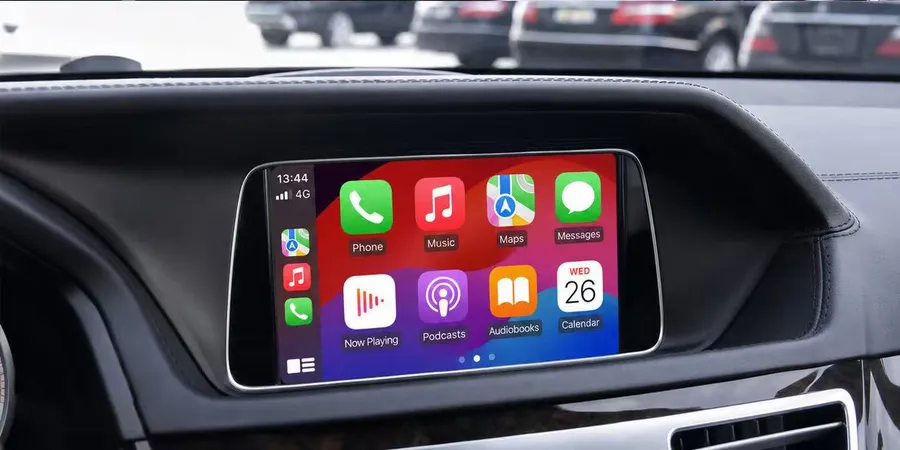
The modules themselves do not complicate this. The unit runs a Linux embedded system on an automotive-grade Sunplus chipset rather than a general-purpose operating environment, so there is no cache to accumulate and no long-term slowdown, and the wireless link runs on dual-band 5GHz WiFi, with the 5GHz band carrying the video stream while the 2.4GHz band handles the handshake, which keeps the picture stable in the crowded parking structures and underground garages where European and Australian buyers work. The factory screen, the factory head unit, the original steering-wheel buttons and the factory reversing camera all stay in place, so the fitment question is entirely a question of which platform code the car carries.
Because the platform code is the whole decision, resolving it from documentation before the order is placed removes the most expensive variable in the transaction. The covering runs 300+ vehicle models and series from 2006 to 2025, and the codes overlap in ways the paperwork has to resolve: one code covers two marques, one nameplate sits under two codes with different year windows, and several transitions fall in the middle of a model year rather than at its boundary.
One more customer-side detail belongs in a sourcing file, because a buyer is often asked about it before the installation is booked. The phone is the one that holds the CarPlay session, and the handover from the Bluetooth step to the wireless video stream is described in the official CarPlay support documentation. The module does not change that arrangement, which is why the fitment question stays a question of which platform code the car carries and nothing else.
Turning the Paperwork Into a Purchase Order
A workable procedure for a distributor is short enough to run over email and specific enough to survive a dispute. Ask for the VIN, the build plate and a photograph of the factory screen for every vehicle on the list, and treat a missing build plate as a request for the factory build record rather than as a detail to be skipped. Return a platform code against each entry together with the head unit part number the code was derived from, so the buyer can see the evidence rather than a bare assertion. Where two vehicles in the list share a model name but carry different build months, split them onto separate codes rather than averaging them into one line.
The commercial terms are the same as for any other stock order from this factory. 10 pieces is the minimum for stock, and mixed platform codes can be combined in one shipment at that level. A private-label programme starts at 500 pieces per model, and a Full OEM firmware programme at 1000 pieces per model. Samples take 7 to 15 days by DHL or FedEx, a large-volume order runs 15 to 20 days, and a quotation comes back within 12 hours of the request. Payment is 30% deposit with the remaining 70% against a copy of the bill of lading by T/T, and the sample fee is deducted from the first large-volume order.
Frequently Asked Questions
Can the tenth character of a VIN be trusted to give the model year?
On North American cars, yes. That position carries the model year under the United States rule and follows a thirty-year code cycle. On cars built for Europe and several other markets it frequently holds 0, U or Z, or serves another purpose, so the build plate is the more reliable source there.
Why not simply order on the model year the seller lists?
Because the model year is a classification rather than an engineering fact. Generations change mid-year in most of these nameplates, and the factory parts catalogue records the head unit change inside the year rather than at its edge. A car sold as one model year may have left the line with either of two different head units.
What is the fastest route to the head unit part number?
A factory build record retrieved through the VIN, or the parts-catalogue entry reached through the same branch, then confirmed against the number printed on the unit. The build plate is what makes the catalogue branch reliable, because it fixes the production month that the catalogue production windows are measured against.
Is the build plate always present?
On most cars it is, in MM/YY format on the driver's door frame or B-pillar. Where it has been removed or damaged, a factory build record from the manufacturer or an authorised dealer is the next authority, and component date stamps serve only as supporting evidence.
Does this evidence transfer to a replacement or rebuilt unit?
Partly. A head unit swapped during a repair carries the part number of the unit installed, not the one the car left the factory with, so the catalogue supersession chain for the date of the replacement is what applies. That chain is also why the catalogue is worth reading rather than only its headline part number.
Send the vehicle list with the VIN, the build plate and a screen photograph for each entry, and the platform code for every line comes back within 12 hours along with the head unit number behind it. Sample requests for the codes on the list can be arranged through the inquiry form, and the full coverage across 300+ vehicle models and series from 2006 to 2025 is listed on the vehicle fitment finder.
Need the Module From This Guide?
Wholesale from 10 pcs (mixed models OK), samples in 7–15 days (DHL/FedEx express). Fitment confirmation within 12 hours.
Request Pricing Check FitmentRelated Resources
- CarPlay Collections — browse by marque family (German, British, Italian, Japanese, luxury)
- CarPlay Fitment Checker — find the module for your car
- CarPlay Decoder FAQ — 34 answers on compatibility, install and wholesale
- CarPlay Retrofit Buying Guide — platform identification & selection
- Wholesale, Private Label & OEM Program — MOQ, lead times, payment terms
- All installation & technical guides