
Published 2026-10-17 · DIYCarPlay Engineering Team · 11 min read
Two Platforms, Two Model Lines: Sourcing Bentley CarPlay Modules Across BE-1 and BE-2
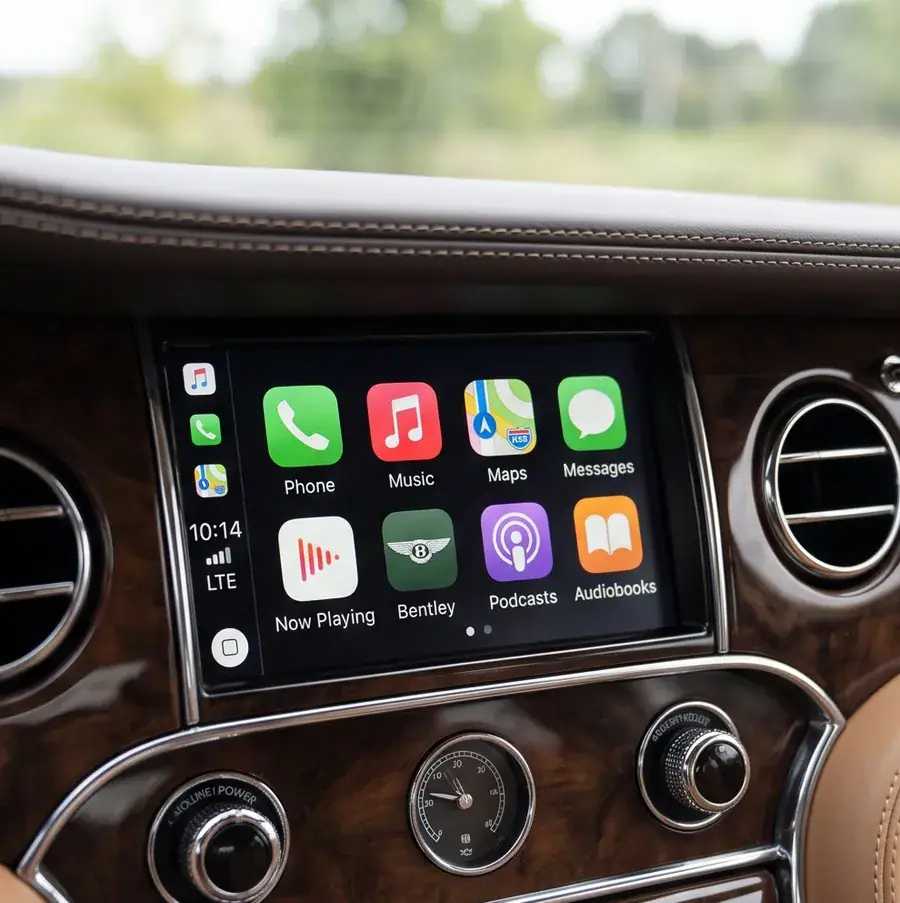
Bentley splits its infotainment across two factory platforms that arrived within the same decade and are still fitted to cars of overlapping model years. The BE-1 unit serves the Mulsanne for 2011–2020, and the BE-2 unit serves the Bentayga for 2016–2019. From the driver's seat the two look close enough to be mistaken for each other, and behind the dashboard they terminate into different connectors. For a distributor or installer, that is the whole problem in one sentence: the module has to be matched to the platform before it is boxed, because a Bentley owner who finds the car back at stock is not a customer who orders again. The modules described here connect to the vehicle's own wiring behind the factory head unit and put Apple CarPlay on the factory display, leaving the original screen, the original menus, the physical keys, the steering-wheel controls and the factory reversing camera exactly where they were.
Why Bentley Is a Different Buying Decision
Most sourcing decisions in this product line are made on volume. The buyer picks the platform with the deepest parc, orders against it, and the economics sort themselves out through freight efficiency. Bentley inverts that. Annual sales across the marque are a fraction of what one mainstream platform moves in a month, so the question is never unit price. It is landed cost per correctly matched unit, and how few returns the distributor can afford to carry.
Three things drive it. First, the two platform windows overlap between 2016 and 2019, so a buyer cannot order by model year alone and be confident of the variant. Second, the customer profile is unforgiving in a way that few other marques are: the vehicle is often bought used, inspected by a specialist buyer, and resold within a few years, so anything left behind behind the dashboard becomes a negotiating point at resale. Third, workshop labour on these cars is billed at a rate that makes one diagnostic hour more expensive than the module itself. Fitment settled before dispatch is the cheapest variable in the entire transaction.
Two Platforms, Two Model Lines
The BE-1 platform covers the Mulsanne across model years 2011–2020. The BE-2 platform covers the Bentayga across model years 2016–2019. The Bentley decoder range is built around exactly these two variants, and the fitment figures below are taken from the corresponding product pages rather than from a general model list.
| Model | Model years | Head unit | Variant |
|---|---|---|---|
| Mulsanne | 2011–2020 | Bentley infotainment (Mulsanne) | BE-1 |
| Bentayga | 2016–2019 | Bentley infotainment (Bentayga) | BE-2 |
The overlap between 2016 and 2019 is the trap. A car from that window is inside both ranges, and only the head unit generation separates them. A distributor who sorts an inbound vehicle list by registration year alone will eventually order the wrong variant, and the failure mode is quiet rather than obvious: the module powers up, the connector mates, the unit boots — and the display stays on the factory menu because the video handshake never completes. Nothing smokes, nothing throws a fault code, and the installer loses an hour before reaching for a multimeter.
The wider fitment picture across marques — including where Bentley sits among the other luxury platforms — is set out on the vehicle compatibility page. Buyers assembling a mixed-brand catalogue should work from that page rather than from individual marque pages.
Identifying the Platform Before Ordering
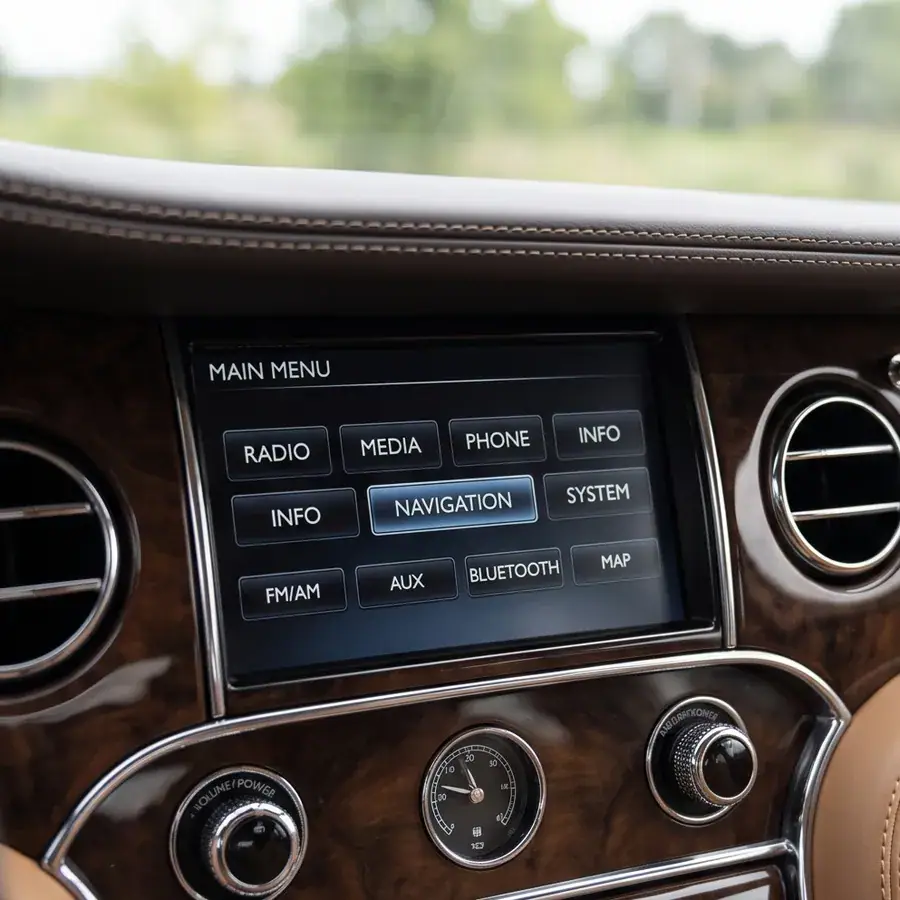
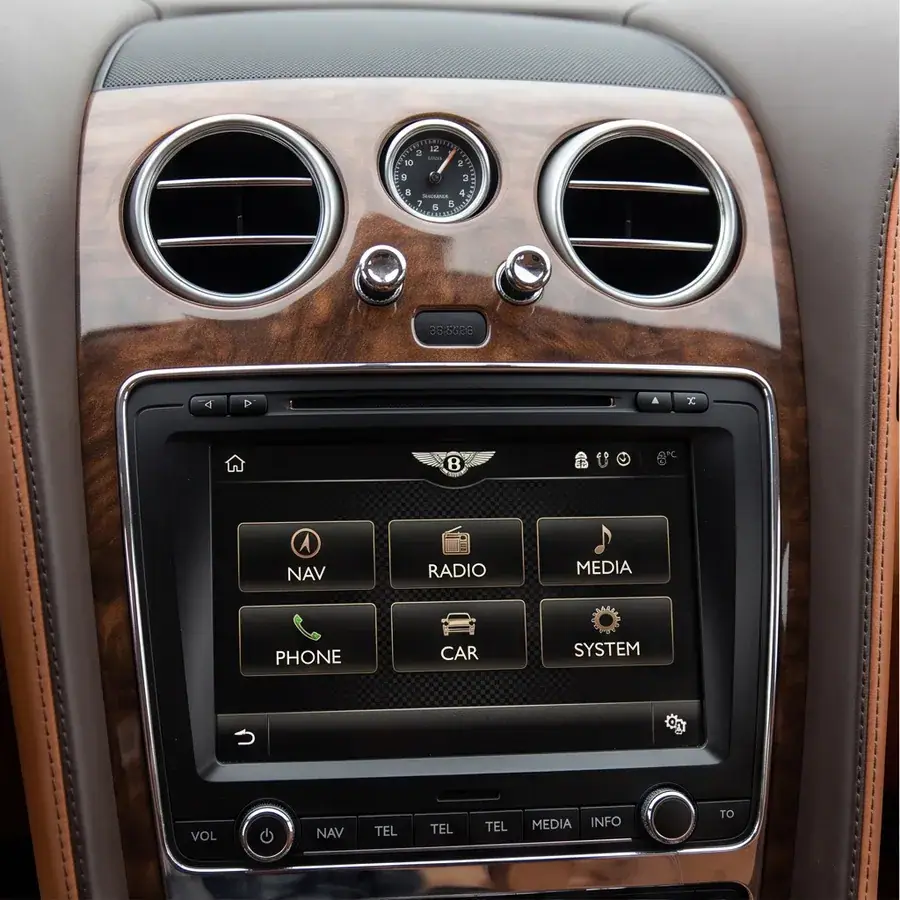
On most marques the screen layout settles the question. On Bentley it is less reliable, because both units were hand-finished to a similar standard and both present a similar arrangement of large labelled tiles. The photographs at the top of this page show the difference that actually holds: it is not the on-screen menu, it is the physical console around it.
The Mulsanne BE-1 console carries a wide horizontal display set into a wood-veneer fascia, flanked by two round air vents, with an analogue clock and the volume and tuning controls on the row directly below the screen. The factory menu on that unit is titled MAIN MENU and lays out a dense grid of rectangular buttons. The Bentayga BE-2 console places the display lower in a taller centre stack, with turbine-style vents above the panel and a longer bank of hard keys beneath it — NAV, TEL, MEDIA and INFO around a central rotary controller — and its factory menu presents a shorter set of larger tiles.
Two practical checks settle it before anything is ordered. The first is the navigation map version shown in the factory system settings. The second is the console photograph itself, because the physical key row differs between the two units and is visible in a single frame. Neither check requires specialist equipment; both do require the vehicle in front of the installer.
For a distributor taking stock before the vehicle list is confirmed, the sequence is straightforward. Collect one dashboard photograph per unit, confirm the platform against the two rows in the table above, and label each module by variant before it is packed. Once the label is right the boxing error rate drops to effectively nothing, because the label is the only thing standing between a BE-1 and a BE-2 arriving in the same carton at the same customer's workshop. A method that generalises across marques is set out in the CarPlay retrofit buying guide.
What the Install Leaves Unchanged
The Bentley fitment is a plug-and-play harness that connects behind the factory head unit. No wire is cut, no solder joint is made, and no permanent modification is left behind, so the vehicle can be returned to stock by pulling the harness. That reversibility is the argument that closes the conversation with an owner who is worried about resale value, and on this marque it tends to be the argument that matters most.
What stays on the car afterwards is the longer list. The factory display remains the original panel rather than a replacement. The physical keys beneath the screen keep their factory functions. The steering-wheel controls continue to operate the audio system. The factory reversing camera path stays alive, and aftermarket reversing cameras are supported as well. The real installation cases section shows the same camera position and console trim before and after, which is the fastest way to show a sceptical customer that nothing on the dashboard was removed to fit the module.
Inside the module, the system is Linux in embedded form on an automotive-grade Sunplus chipset from Taiwan-based Sunplus. That combination is what keeps a unit installed for years without the gradual slowdown that accumulates on general-purpose consumer systems, where background processes and cached data build up over time. It is worth noting that several of the factory systems these modules are fitted to also run on Linux for the same engineering reason, so the module behaves like the equipment it is being added to rather than like a different category of device bolted onto it.
Wireless Performance on Dual-Band WiFi
Wireless CarPlay runs over dual-band WiFi, with both 2.4GHz and 5GHz available to the link. The two bands behave very differently inside a car, and the difference matters more on a Bentley than on a city hatchback, for a specific reason: these are the vehicles most often parked in deep underground structures and in dense hotel or retail forecourts, where the 2.4GHz band is at its most crowded.
2.4GHz carries further and penetrates obstacles better, but it is also the band that fills up in exactly those environments — underground car parks with several hundred phones and access points sharing the same channels, and multi-storey hotel decks. 5GHz is the quieter band and carries noticeably more throughput, which is what holds picture quality steady and keeps touch response immediate when the phone and the module are competing with a congested 2.4GHz environment around them. Supporting both means the link settles on whichever band has headroom instead of fighting for a crowded one.
Stability over a long drive is the other half. A wired connection cannot drop; a wireless link can, if the antenna placement is poor. This is why antenna position inside the dash is treated as part of the product rather than as an install detail, and why the module is specified with the factory screen, controller and steering-wheel controls retained rather than introducing a bare panel into the dashboard. Reference points for how the two systems are defined are available on the Apple CarPlay support page, and the marque's own model line-up on the Bentley media site is useful when a buyer is confirming which variants a customer actually owns.
Ordering Terms, MOQ and Lead Times
Bentley volume is small enough that most first orders are mixed. Stock decoders start at 10 pieces with mixed variants accepted within the same order, which is the practical entry point for a distributor testing the market, and volume tiers apply at 100, 500 and 1000+ pieces. Private label — own branding, packaging and manual — starts at 500 pieces per model. Full OEM firmware customisation, covering boot logo, interface layout and default language, starts at 1000 pieces per model.
Samples take 7–15 days by DHL or FedEx express, and the sample cost is deductible from the first large-volume order. On this marque that deduction is what justifies the courier cost of a two-unit sample: one BE-1 and one BE-2, taken to two vehicles, settles the fitment question before a container is committed to anything. Private label lead time is 15–20 days for 500 pieces or more. The complete commercial terms, including the wider MOQ structure across all brands, are published on the wholesale programme page.
Payment is 30% deposit with the balance settled against a copy of the bill of lading, by T/T or PayPal. Quotations are returned within 12 hours. Warranty is 12 months with firmware updates included, which matters on a marque where the customer's expectation is that the module should be as dependable as the equipment it is fitted to.
One practical point for distributors planning a mixed catalogue: the compatibility data covers more than 300 vehicle models and series across the brands held in stock, and the efficient approach is usually to carry the Bentley variants alongside the high-volume platforms rather than as a standalone shipment. Questions on mixed configurations are answered in the decoder FAQ section.
Frequently Asked Questions
Which Bentley models can be upgraded to wireless CarPlay?
The BE-1 and BE-2 head units, which in practice covers Bentley vehicles built between 2011 and 2020 — the Mulsanne and the Bentayga. Any vehicle outside that list should be sent in as a photograph of its unit for confirmation before ordering.
Can the model year alone determine which variant is needed?
No. The two ranges overlap between 2016 and 2019, because the platforms were phased in over the same period. The navigation map version, or the physical console layout visible in a dashboard photograph, is the reliable indicator.
Is the installation reversible?
Yes. The harness connects behind the factory unit with no cutting and no soldering, so the vehicle can be returned to stock. The factory display, the physical keys, the steering-wheel controls and the reversing camera all continue to work as before.
What operating system runs inside the module?
Linux in embedded form on an automotive-grade Sunplus chipset, with dual-band WiFi at 2.4GHz and 5GHz. No general-purpose mobile operating system is involved, and the factory display is never replaced.
Is a two-unit sample worth ordering before a container?
On this marque it is. The platform overlap is exactly the problem a sample resolves, and the sample cost comes off the first large-volume order.
What are the payment and warranty terms?
30% deposit, balance against a copy of the bill of lading, by T/T or PayPal. Private label from 500 pieces per model, Full OEM from 1000 pieces per model. Warranty is 12 months with firmware updates included.
Start With the Vehicle List, Not the Price
On a low-volume marque like this one, the arithmetic that matters is returns avoided rather than pieces per dollar. Send the target vehicle list with a dashboard photograph per unit, confirm BE-1 against BE-2 using the two physical tells described above, and the remainder of the order is straightforward. Fitment confirmed before dispatch remains the cheapest variable in the whole transaction.
Send the vehicle list, quantities and target market through the inquiry form. A quotation follows within 12 hours, with volume tiers, lead times and the variant split for the platforms named.
Need the Module From This Guide?
Wholesale from 10 pcs (mixed models OK), samples in 7–15 days (DHL/FedEx express). Fitment confirmation within 12 hours.
Request Pricing Check FitmentRelated Resources
- CarPlay Collections — browse by marque family (German, British, Italian, Japanese, luxury)
- CarPlay Fitment Checker — find the module for your car
- CarPlay Decoder FAQ — 34 answers on compatibility, install and wholesale
- CarPlay Retrofit Buying Guide — platform identification & selection
- Wholesale, Private Label & OEM Program — MOQ, lead times, payment terms
- All installation & technical guides