
Published 2026-10-19 · DIYCarPlay Engineering Team · 9 min read
One Platform, Two Car Lines: Sourcing the Maserati MA-1 CarPlay Module for Quattroporte and Ghibli
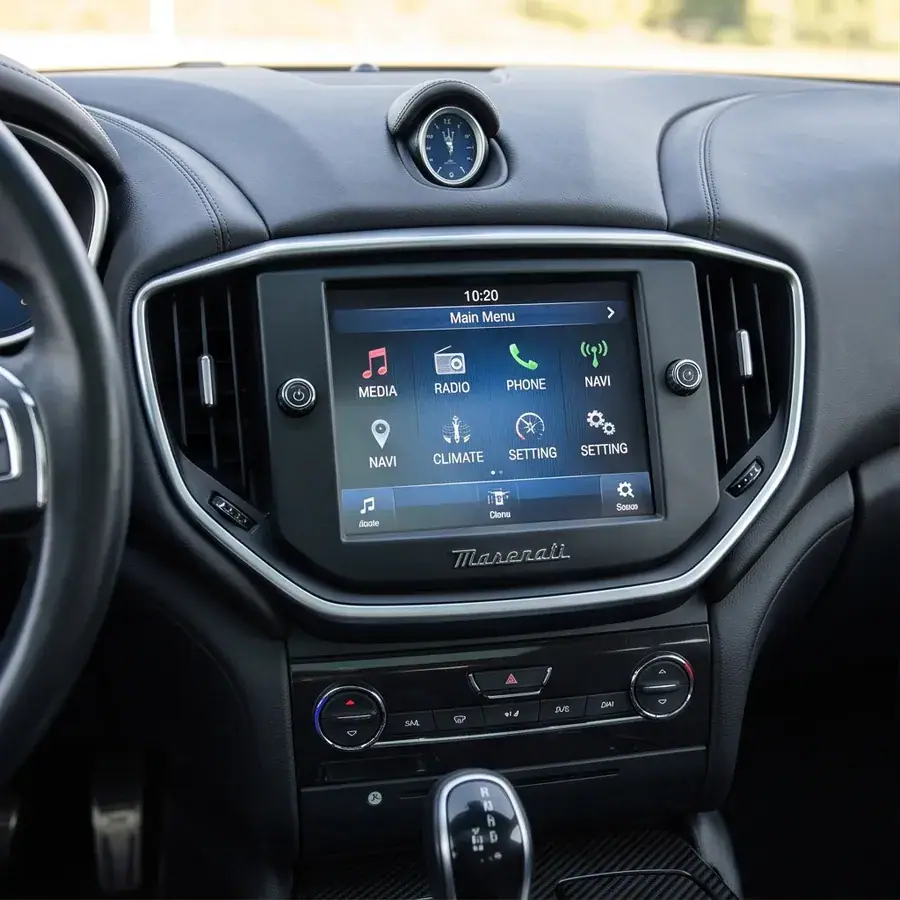
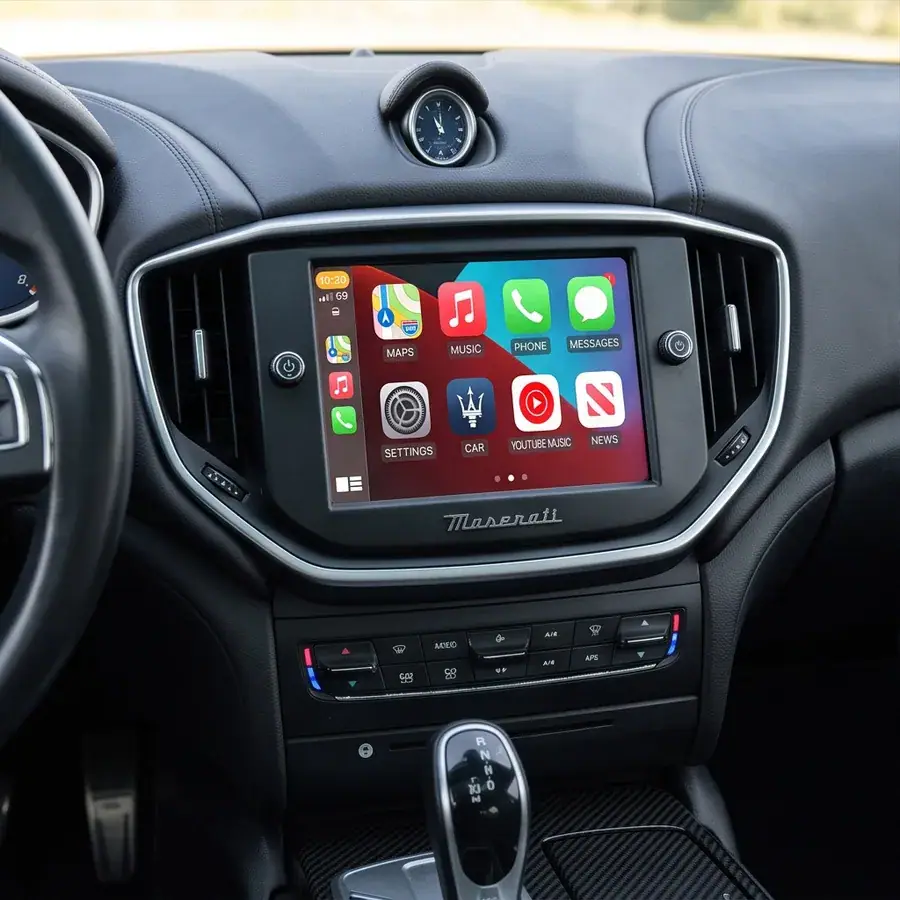
The MA-1 is the only CarPlay decoder module listed for Maserati's 2014–2016 factory infotainment, covering Quattroporte and Ghibli across the whole model range. It is a plug-and-play harness into the original LVDS video and CAN wiring: the Maserati screen, the rotary controller, the steering-wheel buttons and the factory reverse camera all stay in place.
For a distributor sizing this market, the headline is not the module count. It is that a single platform covers the two car lines that carry almost all of the retrofit volume in this marque, and that the cars involved were built without CarPlay in the first place. Apple only reaches these vehicles through a CarPlay-compatible head unit or a retrofit interface the manufacturer supports. A 2014 Ghibli has neither.
Fitment: what the MA-1 covers and what it does not
The Maserati fitment list is narrow by design. One product code, one infotainment family, one year band. That makes the sourcing question unusually easy to answer in advance, which is not true of most marques in this catalogue.
| Model | Years | Product code | Head unit |
|---|---|---|---|
| Quattroporte / Ghibli | 2014–2016 | MA-1 | Maserati infotainment |
Three points follow from that table, and each one has cost consequences downstream.
- GranTurismo, Levante and Maserati Levante-based derivatives sit outside the listed band. The fitment is confirmed against the infotainment, not the badge. A dealer who quotes on the badge alone will eventually ship a harness that does not reach the LVDS connector behind the dash.
- 2017 onward is a different generation. The facelift-era Maserati moved to a different head unit with a different connector layout. A car built after the listed years should be treated as unverified until the VIN is checked against the Maserati module page, not assumed to fit.
- Quattroporte and Ghibli share the platform. One SKU covers both car lines, which is why mixed-model stock makes sense for a dealer stocking this marque rather than a single-model buy.
Installation: what actually happens on the bench
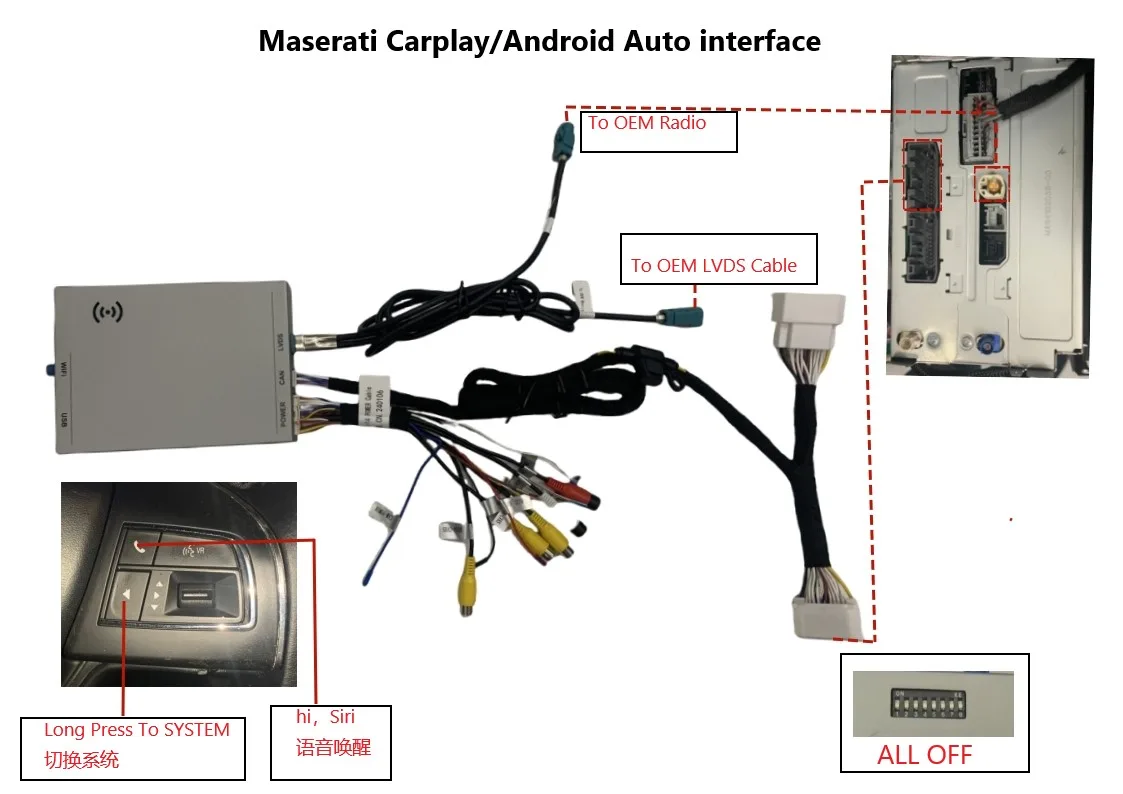
The MA-1 harness lands in three places. LVDS carries the video signal from the factory head unit to the Maserati screen. CAN wakes the module and carries vehicle data. The accessory harness feeds the reversing trigger and the camera path so the factory reverse image keeps working without any menu change.
No wire is cut. The dash is not removed beyond the trim panel needed to reach the head unit connector, and the screen stays on the car. This is the part that decides whether a retrofit installer can take the job at all: a workshop already set up for Maserati service work does not need to learn a new electrical architecture, and a workshop that only does Maserati does not need to buy a screen it will never use.
The failure mode worth planning for is not mechanical. It is a module that pairs but does not hold a link once the car is parked in a covered structure. That points at the radio path, not the harness, and it is why the module runs a dual-band 5 GHz WiFi link with 2.4GHz and 5GHz radios in the same enclosure. Buildings, underground car parks and showrooms load 2.4GHz heavily. The 5GHz side of that link is what holds when the surroundings get noisy.
Why the platform is a Linux embedded unit and not a large aftermarket screen
The MA-1 is a Linux embedded module with an automotive-grade Sunplus chipset from Taiwan. It adds a phone projection layer to an existing display; it does not become the display. That distinction decides two things a dealer ends up explaining to customers.
| Point | Retained factory unit | Large replacement screen |
|---|---|---|
| Screen hardware | Original Maserati display stays | Original display removed and discarded |
| Operating system | Linux embedded, no app cache to accumulate | Android-based, storage and cache grow with use |
| Steering-wheel buttons and controller | Fully retained | Often re-mapped or partially lost |
| Factory reverse camera | Stays on the original path | Usually needs re-wiring |
| Vehicle menus and settings | Unchanged, switchable at any time | Replaced by the new unit's interface |
The stability argument follows the hardware. Fluidity on a factory screen of this era comes from what the display pipeline and chipset can sustain, not from how many applications are running underneath. Linux embedded has no application cache that grows over three years of daily use, and the automotive-grade Sunplus part is specified for the temperature range a dashboard actually sits in — a range quoted in the automotive press coverage of these platforms when these model years were current.
For returns and warranty cost, that matters more than the specification sheet suggests. A Linux embedded module with no screen to fail and no screen to replace turns most of the failure categories a dealer would otherwise carry — cracked panels, backlight fade, dead touch layers — into categories that simply do not exist. The 12-month warranty on the module covers the part that can actually fail.
Wireless link and the two-band question
The MA-1 supports both wired and wireless Apple CarPlay, plus wired and wireless Android Auto and Huawei HiCar, and AirPlay or Miracast screen mirroring, on the same factory display. For a European or Australian dealer, dual-band WiFi is not a spec-sheet detail. Basement parking and dense urban RF environments are where single-band links drop, and a dropped link on a customer's car becomes a comeback.
The Wi-Fi Alliance splits the 2.4GHz and 5GHz bands precisely because they behave differently: 2.4GHz reaches further and penetrates more, 5GHz carries more data with less congestion. Carrying both in one module means the link can settle on whichever band the location favours rather than being locked to the crowded one.
Commercial terms for a Maserati-only order
Maserati volumes are small next to German marques, so the practical question for a new distributor is how a first shipment is structured. Current terms on this platform:
- Stock modules: from 10 pieces, mixed models accepted, so a first order can cover Maserati alongside other brands rather than committing the whole quantity to one low-volume platform.
- Private label: from 500 pieces per model — own logo, packaging and manual.
- Full OEM: firmware customisation from 1000 pieces per model.
- Samples: 7–15 days by DHL or FedEx express. The sample cost is deductible from the first large-volume order.
- Lead time: stock 7–15 days; private label 15–20 days for 500 pieces or more.
- Payment: 30% deposit with the order, 70% against the copy bill of lading, by T/T or PayPal.
- Quotation: replies within 12 hours.
For a dealer whose real volume is Italian marques, the mixed-model allowance on the 10-piece tier is the useful part. MA-1, FE-1 and MC-1 all draw on the same Linux embedded architecture and the same harness discipline, so an Italian-focused importer can cover Ferrari, McLaren and Maserati demand from a single opening order instead of three separate minimums. That is a conversation to settle with the supplier at quotation stage, not after the first stock movement. The wholesale programme is built around that mixed-model opening rather than a per-brand minimum.
Fitment is confirmed the same way across the range. The catalogue covers 300+ vehicle models & series from 2006 to 2025, and the compatibility list is checked vehicle by vehicle before an order is placed, with the current marque added as one entry among many rather than treated as a special case.
What to confirm before an order is placed
Three items settle most Maserati disputes before they start.
- Confirm the infotainment against the VIN, not the model badge. Quattroporte, Ghibli and GranTurismo badges have appeared across more than one head unit generation.
- Confirm the reverse camera path. Factory and aftermarket rear-view cameras are both supported, but the camera trigger has to be read from the vehicle rather than assumed.
- Confirm the language set of the factory menu. Maserati cars are frequently imported, and an Italian or Chinese menu on the factory layer is normal — it is not a symptom of a failed install.
Frequently asked questions
Which Maserati models are covered?
Quattroporte and Ghibli built 2014–2016, using the Maserati infotainment head unit. Other model lines and other year bands are outside the listed fitment and need a VIN check before ordering.
Does the original screen stay in the car?
Yes. The module connects to the existing display through the original LVDS video wiring. No screen is removed and no dashboard trim is replaced.
What operating system runs inside the module?
A Linux embedded system on an automotive-grade Sunplus chipset. There is no application cache that accumulates with use, and there are no memory or storage specifications of the kind found in phone-based aftermarket head units.
Is the link wireless?
Both. Wired and wireless Apple CarPlay are supported, along with wired and wireless Android Auto, Huawei HiCar, and AirPlay or Miracast mirroring, on dual-band 5 GHz WiFi covering 2.4GHz and 5GHz.
Do steering-wheel buttons and the factory reverse camera keep working?
Both are retained. The controller and steering-wheel buttons operate the CarPlay layer, and the factory reverse camera continues on the original trigger path without a menu change.
What is the minimum order?
From 10 pieces for stock modules with mixed models accepted. Private label starts at 500 pieces per model, and Full OEM firmware customisation at 1000 pieces per model.
How long does a sample take?
7–15 days by DHL or FedEx express, and the sample cost is deductible from the first large-volume order.
Fitment for a specific Maserati, or a mixed-model opening quotation across Italian marques, can be confirmed against the VIN. Request a quote and a response follows within 12 hours.
Need the Module From This Guide?
Wholesale from 10 pcs (mixed models OK), samples in 7–15 days (DHL/FedEx express). Fitment confirmation within 12 hours.
Request Pricing Check FitmentRelated Resources
- CarPlay Collections — browse by marque family (German, British, Italian, Japanese, luxury)
- CarPlay Fitment Checker — find the module for your car
- CarPlay Decoder FAQ — 34 answers on compatibility, install and wholesale
- CarPlay Retrofit Buying Guide — platform identification & selection
- Wholesale, Private Label & OEM Program — MOQ, lead times, payment terms
- All installation & technical guides