
Published 2026-10-11 · DIYCarPlay Engineering Team · 11 min read
Parking Mode and Standby Drain: Why a Wired CarPlay Retrofit Module Still Has to Sleep
Parking mode on a CarPlay retrofit module is a power-management state, not a screen setting: the module keeps the factory head unit asleep, drops its own radio into a low-current idle and wakes on an ACC or CAN-bus event, so a parked car does not lose its battery over a week. A CarPlay retrofit module is a Linux-embedded box that sits between the factory head unit and the LVDS display link, adding wireless CarPlay while the original screen, steering wheel controls and reverse camera path stay in place. Because that box is wired permanently to the vehicle, what it draws while the car is parked is the difference between a module that disappears into the car and one that generates a callback.
Installers tend to meet this problem late. The unit passes every bench check, the customer drives away happy, and four days later the car will not start. The fault is rarely the module failing — it is the module staying awake in a car that expects everything switched off. This is why standby current belongs in the technical conversation at the sample stage rather than in the returns stage.
The two conductors that decide how much a parked car loses
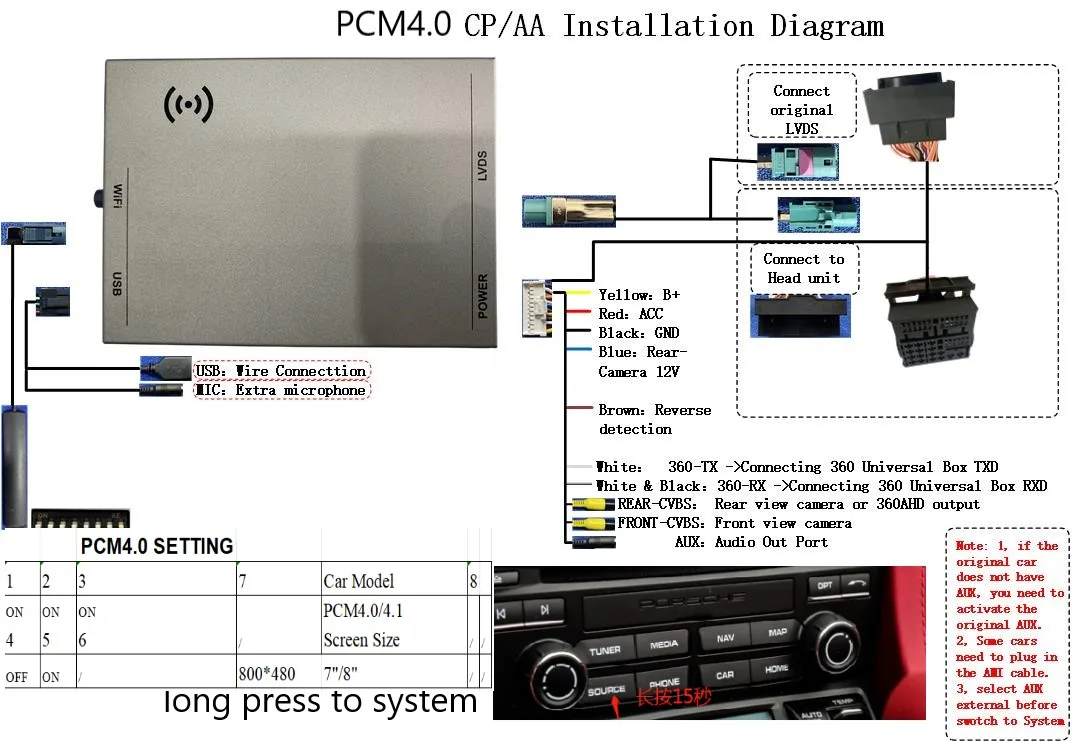
Every retrofit harness exposes at least two supply conductors. The first is a constant battery feed, often marked B+ or 30, which stays live whether or not the ignition is on. The second is an accessory feed, marked ACC or 15, which is only live when the ignition is in the run position. A grounding conductor completes the circuit, and on many platforms a separate reverse-detection or CAN wake conductor decides when the module is allowed to leave sleep.
The module catalogue for a given platform lists which conductor goes where, because getting this wrong is the single most common cause of a flat battery complaint. The Porsche PCM4.0 harness below is a clear example: yellow is B+, red is ACC, black is ground, and the blue conductor is the rear camera 12V feed. That wiring map is not a formality — it is the difference between a module that sleeps with the car and one that does not.
What standby current actually costs over a parked week
Battery drain is arithmetic. A healthy 60 Ah battery holds roughly 3600 watt-hours of stored energy, and a parked car's own electronics — alarm, ECU, keyless entry, parking sensors — already draw a baseline. A retrofit module adds to that baseline. The figures below are the ranges this class of module is normally measured against, given as evaluation guidance rather than as a per-model specification; a buyer should request the measured figure for the exact platform being quoted.
| Parking behaviour | Typical standby draw | Approximate loss per week parked | What happens on wake |
|---|---|---|---|
| No ACC sensing, module left fully awake | 60–120 mA | 10–20 Ah, frequently enough to prevent a cold start | Immediate, but the battery pays for it |
| ACC-sensed idle, radio powered down between wake events | 8–20 mA | 1.3–3.4 Ah, comfortably inside normal vehicle parasitic loss | Fast restore, one ACC edge |
| Full sleep with CAN wake armed | Under 5 mA | Below 1 Ah per week | Restore depends on the bus carrying the wake frame |
| Screen-backlight kept on while parked | Adds 150–400 mA depending on the head unit | Dominates everything else on this list | n/a — this is the largest single avoidable loss |
The fourth row is the one worth dwelling on. Backlight leakage dwarfs module quiescent current, which is why parking mode has to cover the display state and not merely the decoder state. A module that powers the factory screen down with the ignition is doing more for battery life than a module with an extremely low idle figure but no screen-off behaviour.
Wake paths decide whether a low idle figure is actually reachable
A module cannot sit at 4 mA and still be instant. Something has to tell it to wake. In practice three paths are used, and the platform determines which are available.
The first is an ACC edge: the accessory feed goes live and the module boots. This is the simplest path and the one most platforms support, but it means the module is fully awake whenever the ignition is on, including while the car is idling in a car park.
The second is CAN-bus activity. The module listens passively and only powers up its radio when the bus carries a relevant frame. Because the module is not transmitting, it is not drawing radio current, and the sleep window extends to cover an ignition-off parked period.
The third is a retained wake line, common on platforms with a body control module that handles keyless entry. The body module wakes the decoder after a keyless-entry event, which keeps the module asleep through the entire locked period — the most favourable arrangement for battery preservation, and the one that requires the platform-specific CAN compatibility to be correct.
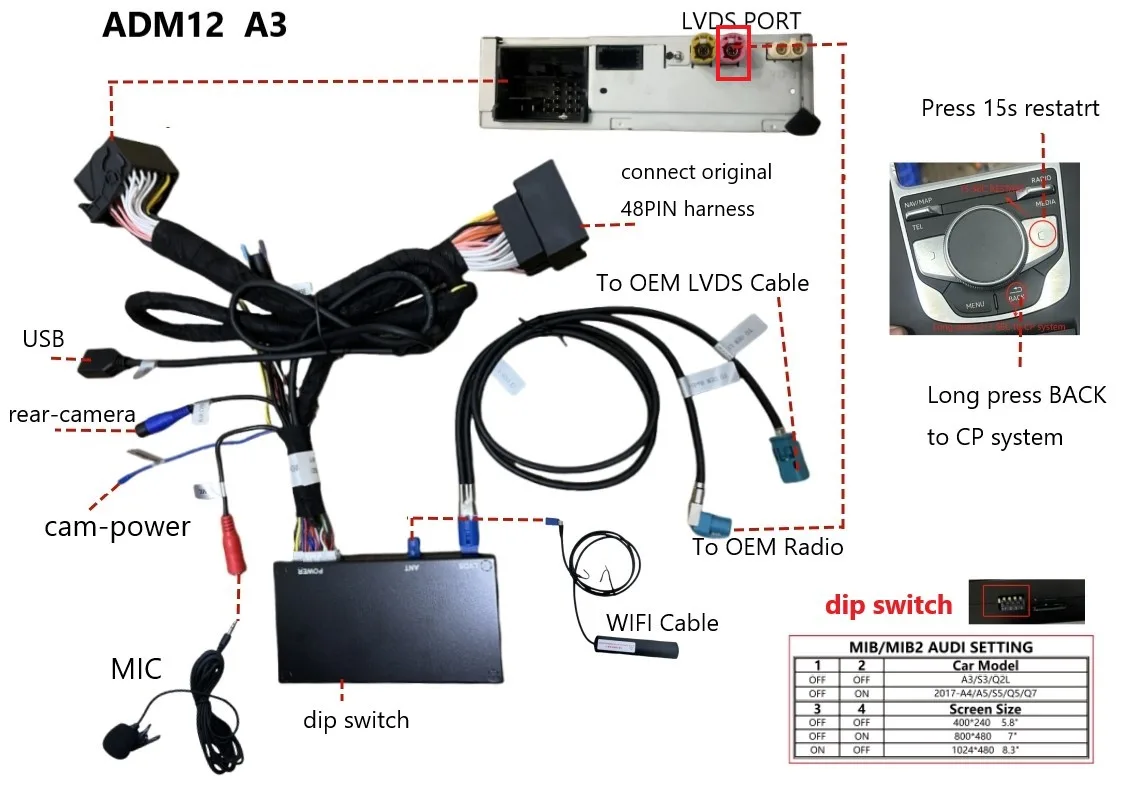
Installers should verify the wake path on the bench before the module goes into a customer car. The Audi A3 harness below shows the dip switch block used to configure the module for a specific platform, alongside the rear camera and camera power conductors. Setting the switch for the wrong platform can leave the module listening on a bus where it will never receive a wake frame, and it will simply never come back after the ignition is switched off.
Where Linux embedded and an automotive chipset change the sleep behaviour
Sleep behaviour is a property of the whole stack, not just the radio. A general-purpose operating system built for an interactive touchscreen is designed to stay responsive, and keeping it responsive in a parked car means keeping background services, cached state and a graphics compositor alive. Over a week that becomes measurable.
Linux embedded behaves differently because it has no general-purpose application model to keep warm. The radio is a driver rather than an application, the display pipeline is idle until a link is established, and the system's activity is bounded by a small fixed set of tasks. That is why the fluency of such a system comes from the hardware rather than from resource contention — the same reason factory head units built on Linux remain usable after several years of service.
The chipset matters for the same reason. An automotive-grade Sunplus part is specified for wide temperature operation, stable behaviour across a long service life and predictable low-power states, and it is the part that determines how quickly the module can go from full current to microamp idle and back again without a restart. Detailed specifications are available in the vehicle compatibility and platform list, which maps platforms to the harness and wake configuration each one requires.
5GHz dual-band WiFi and the power budget while parked
A wireless link costs power in proportion to how hard the radio is working. The idle state is cheap; association, scanning and video streaming are not. For a parked car the goal is therefore to keep the radio de-associated entirely rather than to leave it associated and idle, and the Apple CarPlay connection guidance describes the link conditions that apply once a device is actually in the car.
That is why dual-band support matters here. A module operating on the 2.4 GHz band in a multi-storey car park competes with a dense field of other 2.4 GHz devices, and a link that keeps retrying in that environment burns far more current than a link that simply sleeps. A module supporting 5 GHz alongside 2.4 GHz establishes a cleaner link in exactly the crowded environments where a 2.4 GHz-only unit would be retrying hardest, which lowers both the wake-up current and the drive-time consumption. The band split is governed by the Wi-Fi Alliance specifications covering 5 GHz operation.
Parking mode has to leave the factory functions intact
Battery management is worthless if the module parks the car in a state where its original functions stop working. The whole premise of a retrofit install is that the factory screen, the original head unit, the steering wheel controls and the reverse camera path all keep operating. Parking mode interacts with each of these.
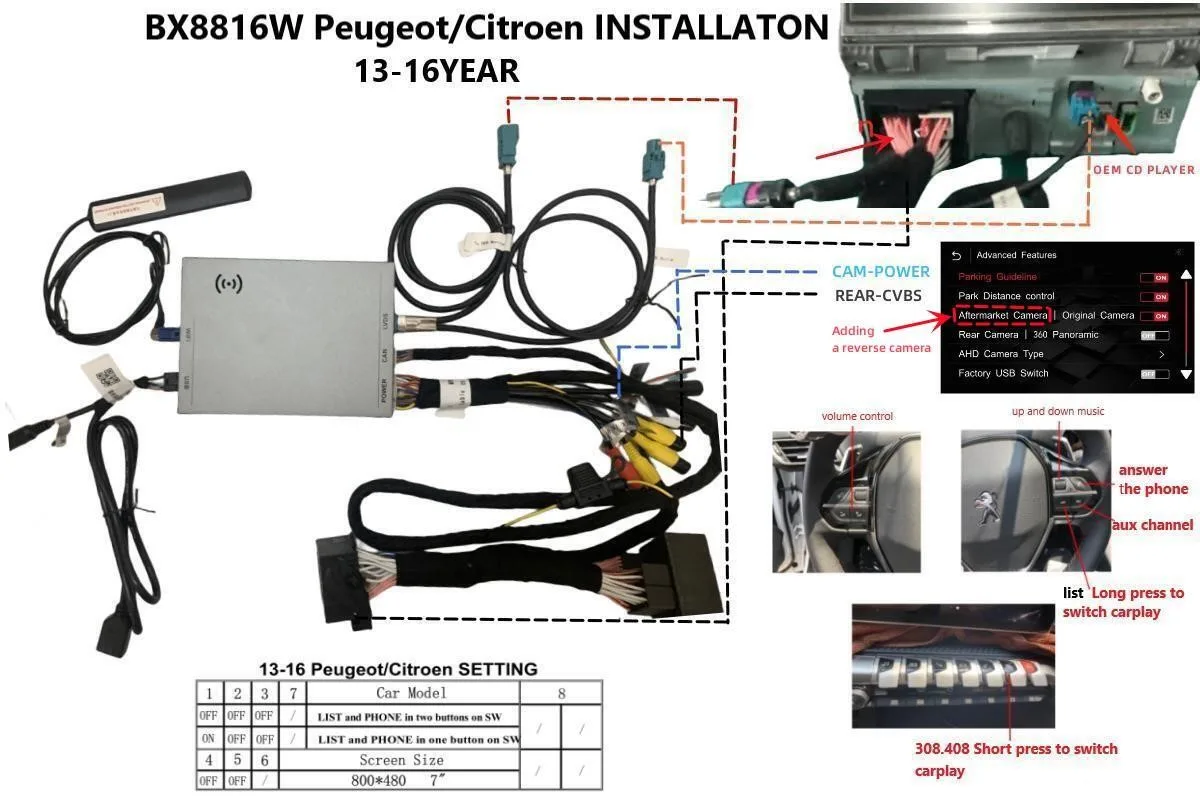
Park distance sensors and factory parking guidance run off the vehicle's own bus and the factory screen, so a module in full sleep must not hold an output that would mute or block them. The Peugeot/Citroen settings menu shown below places parking guidance alongside camera selection, which is a useful reminder that on these platforms the parking display is a factory feature the module has to coexist with rather than replace. Install case notes document how individual platforms handle this.
The reverse camera is the other interaction. Because the camera feed is requested through the factory reverse path rather than through a separate display, putting the module to sleep must not interfere with the reverse trigger. A module that sleeps and then fails to wake on reverse is a failed install, and this is worth testing on every platform: ignition on, ignition off, wait, then select reverse.
What to ask a supplier before ordering samples
Standby current is a specification that should be answered in writing before any volume commitment. The questions that separate a supplier who has measured from one who has not are straightforward.
Ask for the measured standby current per platform, with the parking state defined. Ask which wake paths are used per platform — ACC, CAN or retained wake. Ask what happens to the display state when the module sleeps. Ask for the bench procedure used, since a supplier that publishes a current figure usually publishes how it was measured. A current figure quoted without a parking state is meaningless, because the same module will return different numbers in ACC-idle and CAN-sleep.
For sourcing purposes, wholesale terms apply as follows: stock MOQ is 10 pcs with mixed models permitted, private label is 500 pcs per model, and Full OEM firmware customisation is 1000 pcs per model. Sampling runs 7–15 days by DHL or FedEx, and a large-volume order of 500 pcs or more runs 15–20 days. Quotations come back within 12 hours. Terms are 30% deposit with 70% against a copy of the bill of lading, and any sample fee is deducted from the first large-volume order. Payment is by T/T or PayPal. Coverage spans 300+ vehicle models & series.
Frequently asked questions
Does a CarPlay retrofit module drain the battery?
A properly wired module should not cause a flat battery. A module with correct ACC sensing and CAN wake draws single-digit milliamps while parked, which sits inside the parasitic loss the vehicle already has. A module left permanently awake at 60 mA or more will flatten a battery over a week.
Why did the customer's battery go flat after fitting a module?
Three causes account for most cases: ACC not connected so the module never sleeps, a dip switch or compatibility setting left on the wrong platform so the module listens on a bus that carries no wake frame, or the factory backlight left powered while parked. All three are checkable on the bench before the car leaves.
Will parking mode disable the factory reverse camera?
No. The reverse trigger runs independently of the module's sleep state. The correct bench test is to switch the ignition off, wait for the sleep delay, then select reverse, and confirm the factory camera image still appears.
Does the module need a permanent battery feed at all?
Most platforms use a constant feed for the module and an ACC sense line to control when the radio may be active. Some platforms also carry a retained wake line. The harness documentation for each platform states which conductors are required.
How is standby current measured?
The module is connected to a regulated bench supply replicating the vehicle feed, the parking state is established, and current is read after the state has settled. Figures quoted without the parking state are not comparable.
Will an aftermarket touchscreen unit behave differently?
An aftermarket touchscreen unit replaces the original display and runs a general-purpose operating system designed to stay interactive, so it holds more power in a parked car. A Linux-embedded retrofit module keeps the original display and drops to a low-current idle instead.
Request a sample and check the standby figure
Standby current is one of the few specifications that can be verified on a bench within minutes of a sample arriving, and it is worth verifying before committing to a large-volume order. Send the platform list and the target quantities with an enquiry, and a quotation covering the required harness configuration comes back within 12 hours.
Need the Module From This Guide?
Wholesale from 10 pcs (mixed models OK), samples in 7–15 days (DHL/FedEx express). Fitment confirmation within 12 hours.
Request Pricing Check FitmentRelated Resources
- CarPlay Collections — browse by marque family (German, British, Italian, Japanese, luxury)
- CarPlay Fitment Checker — find the module for your car
- CarPlay Decoder FAQ — 34 answers on compatibility, install and wholesale
- CarPlay Retrofit Buying Guide — platform identification & selection
- Wholesale, Private Label & OEM Program — MOQ, lead times, payment terms
- All installation & technical guides