
Published 2026-10-17 · DIYCarPlay Engineering Team · 10 min read
The Paperwork Behind the Wireless Link: Radio Certification for a CarPlay Retrofit Module
A wireless CarPlay retrofit module is no longer just an interface box. Once it carries a 5GHz dual-band WiFi radio and a Bluetooth link, it becomes a radio device in the regulatory sense, and the paperwork that follows it into Europe and the United States is part of the purchase decision. Importers who treat certification as a formality discover at customs, or at the first market inspection, that the paperwork was never optional.
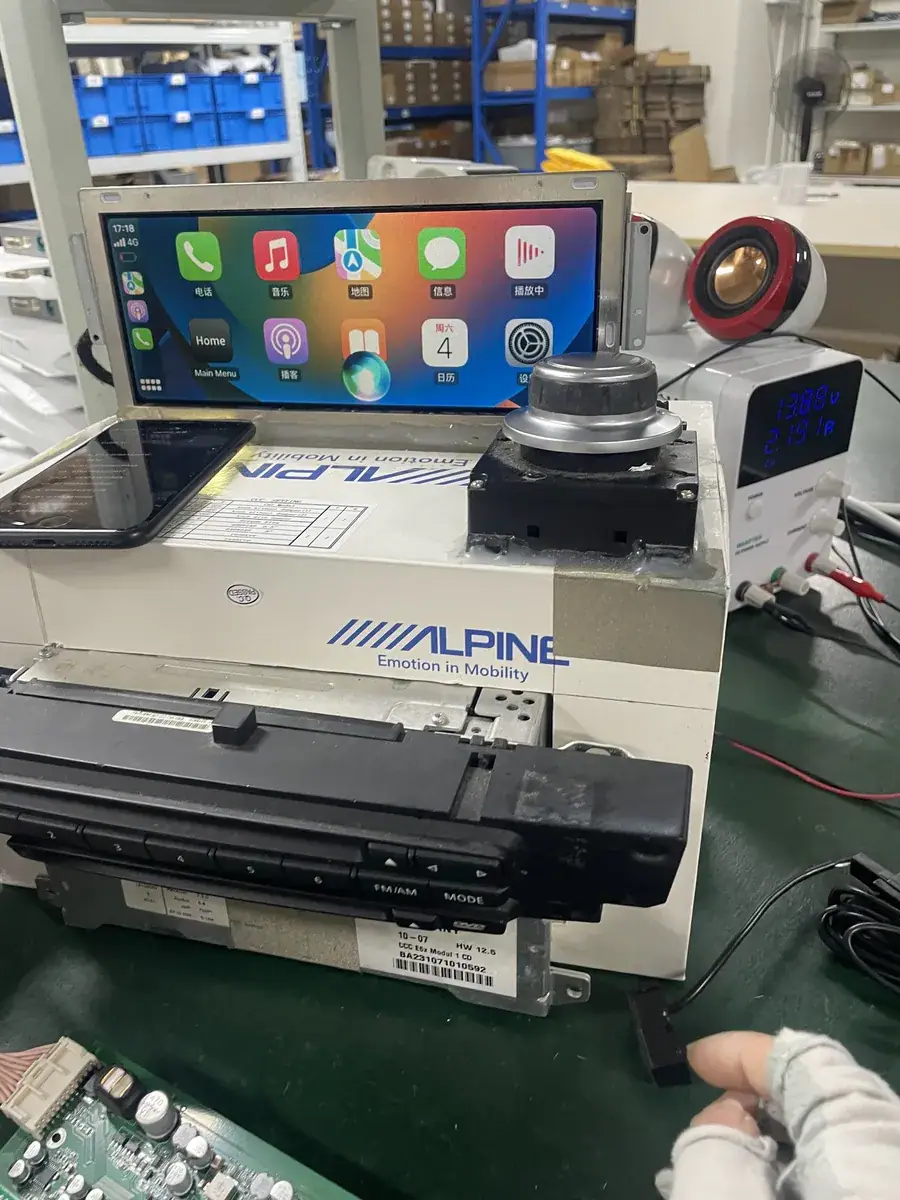
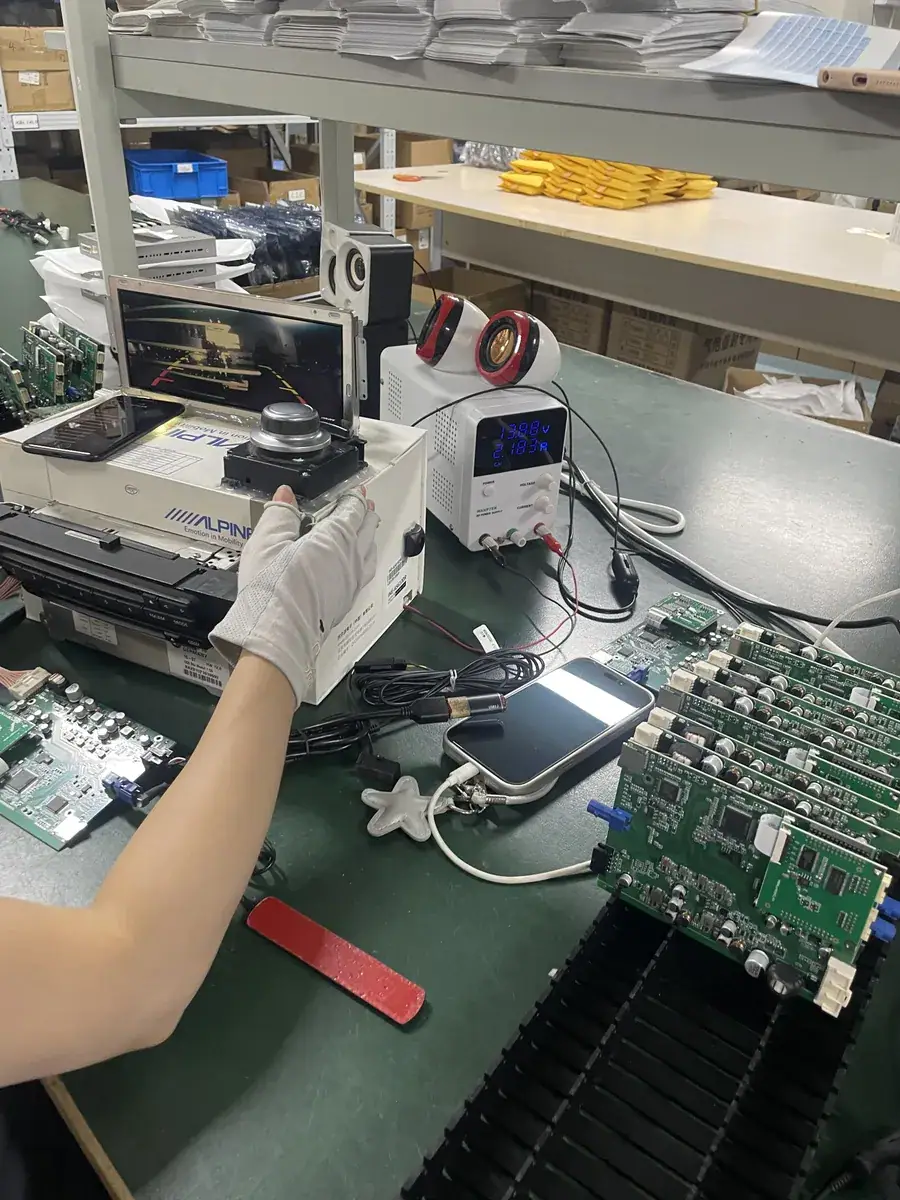
A retrofit module of this kind connects to the factory head unit through the original harness and keeps the vehicle's own display, buttons and reversing camera in service. Nothing about that architecture is in dispute. What changes the conversation is the radio: a device that transmits on 2.4GHz and 5GHz falls inside the scope of radio equipment legislation on both sides of the Atlantic, and the company named on the box becomes legally responsible for that equipment.
What the radio actually is inside the module
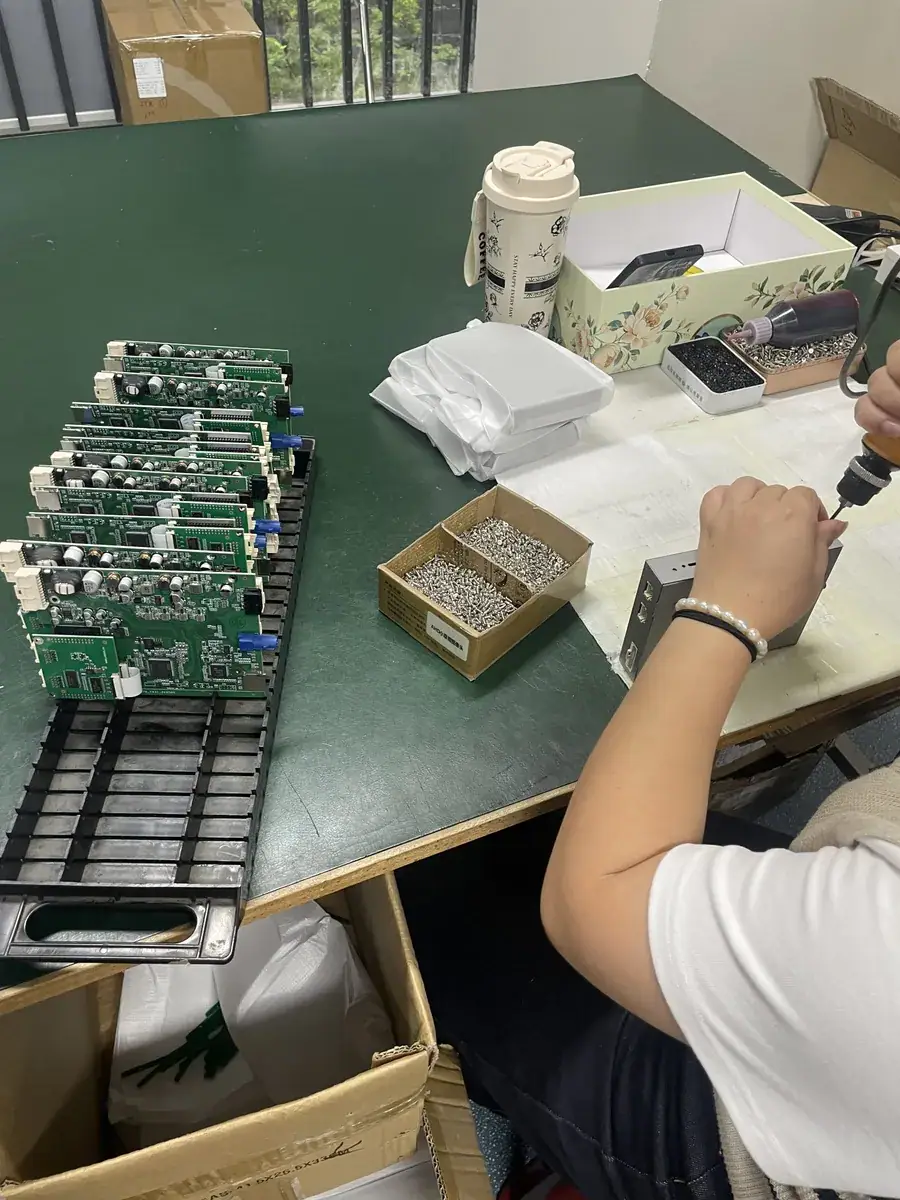
The radio in these modules is not a repurposed consumer dongle. It is a 5GHz dual-band WiFi and Bluetooth combination built around an automotive-grade Sunplus chipset, running on a Linux embedded platform rather than a general-purpose consumer operating system. That distinction matters at the regulatory level. Consumer WiFi parts are built for laptops and phones, sold in enormous volumes, and certified for indoor use with a plastic body and a dipole antenna. An in-car module has to work from a fixed mount behind a dashboard, in a metal enclosure that reflects and absorbs radio energy, over a vehicle electrical supply that sags at cranking and spikes at load dump.
Because the module transmits, several technical parameters are no longer design choices. Transmit power, antenna gain, frequency tolerance and spurious emissions are all fixed values that the certification body has measured. The result is that a documented module cannot be quietly re-tuned for more range without putting the report out of date.
Two regimes, not one
European and United States rules are separate systems, and a supplier who talks about a single "certificate" covering both markets is describing something that does not exist. The European regime is the Radio Equipment Directive 2014/53/EU, summarised on Wikipedia as RED. It replaced the older R&TTE directive in 2016 and has been the only route to market for radio equipment since June 2017. It works by self-declaration: the manufacturer tests against harmonised standards, writes a technical file, signs an EU declaration of conformity, and affixes the CE mark. There is no central certificate to look up. The proof lives in the manufacturer's own file.
The United States regime is certification, not self-declaration. A WiFi transmitter falls under Part 15 of the FCC rules, split across subparts depending on the band, and it needs an FCC ID granted through a Telecommunications Certification Body before it can legally be imported or marketed. Unlike the CE mark, this one is verifiable: the FCC maintains a public database where any buyer can search the grant, the grantee code and the test laboratory behind it.
| Requirement | European Union | United States |
|---|---|---|
| Legal instrument | Directive 2014/53/EU (RED) | 47 CFR Part 15 |
| Route to market | Self-declaration by the manufacturer | Certification via a TCB, FCC ID issued |
| Proof the buyer receives | EU declaration of conformity plus technical file | FCC ID grant and test report |
| Publicly verifiable | No central register of declarations | FCC equipment authorisation database |
| Band-specific standards | EN 300 328 for 2.4GHz, EN 301 893 for 5GHz | ANSI C63.10 measurement procedure |
| Working-language instructions | Required for every destination Member State | Required in the language of the sales market |
The 5GHz band deserves particular attention because it is the harder one to certify. Much of it sits under the U-NII rules, where a transmitter operating in the 5.25-5.35GHz and 5.47-5.725GHz ranges must implement radar detection and respond to it, moving off a channel that proves occupied. A transmitter that stays on a fixed channel across the band cannot simply be sold into those markets. This is one concrete reason why a module that supports 2.4GHz and 5GHz dual-band operation is a stronger proposition than a 2.4GHz-only product, provided the supplier can show the paperwork for both bands rather than only for the easier one.
The obligations that land on the importer
European importer duties under RED are specific and easy to get wrong. Article 12 requires that only compliant equipment is placed on the market, that the manufacturer's conformity assessment has been carried out, that the equipment bears the CE mark and is accompanied by the declaration of conformity, and that the importer's name, registered trade name or trademark together with a contactable postal address appears on the product, its packaging, the shipping parcel or an accompanying document. Instructions and safety information must be supplied in a language the end user can actually read. A copy of the declaration of conformity has to be retained for ten years from the date the equipment was placed on the market, and made available to a market surveillance authority on request.
Two of those duties are commonly mishandled by buyers who source through a trading company. The ten-year retention obligation does not transfer because the invoice named someone else. Nor does the requirement to name the economic operator. Where the manufacturer sits outside the EU, an authorised representative in the EU is the mechanism that satisfies this, and a buyer should be able to see who that representative is before placing the order rather than after a shipment has been held.
Questions that settle the quality of a supplier's radio work
Certification work is visible before any goods are produced, so a buyer who asks precise questions gets precise answers. Useful questions include which band coverage the test report actually covers; whether the FCC ID applies to the module as configured or to a different radio variant; whether the antenna specified in the report is the antenna shipped in the box; whether the CE declaration covers the current firmware revision; and whether changing the antenna invalidates the report. A supplier who answers all five without hedging is a supplier who has done this before.
The reverse is also informative. Reports that cover only 2.4GHz while the product is advertised as dual-band, an FCC ID that cannot be found in the public database, a declaration of conformity that names a different company than the one invoicing the order, or a claim that certification is "in progress" for a product described as already shipping, are all reasons to slow down.
Why the platform underneath the radio changes the argument
The regulatory story is only half of it, and it is the half that gets discussed. The other half is what happens after certification, in a car, for three years. This is where the Linux embedded choice and the Sunplus automotive-grade chipset stop being marketing and start being engineering facts.
An embedded Linux platform on an automotive-grade chipset has no background process accumulating cache the way a consumer operating system does after months of use. It boots into a defined state, holds the wireless association and the LVDS video path, and stays there. For a buyer whose customers will keep these vehicles for a decade, that difference shows up as warranty volume rather than as a specification sheet. A module that starts slowly or needs a restart after a week is a returns problem in every market, and it is invisible in any test report.
The chipset choice matters for the same reason from a different angle. Automotive-grade parts are specified for temperature extremes, vibration and supply-voltage tolerance, which is precisely the environment inside a dashboard. The factory screen stays in place, the original buttons and the reversing camera keep working, and none of that depends on the radio paperwork, but it does depend on the board under it.
What a workable first order looks like
For a buyer validating a supplier rather than committing a full year of volume, the sensible sequence starts with a mixed sample order to confirm the harness fits the intended vehicles. Stock is available from 10 pieces with mixed models allowed, so the sample can cover several head unit families in one shipment. Samples take 7 to 15 days by DHL or FedEx.
Private label programmes run from 500 pieces per model, and full OEM firmware programmes from 1000 pieces per model. Production lead time for 500 pieces or more is 15 to 20 days. Sample charges are credited against the first large-volume order, which keeps the cost of a failed supplier evaluation low.
Payment is 30% deposit with the balance against a copy of the bill of lading, by T/T or PayPal. Quotations are returned within 12 hours, including the compatibility list for the specific head units in question. Compatibility covers 300+ vehicle models and series across the 2006 to 2025 range, and the vehicle compatibility list should be requested against the exact target models rather than accepted as a general assurance.
Coverage runs to 300+ vehicle models and series, so the practical step before any volume discussion is to send the target head unit list and get a written compatibility confirmation against it.
Frequently asked questions
Does a CarPlay retrofit module need radio certification to be sold?
Yes, if it transmits. A wired module with no radio is treated differently from one carrying 5GHz dual-band WiFi and Bluetooth. The radio is what brings it into the scope of Directive 2014/53/EU in Europe and Part 15 in the United States.
Can one certificate cover both Europe and the United States?
No. The two systems are independent and the documentation is separate. A supplier claiming a single certificate covering both markets is either holding two sets of paperwork and calling them one, or holding one set and planning to sort out the other after the first shipment.
Does changing the antenna invalidate the report?
Frequently, yes. Antenna gain is part of what was measured. Substituting a longer pigtail or a higher-gain antenna changes the emission profile, so the original report no longer describes the product in the box.
Does a factory screen have to be replaced to add wireless CarPlay?
No. The module works through the original harness, and the vehicle's own display, steering wheel buttons and reversing camera remain in use. The radio certification question is entirely separate from the display question.
Why does the 5GHz band take longer to certify than 2.4GHz?
Because much of the 5GHz range carries additional obligations, including radar detection on part of the band. A transmitter that cannot detect and vacate an occupied channel cannot be authorised for those ranges, which is why a genuine 2.4GHz and 5GHz dual-band report is worth more than a 2.4GHz-only one.
For a distributor weighing two suppliers quoting similar prices on the same hardware, the fastest differentiator is still the paperwork. Ask for the declaration of conformity, the FCC ID and the antenna specification. The manufacturer behind the wholesale programme supplies these with the quotation rather than after the first order.
A quote can be requested through the contact page, and the reply comes back within 12 hours with pricing, lead time and the compatibility confirmation for the head units specified.
Need the Module From This Guide?
Wholesale from 10 pcs (mixed models OK), samples in 7–15 days (DHL/FedEx express). Fitment confirmation within 12 hours.
Request Pricing Check FitmentRelated Resources
- CarPlay Collections — browse by marque family (German, British, Italian, Japanese, luxury)
- CarPlay Fitment Checker — find the module for your car
- CarPlay Decoder FAQ — 34 answers on compatibility, install and wholesale
- CarPlay Retrofit Buying Guide — platform identification & selection
- Wholesale, Private Label & OEM Program — MOQ, lead times, payment terms
- All installation & technical guides