
Published 2026-10-23 · DIYCarPlay Engineering Team · 15 min read
CarPlay Ultra Cannot Be Retrofitted: What the Dashboard Takeover Means for the Cars Still on the Road
Apple's CarPlay Ultra is the first version of CarPlay that does not stay on the centre display. Apple's own product page describes it as providing content for all of the driver's screens including the instrument cluster, with vehicle functions such as radio and temperature controls handled from inside CarPlay. Every automaker shipping it builds custom themes with Apple, which means the interface is co-engineered with the car's own electronics rather than running on the phone alone.
For a retrofit module programme, that description raises a commercial question that eventually has to be answered out loud: if Apple's next generation of CarPlay occupies the whole cockpit, is there still a business adding CarPlay to a car that never had it? The answer is that Ultra cannot be retrofitted at all, and the cars it is aimed at are the ones that already shipped with CarPlay in the first place. The 300+ vehicle models and series that a retrofit programme covers sit on the other side of that line entirely.
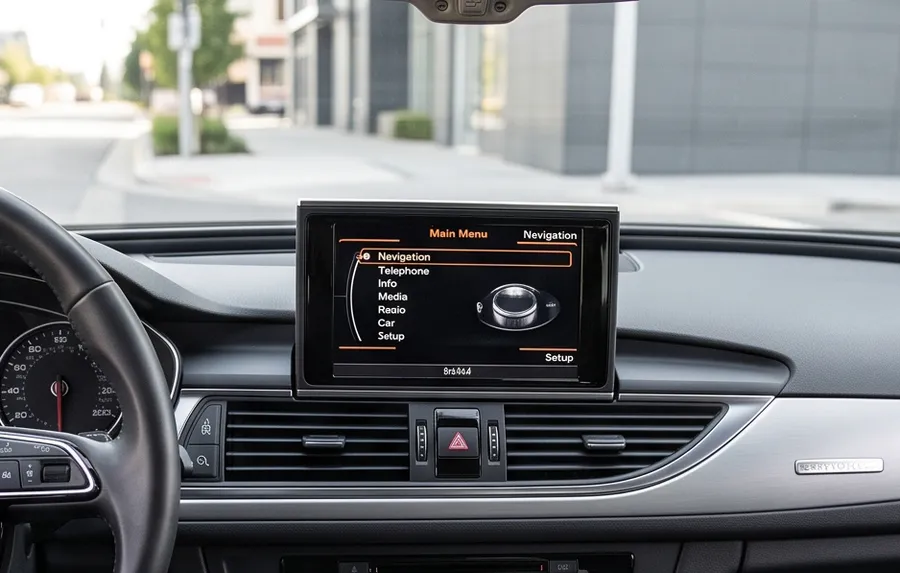
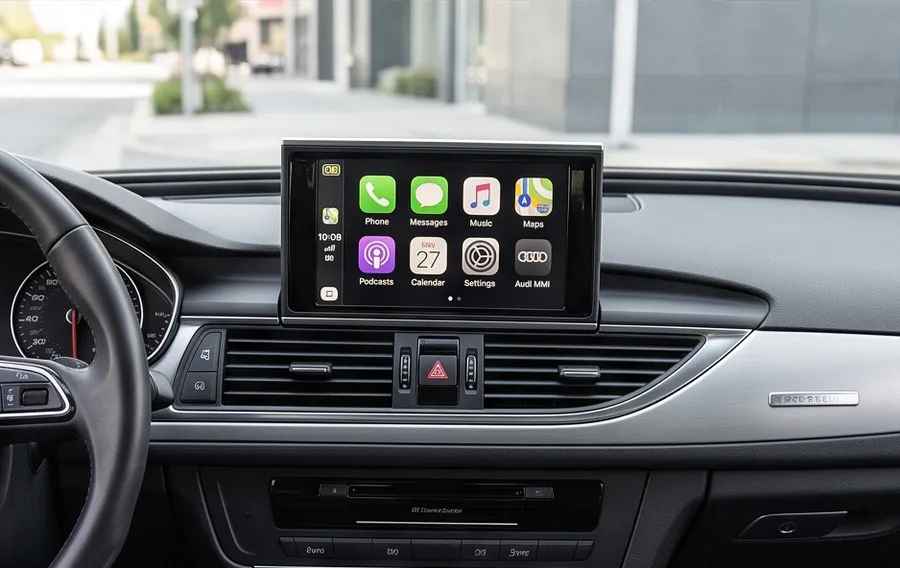

What CarPlay Ultra actually changes
The difference between CarPlay and CarPlay Ultra is not a better interface. It is a change in how much of the car Apple is allowed to address. Standard CarPlay projects a selected set of iPhone apps onto the centre display and leaves everything else — the instrument cluster, the climate system, the drive modes, the radio — running on the car's own software. Apple describes Ultra as delivering content for all of the driver's screens, which includes the instrument cluster with its own gauge designs, the speedometer, the tachometer, the fuel and temperature readouts, and widgets carrying iPhone content into the driver's display.
The vehicle data is merged into the same picture. Apple states that a driver can show information from the iPhone, such as maps and media, alongside information that comes from the car itself, including tire pressure and driver assistance systems, directly inside the instrument cluster. Climate, radio, audio configuration and performance settings are handled from inside CarPlay rather than from the car's own menus. In other words, Ultra is not a display mode. It is a handover of the cockpit to a second operating system, with the automaker supplying the data and the vehicle functions that the phone is allowed to reach.
The phone requirement is a hard constraint rather than a preference. According to Apple's launch announcement, CarPlay Ultra works with iPhone 12 or later running iOS 18.5 or later. The rollout started in May 2025 with Aston Martin, first for new vehicle orders in the United States and Canada, with the intention of expanding to vehicles globally over the following twelve months. Hyundai, Kia and Genesis were named as newly committed brands at the same time.
Why Ultra cannot be added to an existing car
The rollout detail that matters most for anyone in the aftermarket is what happens to cars that are already on the road. Apple's announcement is explicit: existing Aston Martin vehicles qualify only if they feature the brand's next-generation infotainment system, and they receive Ultra through a software update at the dealer. The update is the last step, not the first one. A car built without the required cockpit hardware does not become eligible because a phone or a head unit changed.
That is a structural constraint, and it is worth understanding why it exists. Ultra composites content rendered on the phone with data generated inside the vehicle, then draws the result across more than one display. The vehicle's own graphics hardware has to be able to receive that stream, and the car's control systems have to be willing to accept commands arriving from it. Those are decisions made when the platform is designed, because they decide how much of the vehicle network is opened up and who carries the liability when a dashboard update goes wrong.
A retrofit module takes the opposite approach to every one of those points. It adds a projection source to a screen that already exists in the car and asks the vehicle for nothing it does not already hand out on the video path. It adds no cockpit hardware, opens no additional vehicle network access, and does not attempt to draw anything on the instrument cluster. That is not a limitation being apologised for in a footnote. It is the reason a retrofit can be fitted to a 2014 car at all, and it is why a retrofit will never be able to deliver Ultra, and never needs to.
| Point of comparison | CarPlay Ultra in a factory-integrated car | Standard CarPlay on a retrofit module |
|---|---|---|
| Screens it occupies | Centre display, instrument cluster and secondary displays | Centre display only |
| Instrument cluster | Rendered by Apple, with vehicle data merged into it | Left entirely on the car's own system |
| Vehicle functions | Radio, climate and vehicle-specific controls move inside CarPlay | Remain on the factory menus |
| Phone requirement | iPhone 12 or later, running iOS 18.5 or later | iPhone 5 or later |
| Hardware prerequisite | Next-generation infotainment system built with Apple | The existing head unit, unmodified |
| Can it be added to an older car | No | Yes, which is the retrofit case in full |
The brands that turned Ultra down
The commercial news for the aftermarket is not Apple's rollout, it is who refused to join it. Financial Times reporting, carried by MotorTrend, establishes that Audi, Mercedes-Benz, Volvo, Polestar and Renault are opting out of including Ultra in their future cars. Volvo confirmed the reporting directly, while Polestar said the brand had nothing to announce. An unnamed Renault executive was reported to have told Apple not to try to invade its own systems.
An Audi spokesperson stated the position plainly: traditional CarPlay continues on its vehicles, and Ultra has not been integrated into the current portfolio, in a line that had just introduced a new MMI interface on its latest models. That distinction carries the whole argument. A brand declining Ultra is not declining CarPlay. It is declining to hand the dashboard over, and the cars it builds from now on will keep the conventional arrangement that a retrofit module is built around. On the other side, the Hyundai Motor Group covering Hyundai, Kia and Genesis confirmed that all three still intend to introduce Ultra, and Porsche told the same publication it still planned to support it, so the platform is not dead. It is simply not coming to the marques the aftermarket serves most.
General Motors is a separate case again, and it runs the opposite way. GM has been phasing CarPlay and Android Auto out of its new electric vehicles in favour of an operating system it built with Google, and the withdrawal extends beyond the electric line. A GM spokesperson said existing vehicles are unaffected and that both platforms remain available on its petrol-powered vehicles for the foreseeable future. Tesla and Rivian never offered CarPlay in any form, so Ultra was never in scope for them either. Whatever the timing, the direction is that some new vehicles will arrive without CarPlay at all, and a used car from that period has no factory path back to it.
Why that widens the retrofit market rather than shrinking it
Set the two populations side by side and the arithmetic is not close. CarPlay Ultra addresses cars built to a cockpit specification co-engineered with Apple, sold by a shrinking list of brands, starting with a price bracket that excludes most of the market. The retrofit market addresses everything else: the 300+ vehicle models and series from model years 2006 to 2025 that shipped without CarPlay, and the brands that just declined to put Ultra into their next generation. Ultra's slow rollout and the list of brands walking away do not take customers away from a retrofit programme. They are the reason the retrofit programme exists.
Apple's own position on the aftermarket is on record as well. The CarPlay product page lists more than 800 models that work with CarPlay, and states directly that CarPlay can be added to a current car with an aftermarket system, naming the head unit brands that offer it. The standard version of CarPlay is the volume tier of this ecosystem, and it is the version a retrofit module delivers.
The phone requirement widens that gap further. CarPlay itself runs on iPhone 5 and later devices, while Ultra demands iPhone 12 or later on iOS 18.5 or later. A retrofit sold into a market still working older phones is not competing with Ultra for the same customer; it is serving the customer Ultra cannot reach at any price.
And the withdrawal of CarPlay from new vehicles creates work rather than removing it. A used GM without CarPlay, or any car that left the factory before the platform existed, has exactly one route to a phone on the centre display, and that route runs through the aftermarket. The install base being left behind by Ultra's rollout is the same install base a retrofit module was built for in the first place.
What a retrofit module actually is
Keeping the factory screen and the factory cluster untouched is not a compromise in this product, it is the specification. The module sits behind the head unit, receives video from the phone over a 5GHz dual-band WiFi link, and presents it on the original panel through the car's existing video path. The original screen stays in the dash. The original host stays in the dash. The steering wheel buttons, the rotary controllers, the factory menus and the factory reversing camera with its original trigger path all remain in circuit, and the car can be returned to stock by removing the harness.
The system on the module is Linux in an embedded configuration, running on an automotive-grade chipset from Sunplus in Taiwan. That choice is about behaviour over a decade rather than a benchmark. There is no application cache accumulating on a unit that spends its life parked in the sun and driven hard, no general-purpose operating system to update, and no storage shared with anything else. The smoothness comes from the hardware doing one fixed job rather than from a system keeping pace with everything installed on it.
| Point of comparison | Retrofit module on the factory screen, Linux-embedded | Aftermarket Android head unit |
|---|---|---|
| What the display becomes | Original panel retained, module projects behind it | New panel, new mounting frame, different ventilation path |
| System behaviour over years | Fixed-function embedded build, no application cache to accumulate | Background services and app cache, variable load |
| Where the smoothness comes from | Automotive-grade Sunplus chipset, 5GHz dual-band WiFi path | General-purpose processor running a mobile operating system |
| Original buttons and reverse camera | Untouched, because the factory harness stays intact | Often need extra trigger and adaptation wiring |
| Instrument cluster | Left on the car's own system, as it was built | Requires the vehicle to be reconfigured to drive a different display |
An aftermarket Android head unit starts from the opposite position, replacing the panel and its mounting frame and running a general-purpose mobile operating system on it. It solves a different problem, which is a failed display rather than a missing one, and it solves it at the cost of the parts and the labour listed in the table. Nothing in this article argues that the Android option is a poor choice for a car whose screen has already failed. The point is narrower: for a car whose factory screen works perfectly and was built to drive an instrument cluster that has nothing to do with Apple, replacing the display buys nothing and costs the trim, the cluster integration and the camera path.
The link is where the engineering sits
A wireless retrofit lives or dies on the radio link, and the reason for carrying both WiFi bands is that the two behave very differently in a parked car. The 2.4GHz band reaches further but sits in the crowded part of the spectrum, which is where a connection that drops partway through a drive usually comes from. The 5GHz band is shorter range and far cleaner. Carrying 2.4GHz and 5GHz together means the link settles on the cleaner band when conditions allow and falls back sensibly when they do not, which is the difference between a module that works in a showroom and one that works in a multi-storey car park.
Apple's own support documentation sets out the vehicle-side requirements for the standard version, and it is worth reading before a customer is quoted. The wireless path depends on the car's own settings as much as on the phone: Siri enabled, the head unit placed in wireless or Bluetooth mode, Auto-Join turned on for the CarPlay network, and the vehicle selected under General then CarPlay. A module that is fitted correctly and a car that is not configured for wireless are the same fault report from the customer's side and completely different jobs for the installer.
It is worth being precise about what Ultra asks for here, because it is not a bigger version of the same link. Ultra has to receive a rendered stream from the phone and draw it across displays while the vehicle's own systems supply live data into the same frame. The bandwidth and the engineering effort sit in the car, in a platform built once with Apple. The retrofit case never enters that discussion. It needs a dependable 5GHz link to move video to one screen, and it needs the vehicle's factory video path to stay intact so that everything around that screen keeps working as it was designed to.
What a distributor is buying
Stock quantities start at 10 pcs with mixed models accepted inside the same order, which matters because the model list inside one platform code is long enough to make a mixed opening order useful rather than inconvenient. Private label starts at 500 pcs per model, with the logo, the packaging, the manual and the warranty card produced to the distributor's specification. Full OEM firmware customisation, covering the boot logo, the interface layout and the default language, starts at 1000 pcs per model.
Samples ship in 7–15 days by DHL or FedEx express, and the sample cost is deductible from the first large-volume order rather than being treated as a separate charge. A private label run of 500+ pcs takes 15–20 days, with artwork approval running inside that window rather than after it. A quotation is normally returned within 12 hours, with the volume tier, the lead time and the platform code named for every vehicle covered.
Payment is 30% deposit with the order and the remaining 70% settled against a copy of the bill of lading before shipment by T/T, with PayPal accepted for samples and smaller quantities. The tiers, the artwork process and the quality control steps are set out on the wholesale programme page.
Frequently asked questions
Does CarPlay Ultra make retrofit modules redundant?
No. Ultra cannot be retrofitted onto a car that was not built with the cockpit hardware for it, and the cars it reaches are ones that already shipped with CarPlay. The 300+ vehicle models and series from 2006 to 2025 have no Ultra path at all. Standard CarPlay remains the volume tier of the ecosystem, and Apple states that CarPlay can be added to a current car with an aftermarket system.
Can CarPlay Ultra be installed on an existing car?
Not as a retrofit. Even existing Aston Martin cars need the brand's next-generation infotainment system before a dealer software update will enable Ultra. A software update completes an integration that was built into the vehicle at the factory, and it does not create that integration.
Which iPhone does a retrofit module need?
Standard CarPlay runs on iPhone 5 and later on iOS 7.1 and above, which is a much broader installed base than the iPhone 12 or later on iOS 18.5 or later that Ultra requires. The older the phone in the target market, the less sense it makes to wait for a cockpit platform that cannot reach that customer.
What operating system runs inside the module?
Linux in an embedded configuration on an automotive-grade Sunplus chipset. There is no application cache to accumulate and no general-purpose operating system to update, because the module performs one fixed function: it presents phone video on the factory screen and steps out of the way.
What stays in place after installation?
The original screen stays in the dash, the original host and its buttons stay in circuit, the factory menus can be brought back at any time, and the instrument cluster keeps running the car's own system. The factory reversing camera stays on its original trigger path, so it still takes priority the moment reverse is selected.
Which brands are most affected by Ultra being declined?
Audi, Mercedes-Benz, Volvo, Polestar and Renault have declined Ultra, and Audi has said explicitly that it will continue to offer traditional CarPlay on its vehicles. Declining Ultra is not the same as declining CarPlay, so the cars these marques build keep the conventional centre-display arrangement that a retrofit module is built around. That is a larger addressable base, not a smaller one.
What is the minimum order?
From 10 pcs for stock, with mixed models accepted inside the same order. Private label starts at 500 pcs per model and Full OEM firmware customisation at 1000 pcs per model.
Apple's CarPlay product page is the primary reference here: it describes what Ultra covers across the driver's screens, lists the iPhone models CarPlay runs on, and confirms that CarPlay can be added to a current car with an aftermarket system. For the brand-by-brand position on Ultra, MotorTrend's summary of the automaker response carries the Financial Times reporting in full.
Check which factory head units are covered, or request a quotation with the platform codes, volume tier and lead time named for every vehicle on the list.
Need the Module From This Guide?
Wholesale from 10 pcs (mixed models OK), samples in 7–15 days (DHL/FedEx express). Fitment confirmation within 12 hours.
Request Pricing Check FitmentRelated Resources
- CarPlay Collections — browse by marque family (German, British, Italian, Japanese, luxury)
- CarPlay Fitment Checker — find the module for your car
- CarPlay Decoder FAQ — 34 answers on compatibility, install and wholesale
- CarPlay Retrofit Buying Guide — platform identification & selection
- Wholesale, Private Label & OEM Program — MOQ, lead times, payment terms
- All installation & technical guides