
Published 2026-10-24 · DIYCarPlay Engineering Team · 16 min read
The Screen Is in the Cluster: Why a Ferrari FE-1 Order Depends on Where the Display Sits
Ferrari built 13,752 cars in 2024 and 13,640 in 2025. The 458 Italia ran for seven years on an estimated 13,318 coupes. A platform line with that kind of volume cannot be stocked or sold the way a mainstream marque is, and the badge alone does not tell a buyer what a CarPlay retrofit would connect to, or whether the car in front of them already carries CarPlay from the factory.
The FE-1 is the platform code covering that decision. One code, six nameplates — California T, 458, 488, F12, F8 and 812 — and one identification rule that matters more than the year on the VIN: the head unit generation decides the module, because Ferrari phased these units in over overlapping years. The screen is what settles it.
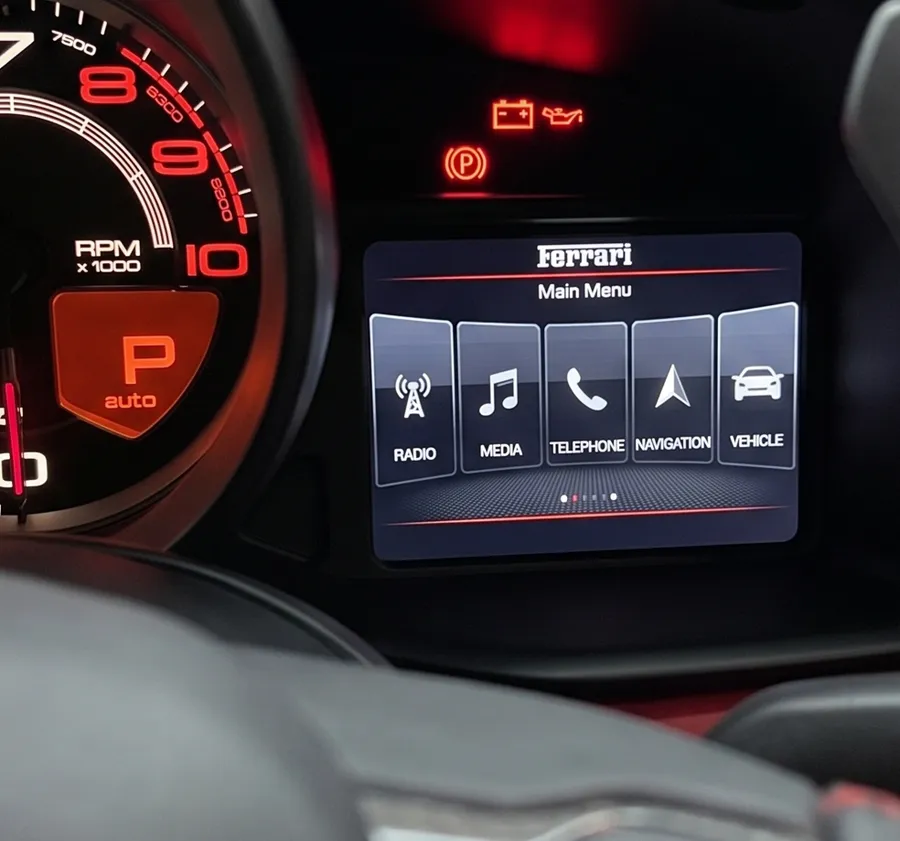
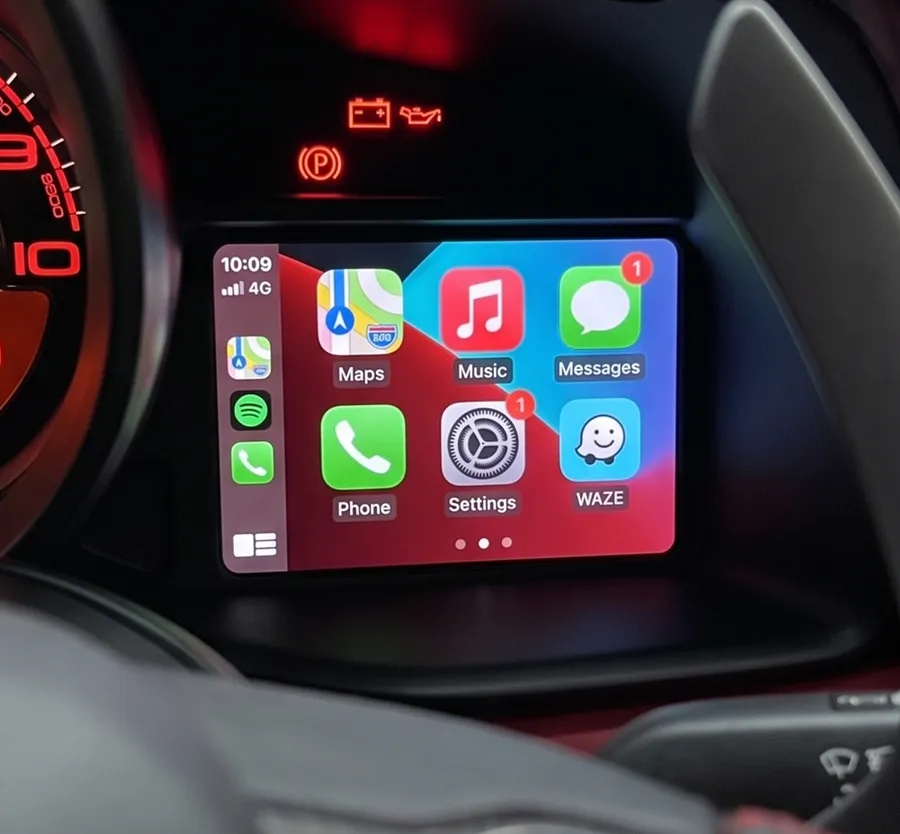
On this marque the screen is where nobody expects it. There is no central infotainment screen to fit a CarPlay interface into on the 458, the 488, the F12, the 812 or the F8. The display sits in the instrument binnacle, flanking the large central tachometer, and the right-hand of those two panels is the infotainment screen. The California T is the exception inside the FE-1 range: it carries a 6.5-inch touchscreen in the centre console. For a distributor, that is not a trim detail. It changes what the harness reaches, what the workshop has to open, and what has to be photographed before an order is placed.
The fitment list and where each screen lives
The FE-1 list is short and the generation behind it is single, but the physical layout of the display differs across the nameplates, and the factory CarPlay record differs again. Both belong on the same sheet, because they answer different halves of the question a distributor asks before quoting a Ferrari customer.
| Nameplate | Factory display location | Factory CarPlay listed by Apple | Module |
|---|---|---|---|
| California T | 6.5-inch centre-console touchscreen | 2016–2017 | FE-1 |
| 458 | Binnacle, right-hand TFT beside the tachometer | Not listed | FE-1 |
| 488 | Binnacle, right-hand TFT beside the tachometer | 2016–2020 | FE-1 |
| F12 | Binnacle, right-hand TFT beside the tachometer | 2016–2017 | FE-1 |
| 812 | Binnacle, right-hand TFT beside the tachometer | 2018–2021 | FE-1 |
| F8 | Binnacle, right-hand TFT beside the tachometer | 2020–2023 | FE-1 |
Apple's published list of CarPlay-compatible vehicles records the model years in which each nameplate was offered with CarPlay. It is a factory-fitment record, not a retrofit-fitment record, and it is the fastest way to establish what a customer's car already has before a conversation about a module begins — Apple keeps the full compatible-vehicle list, and it is worth checking before a quote goes out. The fitment data behind the code is on the vehicle fitment finder, and the FE-1 decoder page carries the authoritative list. The wider catalogue behind it covers 300+ vehicle models and series from 2006 to 2025, and the same generation rule applies across the range: the head unit decides the part, and a photograph of the screen settles it faster than a model year.
One code, two screen locations
The 458 is the clearest case, and it is worth reading its layout carefully because the cars that followed inherited it. Ferrari's own 458 material describes an infotainment status display at the right of the instrument panel carrying navigation, radio, media and phone functions, operated from a right-hand satellite pod, while the left pod handles the vehicle dynamic assistance readout. There is no indicator stalk: the blinkers, headlights and wipers are switched from the steering wheel boss, and the Manettino drive-mode dial sits on the opposite side of the rim from the engine start button. A road test of the car described it plainly: there is no conventional centre stack, and instead there are two screens either side of the giant tacho, with the left carrying vehicle data and the smaller digital speedometer while the right carries the satellite navigation and the audio.
The 488 kept the arrangement and improved the panel. The screens flanking the larger central tachometer are described in the same review as high-definition, with the left one carrying car data including boost and turbo-efficiency gauges and the right one being the infotainment screen, controlled by a multifunction knob on the dash. The review's verdict is worth noting for a buyer: on the 488 Ferrari came with a usable infotainment unit, in a form that deliberately avoided the tall centre stack a sports car does not need.
The F12 states it in the manufacturer's own words: all the main information is displayed in the main binnacle straight ahead, the right-hand satellite pod controls the TFT screen that carries infotainment information and is also used for the sat nav, the stereo with Bluetooth audio streaming, and voice-activated track, artist, album and song selection. The 812 carries the same two-panel arrangement, and a road test of that car noted the practical consequence plainly — presenting the system inside two 5.0-inch screens inside the instrument binnacle continues to impose limitations on usability. The F8 keeps the binnacle layout and adds an optional 7-inch passenger touchscreen ahead of the passenger seat.
The California T is the one nameplate on the list that breaks the pattern, and it breaks it in the opposite direction. Its cabin carries a 6.5-inch touchscreen on the centre console, with a simplified interface reachable either by full touch or by buttons, alongside the Turbo Performance Engineer display mounted between the two central air vents.
For a distributor, that split decides where the harness terminates and what the workshop opens. On a binnacle car the video path runs to a cluster display and the control surface stays the right-hand satellite pod, so a retrofit that drives CarPlay into that panel has to leave the pod able to switch between the factory screen and the phone screen. On a California T the harness terminates at the centre stack instead. The same platform code, a materially different bench job, and a photograph of the wrong part of the dashboard is how a unit comes back.
The car may already have CarPlay fitted
Ferrari was the first manufacturer in the world to offer CarPlay. The marque's own media centre recorded the FF as the first car in the world to be offered with CarPlay, demonstrated at the Geneva show with Apple's technical staff explaining how the phone interface integrates with the car's native system and drives the central touch-screen display. By the Frankfurt show that September, CarPlay was being extended to the entire range, having premiered on the FF and then been made available on the California T.
That history is visible in the current compatibility list. Ferrari nameplates appear there with factory CarPlay from 2016 onward: the 488 GTB and 488 Spider across 2016 to 2020, the California T across 2016 to 2017, the F12 Berlinetta across 2016 to 2017 and the F12 tdf in 2016, the FF in 2016, the GTC4Lusso from 2017, the 812 Superfast from 2018, and the F8 Tributo and F8 Spider from 2020.
So a distributor quoting a Ferrari is in a different position from a distributor quoting almost any other marque on this site. On a mainstream platform the retrofit supplies an interface the car has never had, and the conversation is simple. Here, on most of the nameplates in the FE-1 range, the customer's car may already run Apple's interface from the factory, which changes what is being sold and what has to be demonstrated. Apple's own documentation splits vehicle support three ways: a car that takes a cable, a car that takes a cable and later offers a wireless connection, and a car that supports only a wireless connection. A car delivered with factory CarPlay on a cable is the case where the module's contribution is the wireless path and the retained factory hardware, not the introduction of an interface the car has never seen.
What stays with the car in either case is the part a buyer can actually promise: the original screen remains in the dash, the Manettino and the steering-wheel buttons remain in circuit, the factory menus can be brought back at any time, and the factory reversing camera keeps its original trigger path, so the camera image still takes priority over whatever the panel is showing when reverse is selected. On a binnacle car the camera feed is on the same panel the retrofit drives, which makes that path the single most important thing to verify at the bench.
The 458 runs the other way and is the exception in the opposite direction. It is the one nameplate in the range that has never appeared on Apple's CarPlay vehicle list, because the 458 predates the marque's CarPlay rollout. On a 458 the module is the only route to phone integration, and the car with no factory CarPlay is also the car with the least conventional display.
A low-volume marque is stocked differently
Ferrari's published shipment figures make the commercial point better than any argument about scarcity. The whole marque, every model combined, shipped 8,014 cars in 2016, 9,251 in 2018, 11,155 in 2021, 13,663 in 2023, 13,752 in 2024 and 13,640 in 2025. The 458 Italia coupe run is generally estimated at 13,318 cars across seven years, with the Speciale A's 499 the one confirmed figure because it was announced as a limited edition; Ferrari does not publish official production numbers for the 458. These are the numbers behind the nameplates, and they are small enough that a single platform code covers a meaningful share of everything on the road.
That has direct consequences for how a distributor buys. A deep position in one platform code on a high-volume marque can be worked off over a quarter. The same position on Ferrari cannot be worked off at all, because the entire marque's annual output is smaller than the annual output of a single mainstream nameplate. The 10-piece minimum with mixed models allowed in the same order is therefore the practical entry point rather than a small opening courtesy, and the value of that mixed-model allowance is higher here than anywhere else in the catalogue: it is what allows a Ferrari line to sit inside a programme built around platforms that actually move.
Private label at 500 pieces per model and Full OEM firmware customisation at 1000 pieces per model make the same point from the other direction. At that volume a private-label Ferrari line cannot stand on its own, so it belongs on the sheet as one line among several, with the artwork, packaging and manual handled for a brand that carries a logo on the box and nothing on the hardware itself.
Returns are the other side of a low-volume decision. Every unit that comes back was paid for twice, once outbound and once as a warranty claim, and on a marque where the customer paid six figures for the car the cost of a failed visit is measured in more than the module. The pre-shipment check is a powered test against a real head unit of the target generation, not a visual inspection of a housing, and the photograph of the binnacle before the order is placed is what stops the mismatch from happening at all.
Why the platform is a Linux embedded unit
The unit runs Linux in an embedded configuration on an automotive-grade Sunplus chipset from Taiwan. The point is not the operating system in the abstract but what it does not do: there is no application cache accumulating on a machine that spends its life parked in sun and driven hard, and there is no phone-derived platform underneath quietly growing its storage and slowing down. On a binnacle car that matters more than on a centre-stack car, because the display area a phone interface has to work within is small enough that a slow interface is immediately visible.
| Point | Retained factory unit | Large aftermarket display |
|---|---|---|
| Display hardware | Original Ferrari binnacle panel stays in the car | Original screen removed and discarded |
| Operating system | Linux embedded, no app cache accumulates | Android-based; storage and cache grow with daily use |
| Steering wheel and satellite pod | Fully retained, including the Manettino and the right-hand pod | Often re-mapped or partially lost |
| Factory reversing camera | Stays on the original path | Usually needs re-wiring |
| Vehicle menus and settings | Unchanged, switchable at any time | Replaced by the new unit's interface |
The wireless link runs on both bands, 2.4GHz and 5GHz. The 2.4GHz band reaches further but sits in the crowded part of the spectrum, which is where a connection that drops partway through a drive usually comes from; the 5GHz band is shorter-range but far cleaner. Carrying both lets the link settle on the cleaner band when conditions allow and fall back sensibly when they do not. The antenna is mounted behind the head unit with its cable kept away from the display link and the climate-control motor, since a run parallel to the video line is what picks up noise on the picture — and on a binnacle install the video run is short, which is an advantage worth having.
What a distributor is buying
Stock modules start at 10 pieces with mixed models accepted inside the same order. Private label with a logo, retail packaging and manual starts at 500 pieces per model. Full OEM firmware customisation — boot logo, interface layout and default language — starts at 1000 pieces per model. Stock models ship in 7–15 days, private label production takes 15–20 days for 500 pieces or more, and samples ship in 7–15 days by DHL or FedEx express. Payment is 30% deposit with the order and the remaining 70% settled against a copy of the bill of lading by T/T, with PayPal accepted for samples and smaller quantities. A sample is charged at sample cost and that cost is deducted from the first large-volume order, which on this marque is the point: evaluating the FE-1 on one 458 and one California T before committing to a platform is cheap, and getting it wrong is not. Every module carries a 12-month warranty against manufacturing defects, and spare parts remain available after the warranty ends.
Before a purchase order is issued
Five items settle a Ferrari order, and each of them takes less time than a return does. First, a photograph of the binnacle with the factory screen awake: the Main Menu tile grid — RADIO, MEDIA, TELEPHONE, NAVIGATION, VEHICLE — identifies the FE-1 in a single frame, and the frame also shows whether the car carries a centre-console screen at all, which is what separates the California T from the rest of the list. Second, the model line and year of every vehicle on the order, so that anything built outside the FE-1 generation is flagged rather than assumed. Third, whether the car already carries factory CarPlay, read from the screen and checked against the manufacturer's compatibility list, because that changes what the module adds. Fourth, the split between a mixed opening order and a single-platform run, which is what sets the volume tier. Fifth, and only for private label, artwork approval before production is released.
The head unit identification guide sets out the general method for the rest of the range, and the warranty and RMA process covers the claim route that comes into play when a cluster car is fitted as a centre-stack car. The wholesale guide to MOQ, lead times and quality control sets out each tier in full, and the factory reversing camera path is the document to have open when the camera question comes up, because on the binnacle cars that panel is the same one the retrofit drives.
Frequently asked questions
Which Ferrari models does the FE-1 cover?
California T, 458, 488, F12, F8 and 812, on the head unit generation the code is built for. The build year alone does not settle it, because Ferrari phased these units in over overlapping years, so the menu layout and the navigation map version on the screen are the reliable check. The fitment list on the Ferrari range page is the authority, and anything not on it is confirmed from a photograph before an order is placed.
Does the module work on a car that already has factory CarPlay?
Yes. On a car delivered with factory CarPlay on a cable, the module's contribution is the wireless path and the retained factory hardware: the original panel stays, the Manettino and steering-wheel buttons stay in circuit, and the factory menus remain available. The 458 is the exception in the other direction, since it never received factory CarPlay and the module is the only route to phone integration there.
Where does the display sit on these cars?
On the 458, 488, F12, 812 and F8 there is no central infotainment screen. The interface lives in the instrument binnacle, in the right-hand TFT panel beside the central tachometer, with the left-hand panel carrying vehicle data. The California T is the exception in the FE-1 range and carries a 6.5-inch centre-console touchscreen.
What operating system runs inside the unit?
Linux in an embedded configuration on an automotive-grade Sunplus chipset from Taiwan. There is no application cache to accumulate, and the unit does not share storage with anything on the factory system, because it does not replace any part of it.
Is the link wireless?
Both. The unit carries 2.4GHz and 5GHz WiFi, so the connection can settle on the cleaner band when conditions allow and fall back when they do not. Where a car supports CarPlay only over a cable, the wired path remains available.
What is the minimum order?
From 10 pieces for stock, with mixed models accepted inside the same order. Private label starts at 500 pieces per model and Full OEM firmware customisation at 1000 pieces per model.
How long does a sample take?
7–15 days by DHL or FedEx express, and the sample cost is deducted from the first large-volume order. Testing on the vehicles the order is actually intended for is worth the wait on this marque, because the display location and the factory CarPlay record both decide what the module does.
Send us your target vehicle list, quantities and target market through the inquiry form. You will receive a quotation within 12 hours, including volume tiers and lead times for the platforms you named.
Need the Module From This Guide?
Wholesale from 10 pcs (mixed models OK), samples in 7–15 days (DHL/FedEx express). Fitment confirmation within 12 hours.
Request Pricing Check FitmentRelated Resources
- CarPlay Collections — browse by marque family (German, British, Italian, Japanese, luxury)
- CarPlay Fitment Checker — find the module for your car
- CarPlay Decoder FAQ — 34 answers on compatibility, install and wholesale
- CarPlay Retrofit Buying Guide — platform identification & selection
- Wholesale, Private Label & OEM Program — MOQ, lead times, payment terms
- All installation & technical guides