
Published 2026-10-18 · DIYCarPlay Engineering Team · 8 min read
CarPlay for Lamborghini: Two Interchangeable-Looking Platforms, One Wrong-Module Problem
Lamborghini coverage splits into two platforms that never interchange: the LP610 for the Huracán (2014–2018) and the LP700 for the Aventador (2011–2016). Both run a plug-and-play CarPlay decoder module that keeps the factory screen, the factory menus, the steering-wheel controls and the original reversing camera in place. No screen is removed, no trim is cut, and the car can be returned to stock by unplugging one connector.
Why Lamborghini is not a single-platform brand
Most marques in this catalogue can be described with one head unit and a year range. Lamborghini cannot. The Huracán and the Aventador are sibling V12 cars built on related but separate electronic architectures, and they arrived in the showroom in an order that catches importers out: the Aventador LP700 was sold from 2011, four years before the Huracán LP610 appeared in 2018-year production. Sorting by model year alone therefore produces the wrong module roughly half the time.
The physical difference is visible before any menu is opened. The Aventador's centre display sits in a flip-up housing with a carbon-fibre bezel and a full row of labelled toggle switches running along the sill beneath it — MENU, RADIO, NAV, TEL, CAR, MEDIA, SETUP. The Huracán replaced that layout with a different console geometry entirely. Two cars from the same marque, the same engine family and overlapping model years will not accept the same harness.
Fitment table: model, years, module
| Model | Years | Module code | Factory display retained |
|---|---|---|---|
| Huracán LP610 | 2014–2018 | LP610 | Yes — screen, menus, steering-wheel controls and reversing camera unchanged |
| Aventador LP700 | 2011–2016 | LP700 | Yes — screen, toggle row, climate panel and reversing camera unchanged |
The Lamborghini decoder range covers both. For individual fitment data, the LP610 Huracán module page and the LP700 Aventador module page list the compatible head unit, model years and camera support for each platform; the vehicle fitment finder confirms a specific car before anything is ordered.
Identification: three checks that settle it in under a minute
For a workshop quoting a customer car, the reliable sequence is mechanical rather than menu-based. Start with the VIN plate and confirm the model and build year, then read the console geometry, then power the head unit and read the platform from its own menu. All three should agree before a harness is cut open.
- Console shape. Aventador: flip-up vertical display, carbon-fibre bezel, a labelled toggle switch row along the lower sill. Huracán: a different console layout with no such toggle row.
- Menu identity. The factory interface carries the marque name and its own menu structure. A unit reporting a different marque lineage is not a Lamborghini unit and must not be fitted with a Lamborghini harness.
- Photo confirmation. One wide photo of the full centre console, taken with the ignition on, resolves the remaining cases. The head unit identification guide sets out the checks for other marques in the same way.
Hand-built production variance makes this worth insisting on. Lamborghini and other exotic marques assemble in low volumes with more build-to-build variation than mainstream plants, so harness connector fitment should be confirmed against the specific vehicle rather than inferred from the model badge.
What the installation actually involves
The module is a plug-and-play harness, not a screen replacement. Installation is a trim-down, two connector terminations and a trim-back-up. The factory display, the factory amplifier, the original wiring and the reversing camera stay in the circuit throughout, which is what makes the work reversible on a car that is likely to be sold or rescheduled for service.
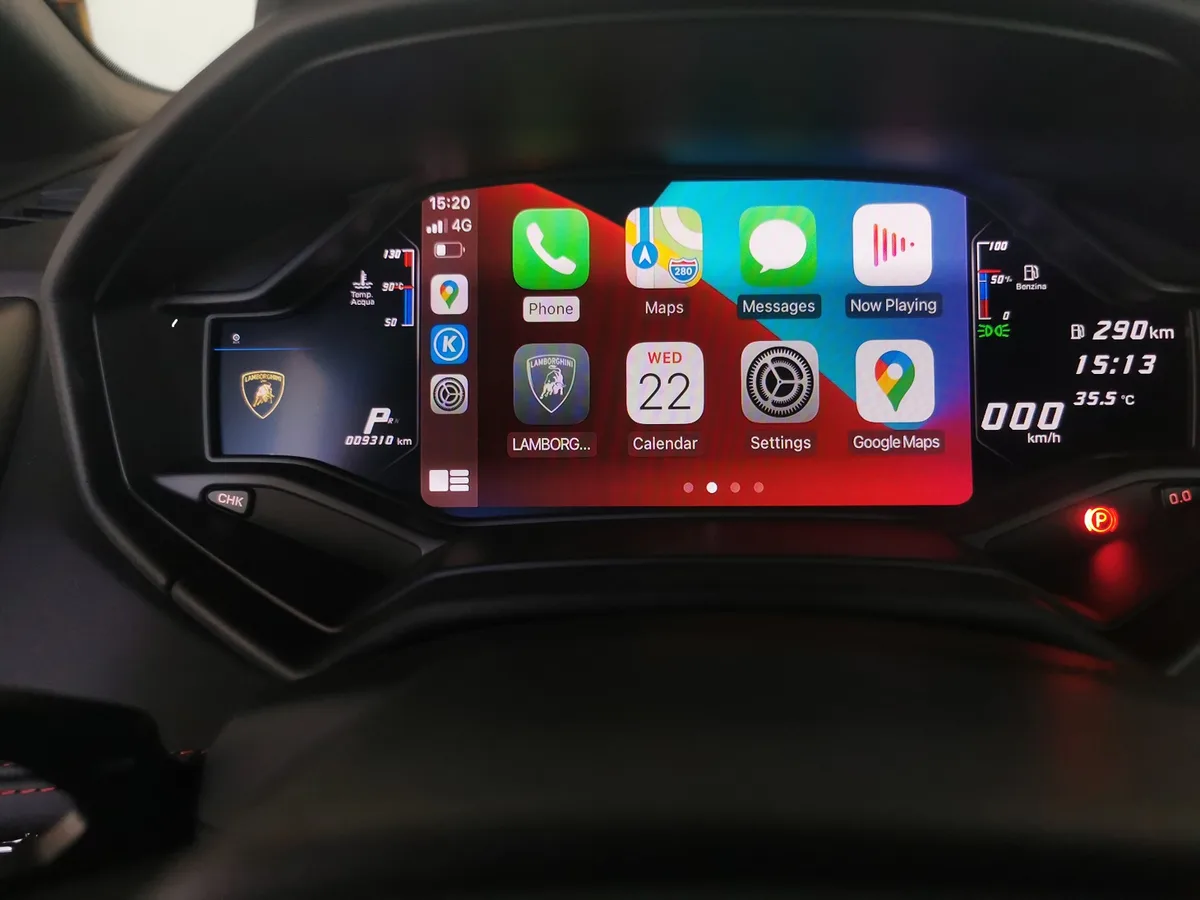
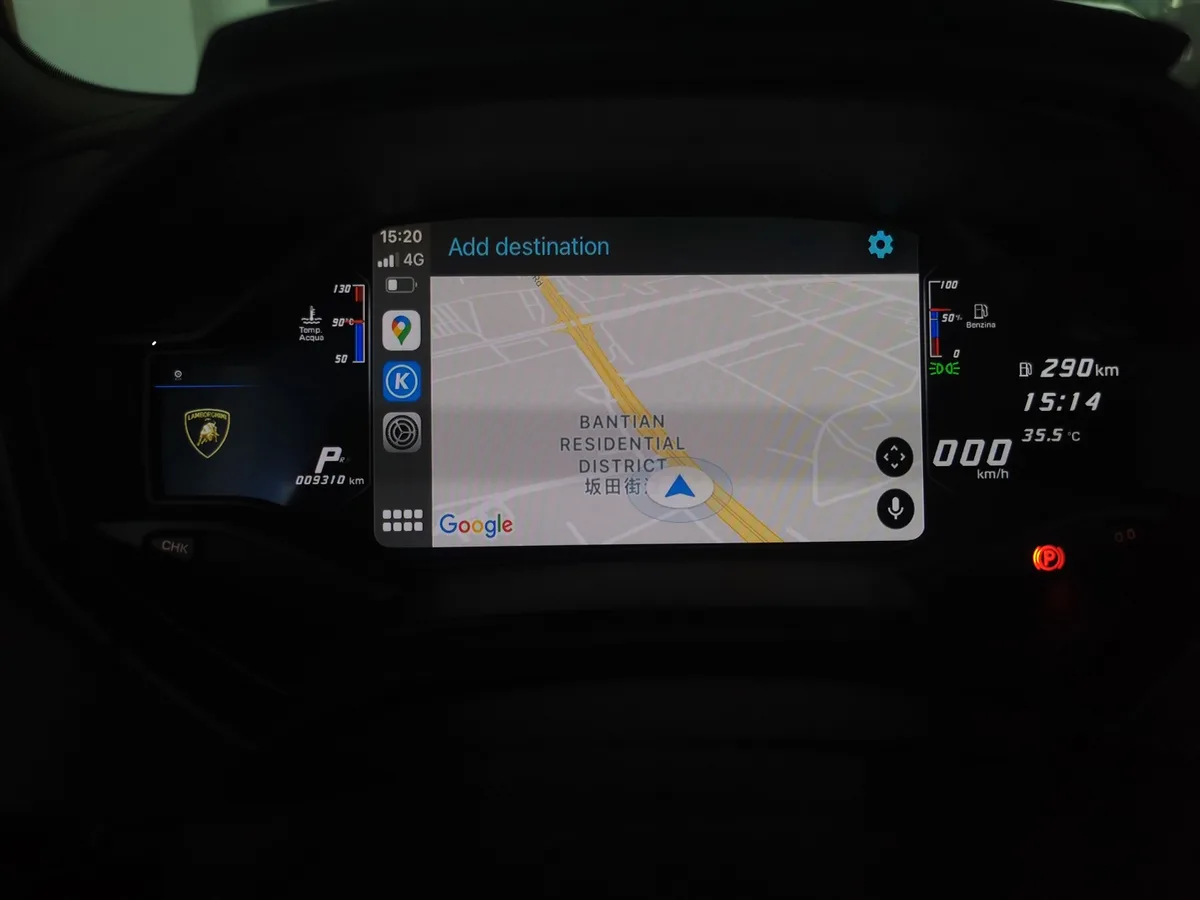
On the Aventador, the flip-up display housing has to be released to reach the head unit connector, and the toggle switch row remains live and usable afterwards — those switches are part of the factory system, not part of the CarPlay layer. On the Huracán the driver keeps the factory steering-wheel controls, which continue to drive volume, track selection and calls. Photos from a real Huracán installation show exactly that: CarPlay running on the factory display while the car's own gauges and warning strip stay live behind the steering wheel.
The camera path is the part most often overlooked on these cars. A factory reversing camera and an aftermarket camera both remain supported, and the original camera continues to work through the factory trigger rather than through a separate switch. There is a fuller treatment of this on the steering wheel control retention page.
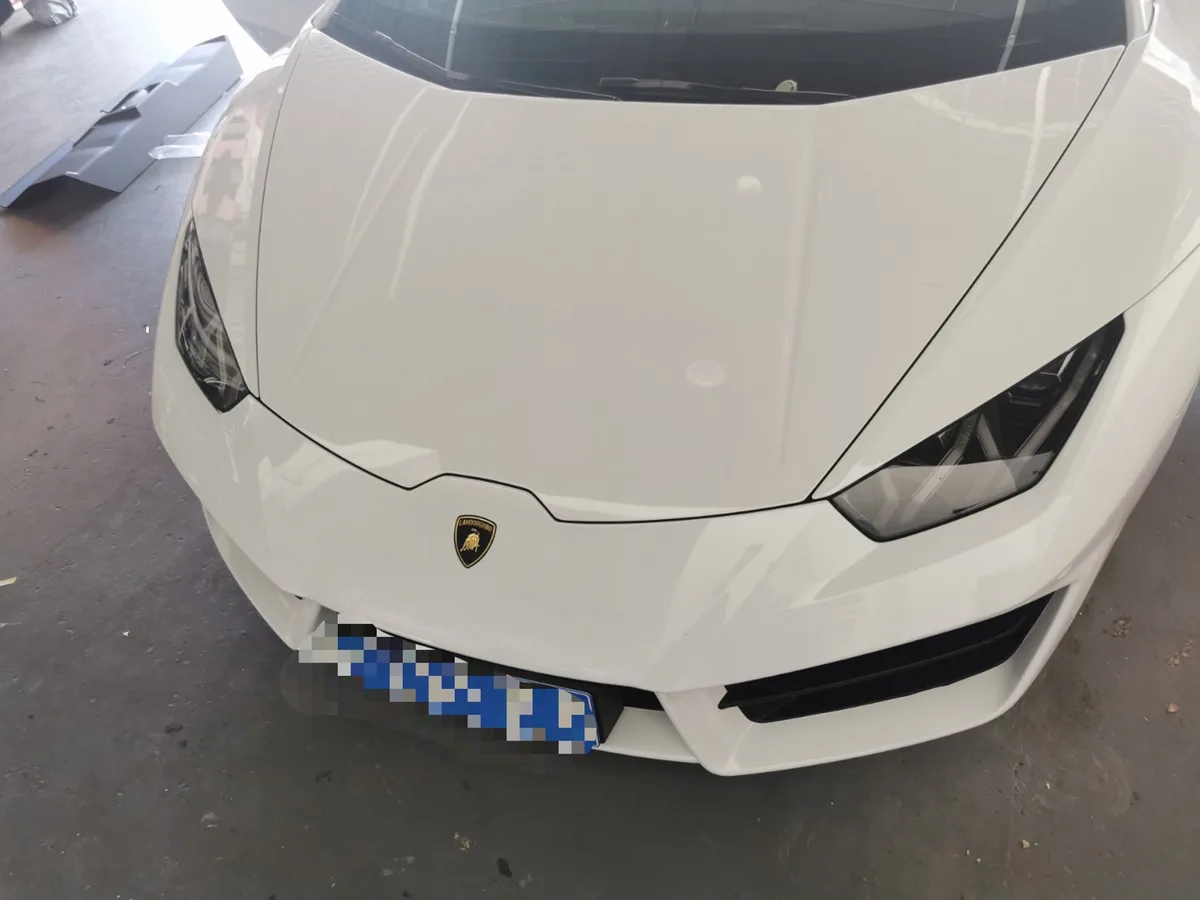
The photos below come from a customer Lamborghini Huracán, shot in a workshop, showing the factory display running wireless CarPlay, turn-by-turn navigation and media after the retrofit.
Wireless performance and why the radio matters on these cars
Connection runs over dual-band WiFi — 2.4GHz and 5GHz both supported. The 5GHz band carries the display stream, where it has more available bandwidth and less congestion than 2.4GHz, which matters in multi-level car parks and dense city blocks where 2.4GHz is shared with a lot of other equipment. The module keeps both bands available and settles on the one with the cleaner path.
Latency is kept low by the radio path itself rather than by buffering tricks, which keeps turn-by-turn navigation and spoken directions usable at motorway speed. Apple's own CarPlay compatibility documentation sets out the phone-side requirements, and the dual-band design follows the Wi-Fi Alliance's dual-band operation guidance.
Stability: Linux embedded rather than a general-purpose OS
The module runs embedded Linux on an automotive-grade Sunplus chipset from Taiwan, the supplier whose silicon also sits behind the factory infotainment in most cars of this class. That choice has a direct commercial consequence for a distributor: the failure modes that generate RMA traffic on general-purpose consumer platforms — cache buildup, background services competing for resources, slow degradation over months of continuous power-on — do not apply here.
Every unit is function-tested on a real head unit before packing: cold start, wake path over the vehicle network, display link timing, camera passthrough, audio routing in both directions, and wireless pairing. Retained samples from each batch can be supplied, and the test log travels with the shipment on request. Across the full catalogue the coverage is 300+ vehicle models and series from 2006 to 2025.
Commercial terms for distributors
Stock modules start at 10 pcs, and model numbers can be mixed within that quantity — useful on a Lamborghini order, where LP610 and LP700 volumes are rarely equal. Private label with the distributor's own logo, packaging and manual starts at 500 pcs per model. Full OEM firmware customisation — boot logo, interface layout, default language, hardware revision for a specific platform — starts at 1,000 pcs per model.
- Samples ship in 7–15 days by DHL or FedEx. Sample cost is deductible from the first large-volume order.
- Stock quantities ship in 7–15 days after payment. Private label production runs 15–20 days for 500+ pieces, depending on packaging artwork approval.
- Payment is 30% deposit plus 70% balance before shipment by T/T. PayPal is accepted for sample and small orders.
- Quotation comes back within 12 hours on business days once the target vehicle list and quantities arrive.
SKU selection for a first container is covered separately in the first-container guide, and the luxury and exotic collection page sets out why reversibility matters more in this segment than price.
FAQ
Can one module cover both a Huracán and an Aventador?
No. The LP610 and the LP700 are separate modules for separate head units. Ordering the wrong one produces a connector that does not mate and a harness that has to be cut, which is why identification is settled before ordering rather than at the bench.
Does the retrofit change how the car looks inside?
No. The factory screen, bezel, menus, steering-wheel controls and original reversing camera all stay as delivered. The retrofit sits behind the dashboard, out of sight, and a future buyer cannot object to it.
What operating system runs inside the module?
Embedded Linux on an automotive-grade Sunplus chipset. There is no general-purpose operating system accumulating cache over time, which is why the interface behaves the same after a year of daily use as it does on day one.
Are mixed model numbers accepted in a small first order?
Yes. Stock quantities start at 10 pcs and different model numbers can be combined within that quantity, so an importer can test LP610 and LP700 demand in one order before committing to either.
Is private label available for these modules?
Private label with distributor logo, packaging and manual starts at 500 pcs per model. Full OEM firmware customisation starts at 1,000 pcs per model.
How long does a sample take to arrive?
Samples ship in 7–15 days by DHL or FedEx, and the sample cost is deductible from the first large-volume order.
Send the target vehicle list — VINs or model years, and which of the two platforms each car carries — and a quotation with MOQ and lead time comes back within 12 hours. Sample requests and fitment confirmation photos go through the contact page, and the full wholesale terms are on the wholesale page.
Need the Module From This Guide?
Wholesale from 10 pcs (mixed models OK), samples in 7–15 days (DHL/FedEx express). Fitment confirmation within 12 hours.
Request Pricing Check FitmentRelated Resources
- CarPlay Collections — browse by marque family (German, British, Italian, Japanese, luxury)
- CarPlay Fitment Checker — find the module for your car
- CarPlay Decoder FAQ — 34 answers on compatibility, install and wholesale
- CarPlay Retrofit Buying Guide — platform identification & selection
- Wholesale, Private Label & OEM Program — MOQ, lead times, payment terms
- All installation & technical guides