
Published 2026-10-14 · DIYCarPlay Engineering Team · 9 min read
CarPlay for Land Rover and Jaguar: Sourcing the Right Module Across JR-1, JR-2 and JR-3
Land Rover and Jaguar vehicles built between 2012 and 2021 rarely carry smartphone integration from the factory, yet the model range is one of the most attractive retrofit segments in the European and Australian aftermarket. The reason is generational: JLR used three distinct infotainment platforms across that span, and each one needs its own decoder module. Sourcing correctly means matching the head unit, not the badge.
Three decoder variants cover the range. The JR-1 serves the Bose-based units fitted from 2012 to 2015. The JR-2 and JR-3 both cover 2016 to 2021 but sit behind different Harman displays, so screen size is the deciding factor. Getting this wrong at order stage is the single most common reason a Land Rover retrofit batch comes back.
Why Land Rover and Jaguar Are a Distinct Sourcing Decision
The JLR and Jaguar model families share platforms, which makes them look like a single fitment list on paper. In practice a distributor handling both brands has to stock at least three part numbers rather than one, and each carries its own firmware, harness and screen-size configuration. That multiplies inventory complexity in a way that German premium brands do not.
A second factor is screen size. The 2016 to 2021 generation split into an 8-inch and a 10.25-inch display, and the two are not interchangeable at the harness level. Ordering by production year alone leaves a buyer with roughly a one-in-two chance of the wrong variant on those model years. The Apple CarPlay compatibility list defines what the phone side expects; the vehicle side is what the module has to satisfy.
Third, the hardware these vehicles ship with is more capable than its interface suggests. A 2012 Range Rover with a 2012-generation head unit is not an underpowered machine that needs replacing. It needs a bridge to modern phone standards. Model generations for these vehicles are set out on Land Rover's own model pages, which is the reference most importers use when confirming a chassis year before quoting a customer. That distinction matters for buyers who have been burned by replacement-screen returns.
The Three Module Variants and How They Diverge
The variant split follows the factory audio and display hardware exactly. The table below reflects the fitment data published on the product pages for each module.
| Model family | Years | Decoder module |
|---|---|---|
| Discovery / Range Rover / F-Pace / XF / XJ / F-Type | 2012–2015 | JR-1 (Bose) |
| Discovery / Range Rover / F-Pace / XF / XJ / F-Type | 2016–2021 | JR-2 (Harman 8") |
| Discovery / Range Rover / F-Pace / XF / XJ / F-Type | 2016–2021 | JR-3 (Harman 10.25") |
The JR-1 targets JLR infotainment paired with Bose audio. The distinguishing feature is not the screen but the audio platform, because the module has to hand call and media audio back into a factory amplifier chain that predates Bluetooth audio profiles.
JR-2 and JR-3 cover the same model years and the same body styles. The split is the Harman display itself. InControl units with the 8-inch screen take the JR-2; InControl Touch Pro units with the 10.25-inch screen take the JR-3. The full range is listed on the Land Rover and Jaguar decoder module page.
Identifying the Head Unit Before Ordering
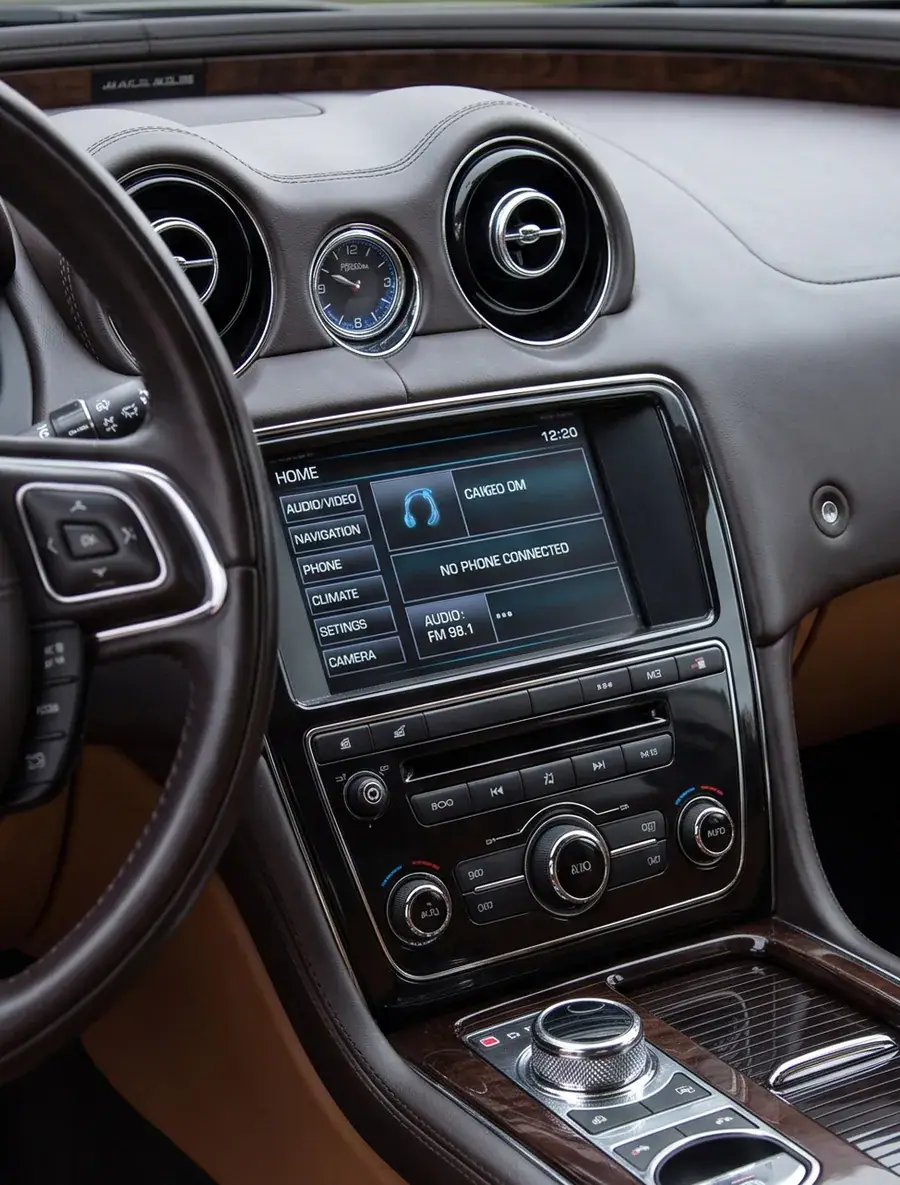
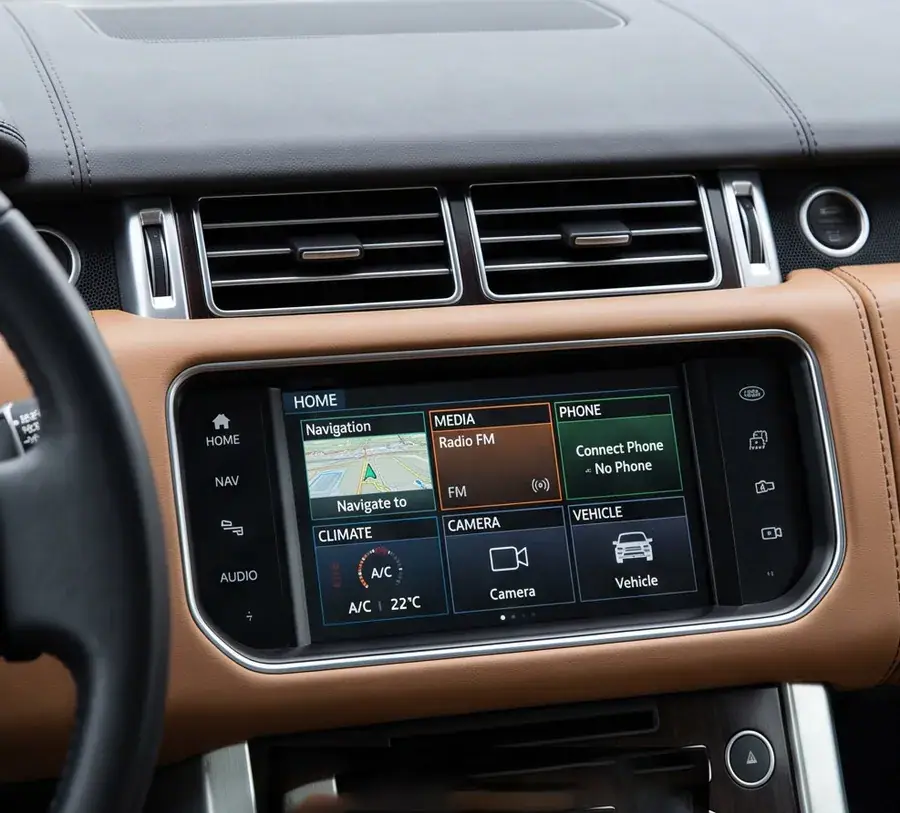
Verification happens in two stages. The first is visual: screen size and bezel shape. An 8-inch InControl screen has a noticeably wider aspect and a different button row than the 10.25-inch Touch Pro panel. Where a buyer is ordering against a VIN or a chassis plate rather than a physical car, the head unit part number is the more reliable identifier.
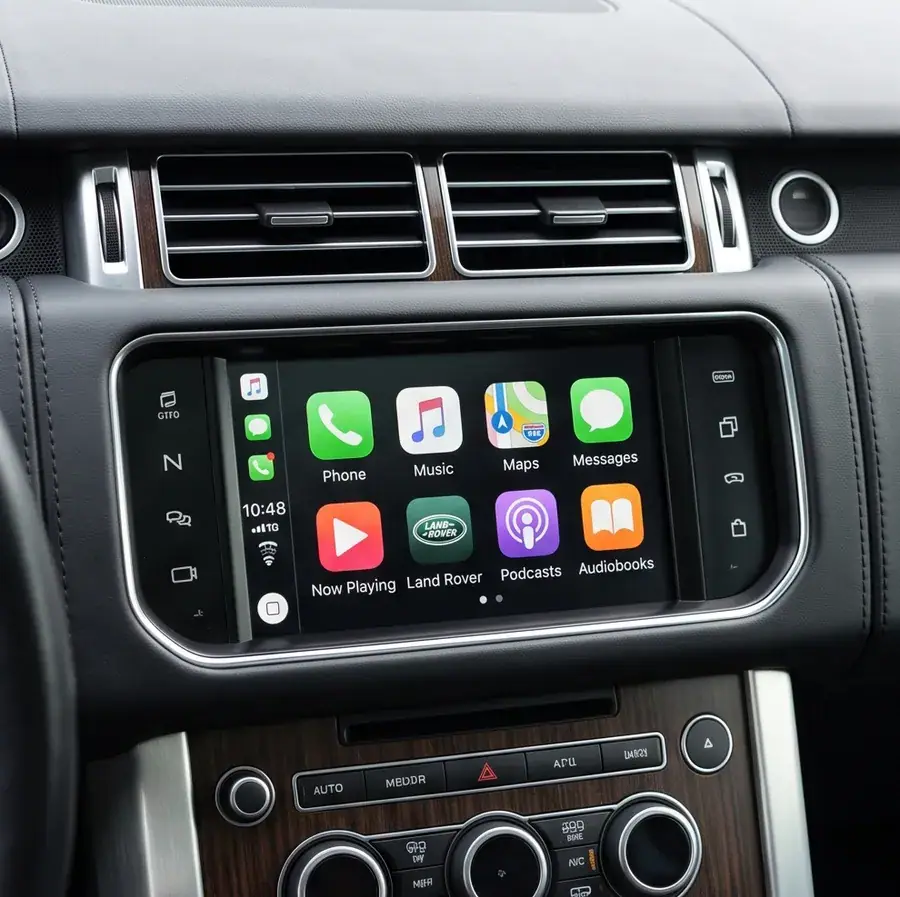
The second stage is the menu layout, which distinguishes generations without a part number. The 2012 to 2015 Bose units show a flat tiled menu with labelled soft keys along the left edge. The later Touch Pro units show a different home arrangement with a persistent left rail. Full identification steps, including how to read the head unit label behind the fascia trim, are covered in the Land Rover and Jaguar head unit identification guide.
Distributors who take this seriously see the difference in their return rate. A documented identification step at intake removes almost all of the wrong-variant returns, because the failure mode of a mismatched module is an immediate and obvious no-signal at first power-up rather than an intermittent fault discovered weeks later.
What Plug-and-Play Means on These Vehicles
All three modules install through a plug-and-play harness tapped into the factory display link and the vehicle network. No wires are cut, no fascia trim is modified, and the factory system remains fully recoverable by unplugging the harness.
What the driver keeps is the part that matters to a JLR owner. The original centre display stays in place, with the original bezel and housing. The steering-wheel controls continue to operate the audio system as they did from the factory. The factory rear-view camera continues to display through the vehicle's own camera trigger, whether the camera is original or an aftermarket unit already fitted. The rotary controller and the surrounding hard keys stay functional.
For an installation shop, the practical consequence is that a JLR retrofit is a short job with a low risk of cosmetic damage. There is no screen to trim around and no double DIN filler panel to fabricate, which is the usual hidden cost in this price segment. Install time runs roughly 30 to 45 minutes including the head unit identification step and a road test of the camera trigger and steering-wheel controls.
Why the Platform Choice Affects Return Rates
Modules run embedded Linux rather than a general-purpose mobile operating system. The distinction is not cosmetic. An embedded Linux build has no application cache to accumulate and no background update process competing for resources during a two-hour drive, so the interface behaves the same on the first week and the third year. That is what a workshop selling the same unit to a customer three years later actually needs.
Processing sits on an automotive-grade chipset from Taiwan-based Sunplus, rather than on a commodity part selected for consumer electronics. Automotive-grade parts carry wider temperature tolerance and longer supply commitments, which matters when a distributor is planning stock six to twelve months out. Smoothness on a compressed video stream also comes from the hardware path and the wireless link, not from the operating system, and the difference is measurable in vehicle environments where the phone and the module are both competing for a 2.4GHz channel.
For that reason the wireless link runs dual-band 5GHz WiFi alongside 2.4GHz. Multi-storey car parks and dense urban retail areas are exactly where a single-band connection degrades, and the 5GHz band has more clean spectrum available there. The dual-band arrangement is the practical answer to the environments where these vehicles actually spend time.
Commercial Terms for Wholesale Buyers
Volume terms are structured in three tiers. Stock orders begin at 10 pieces with mixed models permitted in the same shipment, which is the practical minimum for a distributor testing which variant sells fastest in a given region. Private label runs start at 500 pieces per model. Full OEM programme work, including firmware customisation and branding, starts at 1000 pieces per model.
Lead time on a sample is 7 to 15 days, shipped DHL or FedEx. A production order of 500 pieces or more runs 15 to 20 days. Quotations are returned within 12 hours of a complete enquiry, and the longer the model list in the enquiry the more useful that response becomes, since a mixed-model quote is what most distributors actually need.
| Order type | Quantity | Lead time |
|---|---|---|
| Sample | 1–3 pieces | 7–15 days, DHL / FedEx |
| Stock order | from 10 pieces, mixed models allowed | 15–20 days |
| Private label | from 500 pieces per model | 15–20 days |
| Full OEM | from 1000 pieces per model | Quoted per programme |
Payment terms are 30% deposit with the balance settled before shipment by T/T. PayPal is also accepted. A sample fee is payable with the sample and is deductible from a first large-volume order. The production range covers more than 300 vehicle models and series, and the full cross-reference is listed on the vehicle compatibility index.
Two commercial points deserve attention before the first purchase order is placed. The first is variant mix: given that JR-2 and JR-3 cover identical model years, a distributor stocking only one of them will turn away roughly half the 2016 to 2021 enquiries. The second is documentation. Each module ships with a fitting manual and a video guide, and install photos from real vehicles are available in the installation case library, which is what keeps a sub-agent installation consistent across a workshop team.
Questions Buyers Ask Before Ordering
Which models in the range are actually supported?
Discovery, Range Rover, F-Pace, XF, XJ and F-Type are covered from 2012 to 2021, split across the JR-1, JR-2 and JR-3 variants. Model year narrows the field, and head unit type narrows it further for 2016 to 2021 vehicles.
How is the correct variant determined before ordering?
The 2012 to 2015 vehicles take the JR-1. For 2016 to 2021 vehicles, measure the centre display: an 8-inch panel takes the JR-2 and a 10.25-inch Touch Pro panel takes the JR-3.
What operating system runs inside these modules?
Embedded Linux on an automotive-grade Sunplus chipset. There is no application cache to accumulate and no mobile operating system layer competing for resources, so behaviour stays consistent over years of service.
Is the retrofit reversible and does it affect factory functions?
Yes to both. The harness plugs in without cutting any wires, and unplugging it restores the original system exactly. The factory screen, steering-wheel controls and rear-view camera all continue to work as they did from the factory.
What are the minimum order quantity and lead time?
Stock orders start at 10 pieces with mixed models permitted. Private label starts at 500 pieces per model and Full OEM at 1000 pieces per model. Samples take 7 to 15 days; production runs of 500 pieces or more take 15 to 20 days.
Is private label supply available for these modules?
Private label production starts at 500 pieces per model, and full OEM firmware customisation starts at 1000 pieces per model. Quotation turnaround is within 12 hours of a complete enquiry.
For a distributor working out which variant to hold as stock and which to order against confirmed customer demand, the fastest route is a mixed-model sample order across all three modules. Send the model list and target markets with the enquiry form, and we will reply within 12 hours with a per-model quotation and a recommended stock split.
Need the Module From This Guide?
Wholesale from 10 pcs (mixed models OK), samples in 7–15 days (DHL/FedEx express). Fitment confirmation within 12 hours.
Request Pricing Check FitmentRelated Resources
- CarPlay Collections — browse by marque family (German, British, Italian, Japanese, luxury)
- CarPlay Fitment Checker — find the module for your car
- CarPlay Decoder FAQ — 34 answers on compatibility, install and wholesale
- CarPlay Retrofit Buying Guide — platform identification & selection
- Wholesale, Private Label & OEM Program — MOQ, lead times, payment terms
- All installation & technical guides