
Published 2026-10-23 · DIYCarPlay Engineering Team · 12 min read
One Code, Two Architectures: Sourcing the McLaren MC-1 CarPlay Module Across the IRIS Generation
McLaren's parts catalogue looks simple from the outside and is not from the inside. The marque replaced its own infotainment architecture partway through the model range it covers, so the word "McLaren" on an order form carries no information about the hardware sitting behind the centre screen. What decides the part is the generation of the system in the console, and the boundary falls inside model years rather than between them. The MC-1 covers the earlier generation — the in-house IRIS system fitted between 2013 and 2018 — across the P1, the 12C, the 650S, the 625C, the 675LT, the 570S, the 540C and the 600LT.
The MC-1 and what it covers
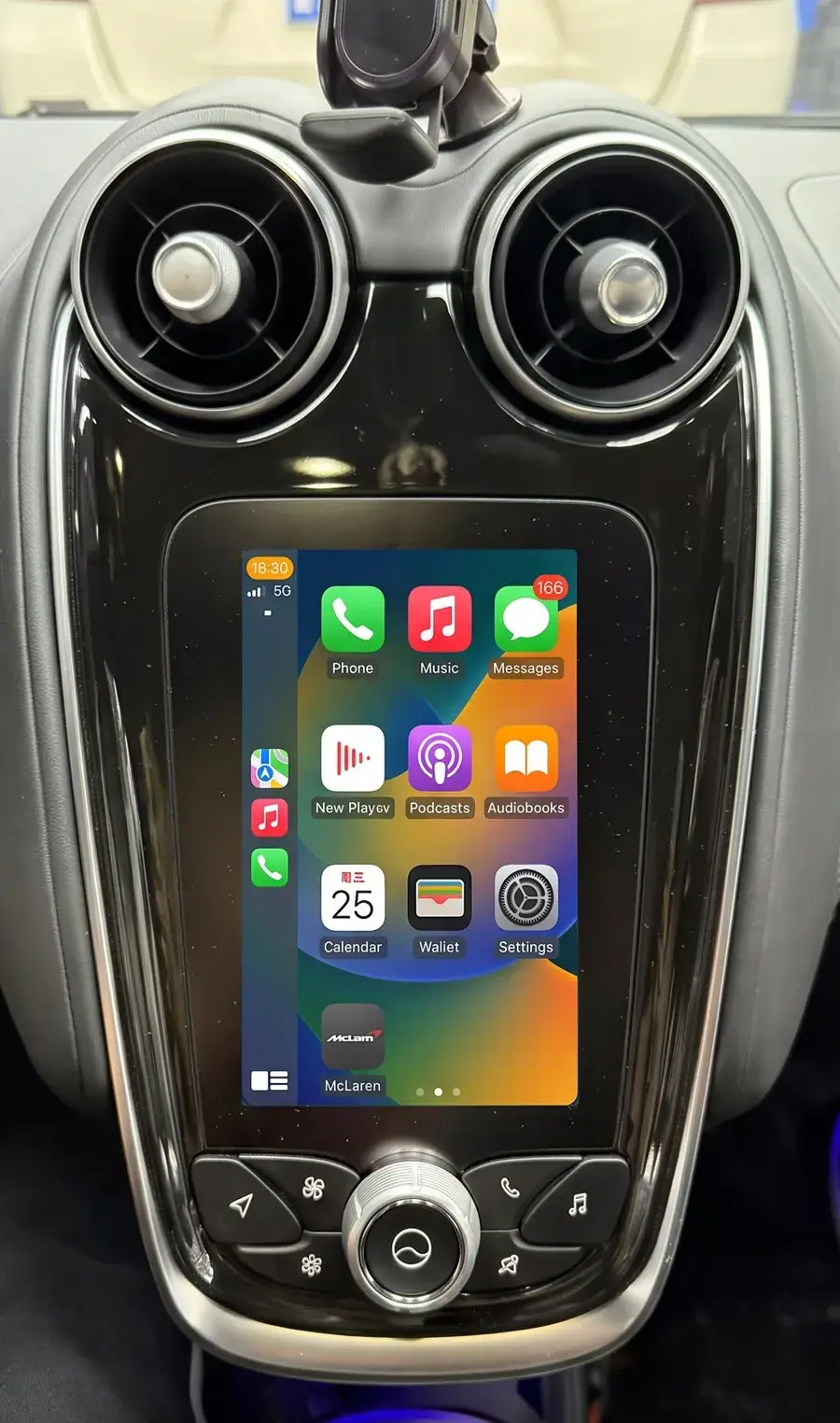
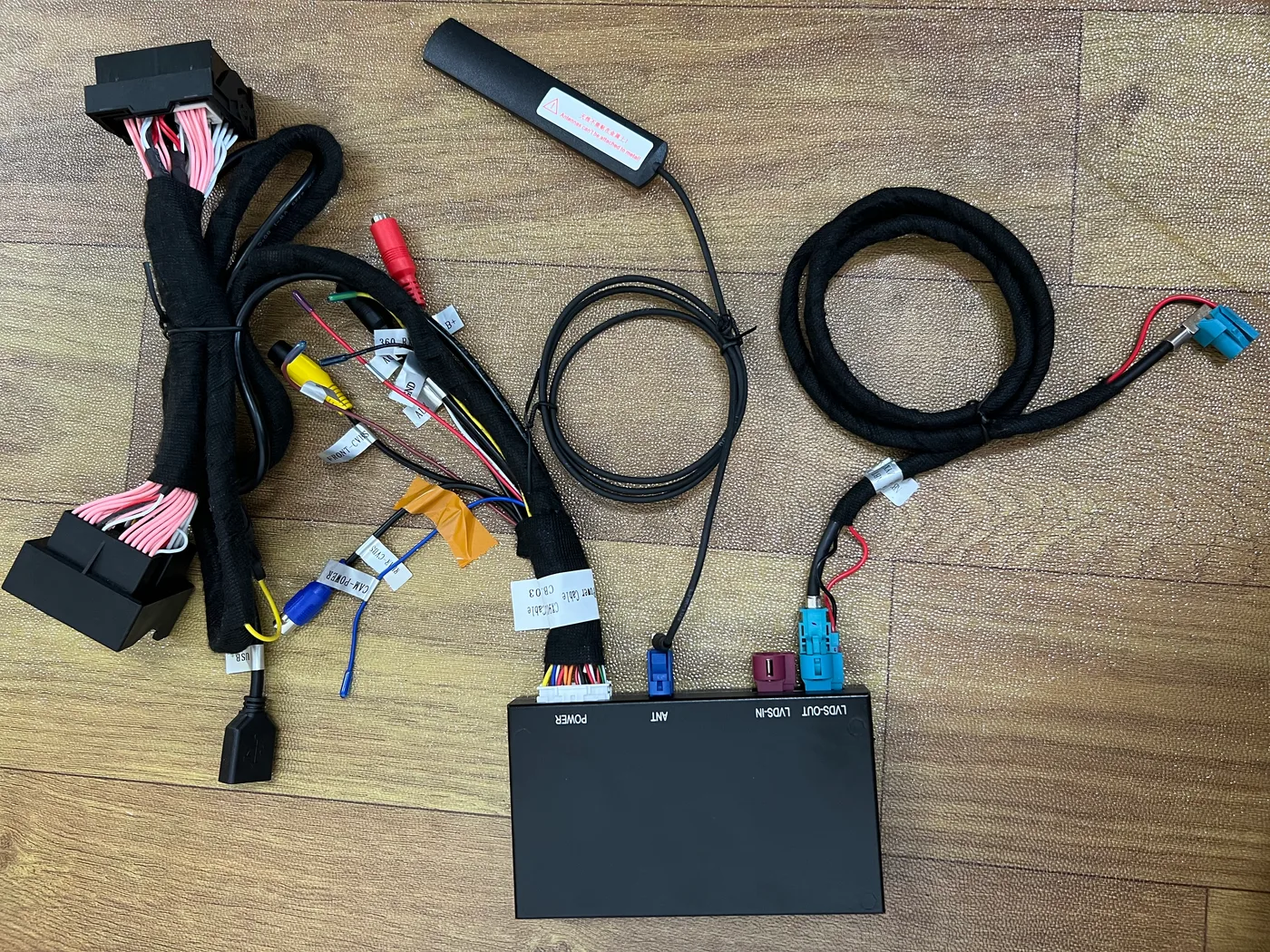
The MC-1 is a plug-and-play harness into the vehicle's own video and network wiring rather than a replacement display. It presents CarPlay on the panel the car was built with, and it leaves the original screen in the dash. For a distributor or installer, the practical consequence is that the McLaren line can be stocked as a single part number instead of a matrix of platform codes, with one harness family and one installation procedure across the whole nameplate list.
| Model lines | Years | Product code | Head unit |
|---|---|---|---|
| P1 / 12C / 650S / 625C / 675LT / 570S / 540C / 600LT | 2013–2018 | MC-1 | McLaren IRIS infotainment |
The wider catalogue behind that code covers 300+ vehicle models and series from 2006 to 2025, and the same fitment data drives the vehicle fitment finder and the McLaren range page. The MC-1 decoder page carries the authoritative compatibility list, and the rule that applies to it is the same rule that applies across the range: the head unit generation decides the part, and a photograph of the centre stack settles it faster than a model year.
Where McLaren changed its own system
IRIS was McLaren's own infotainment programme, developed in-house for the first road cars and carried through the 570S, the 540C and the 600LT. From the 720S generation onward the marque moved to a different architecture altogether, developed with an outside electronics supplier: an eight-inch centre screen with a vertical carousel menu, and a folding driver display behind the wheel that drops flat for track use. That is a different piece of hardware in a different console, and the cars running it are not on the MC-1 list. McLaren's own current supercar range shows how completely the later cars departed from the earlier dashboard.
| Vehicle group | System generation | MC-1 status |
|---|---|---|
| P1, 12C, 650S, 625C, 675LT, 570S, 540C, 600LT | McLaren IRIS, in-house, portrait-format centre display with a rotary console controller | Covered, 2013–2018 |
| 720S, 765LT, 750S and the cars derived from them | Later McLaren architecture developed with an outside supplier, eight-inch centre screen and folding driver display | Not on the MC-1 list — confirm against the screen |
The overlap is the trap. A 2017 or an 2018 McLaren can be either an IRIS car or one of the later architecture, and the badge, the model year and the general shape of the dashboard give no reliable signal either way. An order written against "McLaren, 2018" and filled from the badge alone ships the wrong unit, and the same logic that makes head-unit identification non-negotiable across the rest of the range applies here with more force, because the generation boundary sits inside the model years rather than between them.
Reading the IRIS screen before anything is ordered
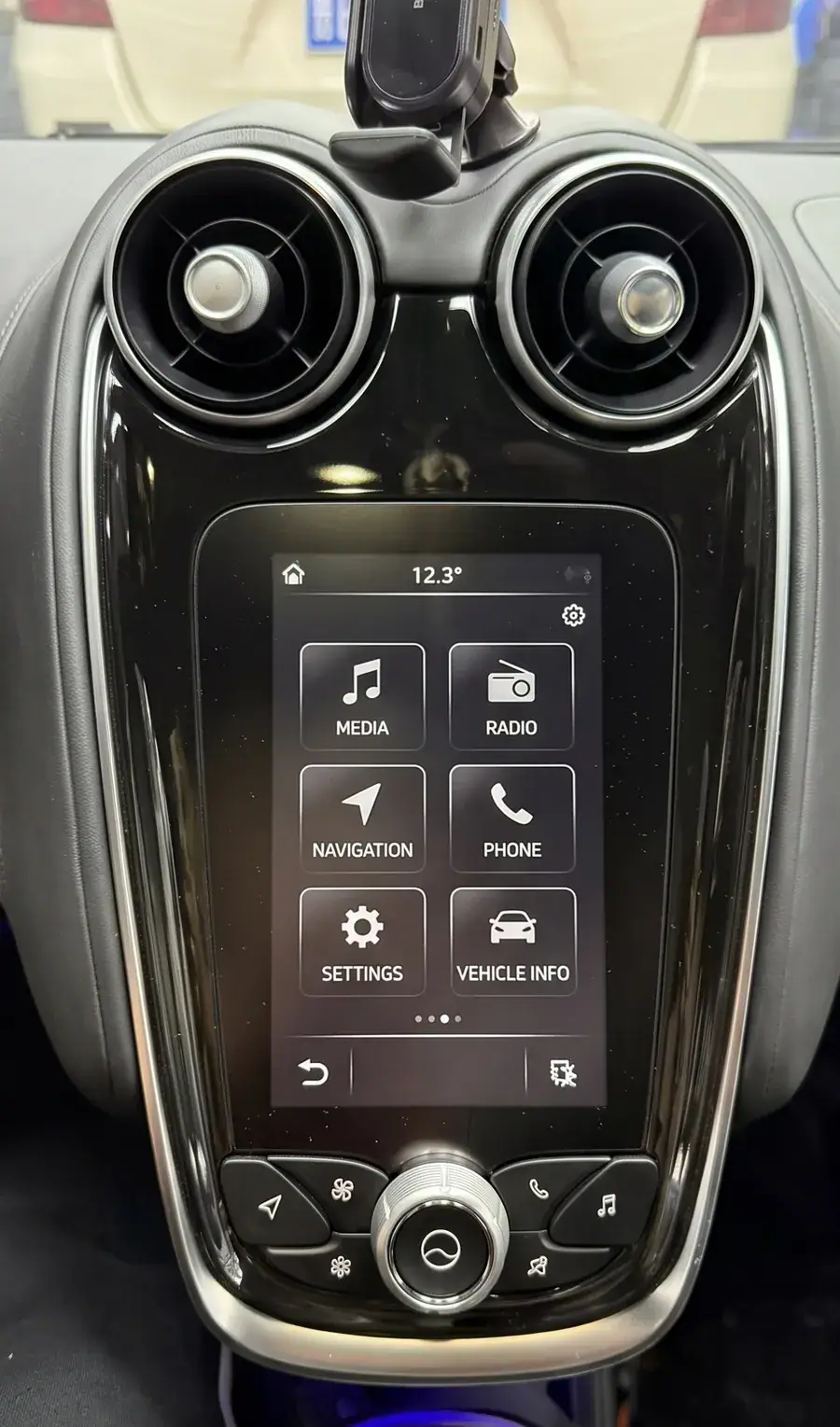
Identification on this marque is unusually straightforward once the correct picture is known. The IRIS centre panel is portrait-format, taller than it is wide, standing in a raised console pod between two turbine-style circular vents. The main menu is a six-tile grid: MEDIA and RADIO on the top row, NAVIGATION and PHONE in the middle, SETTINGS and VEHICLE INFO along the bottom, with a home icon at the top left, a gear icon at the top right, and a back arrow and settings key along the lower edge of the screen.
Below the screen sits the rotary controller, a round knob carrying the McLaren badge flanked by dedicated keys, and it is the part of the console a driver actually operates. The steering wheel on these cars carries no multimedia buttons at all — the IRIS generation moved every control to the console — so there is nothing on the rim that can be remapped or lost. In a photograph, an empty wheel with a portrait screen above a badged rotary knob is an IRIS car, and it is distinguishable from the later cars by the screen proportions alone.
That is the photograph worth requesting before a purchase order is placed. The head unit identification guide sets out the general method for the rest of the range, and the McLaren-specific cues above narrow it further.
What the installation involves on these cars
The centre pod on an IRIS car is reached from the cabin. The trim around the display releases from its clips, the head unit sits behind it with its connectors facing the driver, and the harness goes in between the head unit and the supplied unit, which is then tucked behind the dash and the trim refitted. The factory page records this at roughly 30 to 60 minutes for a technician who has worked on the platform before, with the disassembly rather than the connections taking the time.
Nothing is cut and nothing is soldered. There is no coding, no firmware flashing of the factory unit and no permanent modification, so the car can be returned to stock by removing the harness. The console controller and the keys around it stay in circuit, the factory menus can be brought back at any time, and the factory reversing camera keeps its original trigger path, so the camera image still takes priority over whatever the screen is showing when reverse is selected. Factory and aftermarket reversing cameras are both supported. Each unit ships with a manual and a video guide, and the warranty runs 12 months with firmware updates included.
Why the platform is a Linux embedded unit, and what that means for returns
The unit runs Linux in an embedded configuration on an automotive-grade chipset from Sunplus in Taiwan. The point is not the operating system in the abstract but what it does not do: there is no application cache accumulating on a machine that spends its life parked in sun and driven hard, and there is no phone-derived platform underneath quietly growing its storage and slowing down.
| Point | Retained factory unit | Large aftermarket display |
|---|---|---|
| Display hardware | Original McLaren portrait panel stays in the car | Original screen removed and discarded |
| Operating system | Linux embedded, no app cache accumulates | Android-based; storage and cache grow with daily use |
| Console controller and keys | Fully retained, including the rotary controller | Often re-mapped or partially lost |
| Factory reversing camera | Stays on the original path | Usually needs re-wiring |
| Vehicle menus and settings | Unchanged, switchable at any time | Replaced by the new unit's interface |
There is a second argument for the embedded approach that matters on this marque specifically. IRIS software is released in vehicle software packs targeted to individual cars and delivered through the dealer, so an update to the factory system is a VIN-targeted event rather than a download. A unit fitted behind the head unit is not affected by an IRIS update, and an IRIS update does not disturb it. That separation is what keeps a retrofit from turning into a service complaint about a system the customer never asked to change.
For a distributor, the arithmetic is straightforward. Every unit that comes back is a unit that was paid for twice — once outbound and once as a returned warranty claim — and the fix is to catch the mismatch before it is boxed. The pre-shipment check is a powered test against a real head unit of the target generation, not a visual inspection of a housing, and it is the same discipline applied across the whole range.
The link, the band and the chipset
The wireless link runs on both WiFi bands, 2.4GHz and 5GHz. The 2.4GHz band reaches further but occupies the crowded part of the spectrum, which is where a connection that drops partway through a drive usually comes from; the 5GHz band is shorter-range but far cleaner, and the Wi-Fi Alliance sets out how the two behave against each other in real environments. Carrying both means the link can settle on the cleaner band when conditions allow and fall back sensibly when they do not.
Apple's own CarPlay support documentation covers the vehicle-side requirements, and it is worth reading before quoting a customer: the connection method differs between cars that support CarPlay over a cable, cars that support it both ways, and cars that support it only wirelessly. The same page is the reason the built-in controls in the car remain usable, which on this marque means the rotary controller rather than anything on the rim. The antenna is mounted behind the head unit with its cable kept away from the display link and the climate-control motor, since a run parallel to the video line is what picks up noise on the picture.
What a distributor is buying
Stock quantities start at 10 pcs with mixed models accepted inside the same order, which matters on this marque because the model list inside one code is long enough to make a mixed opening order useful rather than inconvenient. Private label starts at 500 pcs per model, with the logo, the packaging, the manual and the warranty card produced to the distributor's specification. Full OEM firmware customisation — boot logo, interface layout, default language — starts at 1000 pcs per model.
Samples ship in 7–15 days by DHL or FedEx express, and the sample cost is deductible from the first large-volume order rather than being treated as a separate charge. A private label run of 500+ pcs takes 15–20 days, and the artwork approval runs inside that window rather than after it. A quotation is normally returned within 12 hours, with the volume tier, the lead time and the platform code named for every vehicle covered.
Payment is 30% deposit with the order and the remaining 70% settled against a copy of the bill of lading before shipment by T/T, with PayPal accepted for samples and smaller quantities. Full terms are on the wholesale programme page, and the wholesale guide to MOQ, lead times and quality control sets out what each tier means in practice for a distributor who is working out which platforms to hold.
Before a purchase order is issued
Five items settle a McLaren order, and all of them take less time than a return does. First, a photograph of the centre stack with the factory menu open — the six-tile IRIS grid confirms the generation in one frame. Second, the model line and year of every vehicle on the order, so that anything built outside 2013–2018 is flagged rather than assumed. Third, confirmation that no car on the list is a 720S or a car derived from it, since those run a different architecture. Fourth, the split between a mixed opening order and a single-platform run, which is what sets the volume tier. Fifth, and only for private label, artwork approval before production is released.
The warranty and RMA process and the factory reversing camera path are the two documents to have open when a distributor reviews the fitment list with a workshop, because they cover the two questions that come back most often after an install.
Frequently asked questions
Which McLaren generations does the MC-1 cover?
The IRIS generation built between 2013 and 2018, which covers the P1, the 12C, the 650S, the 625C, the 675LT, the 570S, the 540C and the 600LT. The fitment list on the McLaren decoder page is the authority, and anything not listed there is confirmed from a photograph of the screen before an order is placed.
How is the correct system confirmed before an order?
From the console itself. An IRIS car has a portrait-format centre panel with the six-tile menu grid, a rotary controller with a badged knob below it, and no multimedia buttons on the steering wheel. Cars from the later architecture have a wider screen in a different console. A single photograph of the centre stack distinguishes them.
What operating system runs inside the unit?
Linux in an embedded configuration on an automotive-grade Sunplus chipset. There is no application cache to accumulate, and the unit does not share storage with anything on the factory system, because it does not replace any part of it.
Is the link wireless?
Both. The unit carries 2.4GHz and 5GHz WiFi, so it can settle on the cleaner band when conditions allow and fall back when they do not. Where a car supports CarPlay only over a cable, the wired path remains available.
What remains in place after installation?
The original screen stays in the dash, the rotary controller and the console keys around it stay in circuit, and the factory menus can be brought back at any time. The factory reversing camera keeps its original trigger path, so it still takes priority the moment reverse is selected.
What is the minimum order?
From 10 pcs for stock, with mixed models accepted inside the same order. Private label starts at 500 pcs per model and Full OEM firmware customisation at 1000 pcs per model.
How long does a sample take?
7–15 days by DHL or FedEx express, and the sample cost is deductible from the first large-volume order. Testing on the vehicle the order is actually intended for is worth the wait, because the head unit rather than the badge determines which unit fits.
Send us your target vehicle list, quantities and target market through the inquiry form. You will receive a quotation within 12 hours, including volume tiers and lead times for the platforms you named.
Need the Module From This Guide?
Wholesale from 10 pcs (mixed models OK), samples in 7–15 days (DHL/FedEx express). Fitment confirmation within 12 hours.
Request Pricing Check FitmentRelated Resources
- CarPlay Collections — browse by marque family (German, British, Italian, Japanese, luxury)
- CarPlay Fitment Checker — find the module for your car
- CarPlay Decoder FAQ — 34 answers on compatibility, install and wholesale
- CarPlay Retrofit Buying Guide — platform identification & selection
- Wholesale, Private Label & OEM Program — MOQ, lead times, payment terms
- All installation & technical guides