Published 2026-10-22 · DIYCarPlay Engineering Team · 14 min read
Same Badge, Two Overlap Years: Sourcing Mercedes-Benz CarPlay Modules Across NTG4.0, NTG4.5 and HU6
Mercedes-Benz is the marque where the model year on the paperwork is least reliable of any in the European luxury range. Three product codes cover the retrofit-eligible span from 2007 to 2025, and two of those years sit in two rows at the same time: 2013 falls at the end of the NTG4.0 band and the start of the NTG4.5 band, while 2019 falls at the end of the NTG4.5 band and the start of the HU6 band. A wholesale order written against a model name and a registration year will ship the wrong module more often than not, and the error is discovered by the end customer rather than by the distributor.
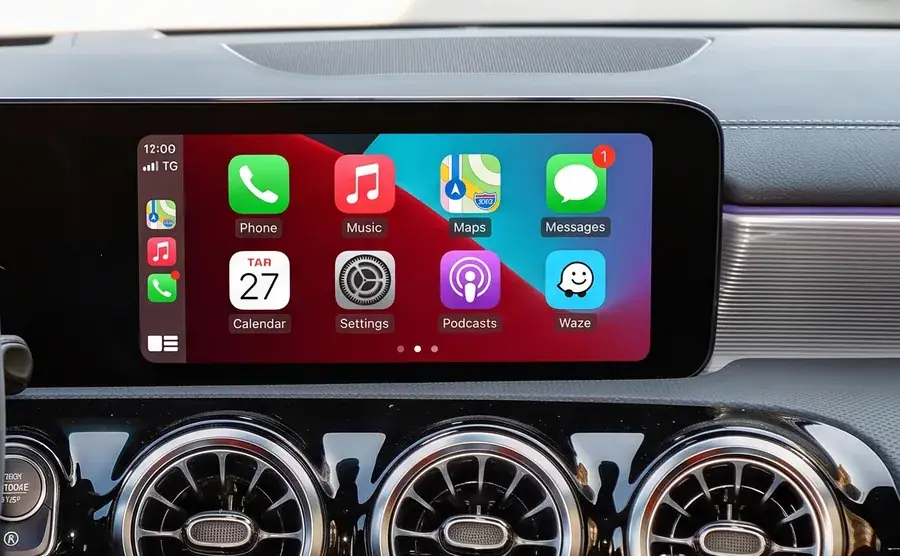
Apple's own CarPlay support page lists the vehicles that ship with a CarPlay-compatible head unit. The Mercedes cars of this era are not on that list. A 2013 A-Class carrying the earlier COMAND display has neither a factory phone interface nor a manufacturer-supported retrofit path, which is why the aftermarket category exists at all. The only route to a phone-driven interface on these cars is a decoder module that speaks to the factory head unit over its own video and data wiring, and adds a projection layer to a display that stays in the dash.
The three platform codes and the year bands that overlap
The fitment below is taken from the module pages for this marque. Each product code is a separate harness, a separate video interface and a separate firmware branch, which is why one module does not cover the range.
| Model lines | Years | Product code | Head unit |
|---|---|---|---|
| A / B / C / E / ML / GL / SLK / S Class | 2007–2013 | NTG4.0 | COMAND NTG4.0, small or flip-up display |
| A / B / C / E / S / CLA / GLA / ML / GL / GLC / GLE Class | 2013–2019 | NTG4.5 / 4.7 / 5.0 | COMAND widescreen, touchpad controller |
| A / CLA / GLA / GLB / GLE / GLS Class | 2019–2025 | HU6 | MBUX generation, touchscreen-first |
Read down the first column and the pattern is clear. The A-Class appears in all three rows, so one badge covers the entire span from 2007 to 2025 with a different unit behind the screen in each period. The C-Class, E-Class, S-Class, ML and GL each appear in the earlier two rows. The CLA, GLA and GLE sit in the middle row and the current one, and the GLC, GLB and GLS appear once each. The model name therefore narrows the field to two or three candidate harnesses rather than to one, and only the build year narrows it further. The complete fitment is listed on the Mercedes-Benz module page.
The two transition years that decide which harness ships
2013 sits in two rows at once. The NTG4.0 band runs to 2013 and the NTG4.5 band starts in 2013, because Mercedes phased the newer COMAND hardware in during model years rather than cleanly between them. A car registered in 2013 may have been built to either specification depending on the month it left the factory, and the registration document is not evidence either way.
2019 sits in two rows as well. The mid-generation band runs to 2019 and the HU6 band starts in 2019, so the same applies at the far end of the range. A 2019 A-Class, CLA, GLA or GLE is the hardest case in the whole fitment table, because those four model lines appear on both sides of that boundary. The screen itself is the better guide than the paperwork in both cases, which is the reason a photograph of the centre display is worth more than a build date on a purchase order.
The remedy is procedural rather than clever. The vehicle list handed over for quotation should carry the head unit specification, or a photograph of the centre display, for every car in the order. One photograph per model line is enough to remove the guesswork, and it is the single change that prevents the most expensive category of return in this category: a harness that powers up, shows a picture, and then cannot drive the panel it was ordered for.
Reading the platform off the head unit itself
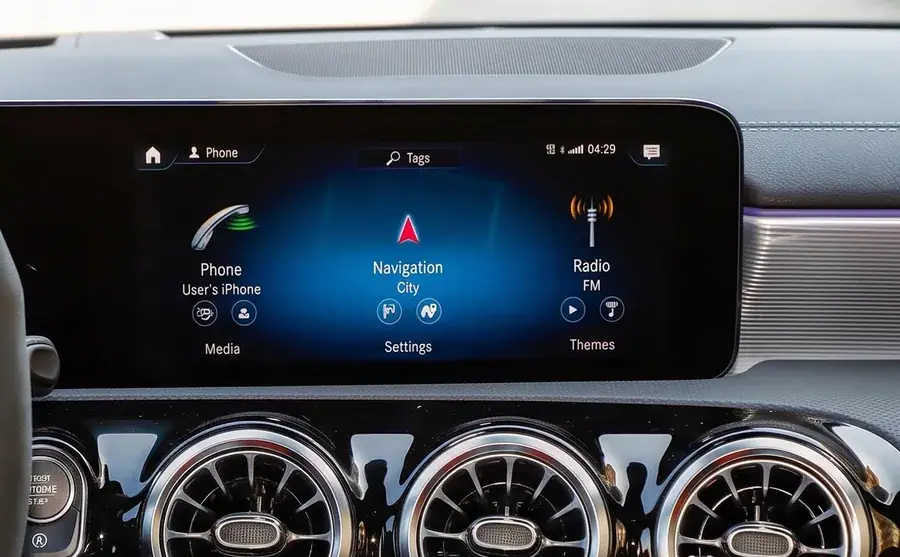
Three physical cues settle it faster than any documentation. The earlier COMAND generation is built around a large rotating controller with a surrounding keypad, paired with a small fixed or flip-up display. The mid generation replaced that with a wider, flatter panel and, in most cars, a small touchpad sitting on top of a dial. The MBUX-era unit in the current row is touchscreen-first, with a voice assistant built in and no physical controller on the console. A single photograph of the centre stack distinguishes all three.
One detail matters commercially. The mid-generation product code covers three internal revisions — NTG4.5, NTG4.7 and NTG5.0 — and they are not the same panel. Factory display options across that band run from 7-inch units up to the 12.3-inch wide screen fitted to later cars, and the harness is configured to the panel it drives. A distributor who orders by product code and then ships to the wrong car inside that band ends up with a blank display and a return that costs a bay slot, a freight leg and the margin on the unit. The COMAND generation guide sets out the visual cues in full, and the platform upgrade guide covers what each code does on the car.
What the installation involves on the bench
The harness behind each of these platforms lands in three places. LVDS carries the video signal from the factory head unit to the Mercedes display. CAN wakes the module and carries vehicle data back from the bus. The accessory branch feeds the reversing trigger and the camera path, so the factory reverse image continues to appear without a menu change. On the COMAND generations the video path is transferred to the original fibre optic link rather than replaced, and the harness terminates in a 48-pin connector at the head unit.
No wire is cut and nothing is soldered. Every platform is a plug-and-play installation: the vehicle-specific harness plugs into the factory connector, and the console trim comes off far enough to reach the head unit connector and then goes back. The factory screen stays in the dash, and the car returns to stock if the module is removed. The factory screen, the head unit behind it, the COMAND controller, the steering-wheel buttons and the factory reversing camera all keep working exactly as they did before the harness was fitted.
Two configuration details from the factory documentation are worth flagging to a workshop before it quotes an installation. On the earliest COMAND platform the audio path is not always live: cars without a factory auxiliary input need the original auxiliary channel activated, some cars need the AMI cable fitted into the chain, and the external auxiliary source has to be selected before the system is switched over. Both are set-up steps on a known car rather than modifications, but they are the difference between an audio path that works on the first test and a callback the following week. The W212 and W204 retrofit walkthrough shows the same sequence on a working installation.
That matters commercially as much as mechanically. A workshop that already services Mercedes does not have to learn a new electrical architecture, and a workshop that only installs Mercedes decoders does not have to buy a display it will never use. The head unit identification guide is the quickest way to route an incoming vehicle to the correct harness before the bay slot is booked.
Why the platform is a Linux embedded unit and not a replacement display
Each platform is a Linux embedded module on an automotive-grade Sunplus chipset from Taiwan. It adds a projection layer to a display that is already in the car; it does not become the display. That distinction decides two things a distributor ends up explaining to customers every week.
| Point | Retained factory unit | Large aftermarket display |
|---|---|---|
| Display hardware | Original Mercedes screen stays in the car | Original screen removed and discarded |
| Operating system | Linux embedded, no app cache accumulates | Android-based; storage and cache grow with daily use |
| Controller and steering-wheel buttons | Fully retained, including the COMAND controller | Often re-mapped or partially lost |
| Factory reversing camera | Stays on the original path | Usually needs re-wiring |
| Vehicle menus and settings | Unchanged, switchable at any time | Replaced by the new unit's interface |
The stability argument follows the hardware rather than the software. Fluidity on a factory display of this age comes from what the video pipeline and the chipset can sustain, not from how much is running underneath. Linux embedded has no application cache that grows over three years of daily use, and the Sunplus part is specified for a temperature range a dashboard actually sits in. Mercedes head units of this generation are themselves built on that kind of embedded architecture, which is why a ten-year-old car still feels immediate on its own menu.
For returns and warranty cost this matters more than a specification sheet suggests. A module with no display to fail and no display to replace turns most of the failure categories a distributor would otherwise carry into categories that simply do not exist: cracked panels, backlight fade and dead touch layers are all display faults, and none of them can happen to a unit that never touches the screen. The 12-month warranty then covers the part that can actually fail, and firmware updates for the platform are included for its life.
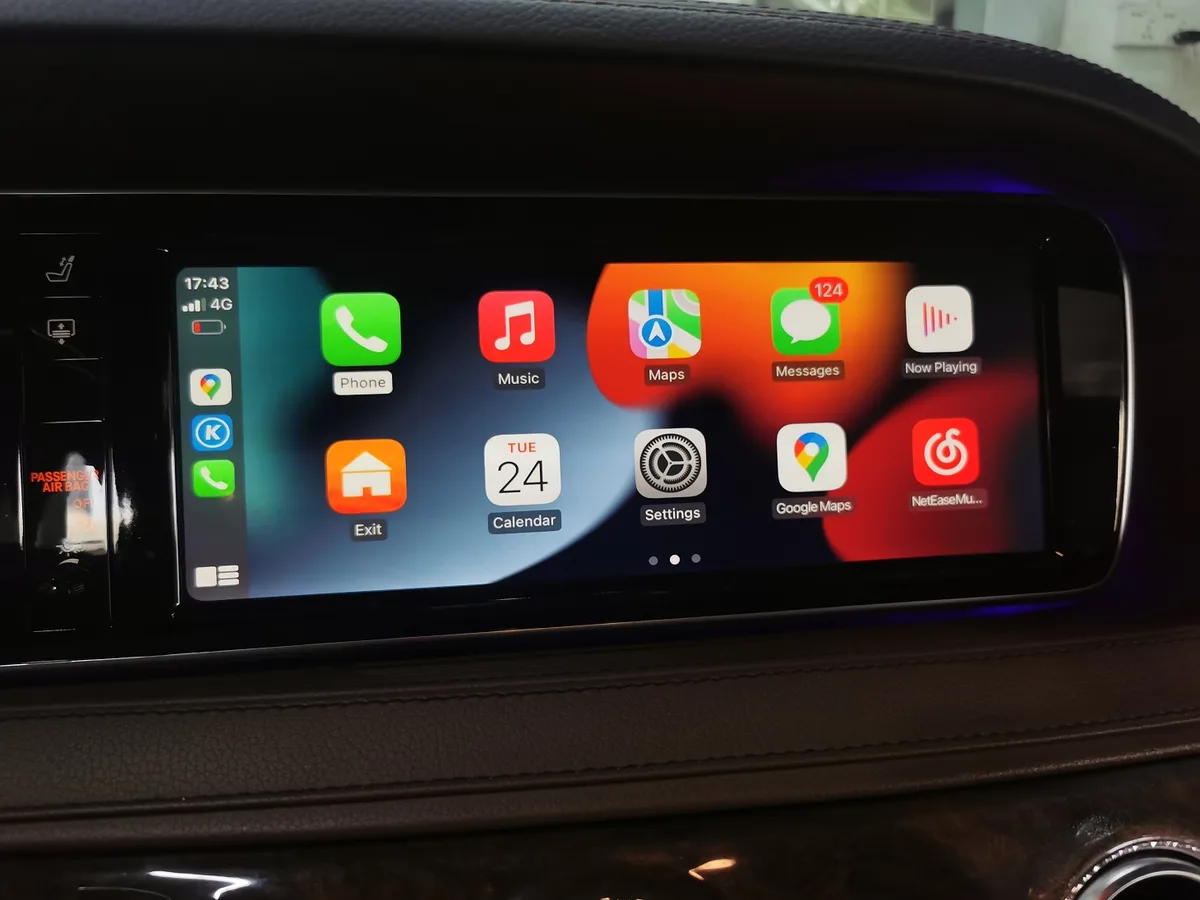
Every platform supports both wired and wireless Apple CarPlay, alongside wired and wireless Android Auto, Huawei HiCar, and AirPlay or Miracast mirroring, on a dual-band 5GHz WiFi link covering 2.4GHz and 5GHz. The three phone platforms are alternatives on the same unit rather than a replacement for it, which means one harness covers a customer base that has not settled on a single ecosystem.
The wireless link and why both bands are carried
For a European or Australian dealer, dual-band WiFi is not a specification-sheet detail. Basement parking and dense urban radio environments are where single-band links drop, and a dropped link on a customer's car becomes a comeback that costs a bay slot rather than a cable.
The Wi-Fi Alliance splits the 2.4GHz and 5GHz bands precisely because they behave differently: 2.4GHz reaches further and penetrates more, while 5GHz carries more data with less congestion. Carrying both in one module means the link settles on whichever band the location favours instead of being locked to the crowded one, and it is the 5GHz side that holds a picture stable on a wide panel. It is also why the antenna pigtails are routed out of the dash rather than tucked behind the head unit, where the metal bodywork and the screen's own shielding cut the signal. The antenna placement guide covers the routing in detail.
Commercial terms for a Mercedes-led order
Mercedes volumes across Europe and Australia are substantial enough that a distributor can build a programme around this marque rather than treat it as one line among many. Current terms:
- Stock platform codes: from 10 pieces, mixed models accepted, so a first order can cover NTG4.0, NTG4.5/4.7/5.0 and HU6 together instead of committing the whole quantity to a single platform.
- Private label: from 500 pieces per model, with own logo, packaging, manual and warranty card.
- Full OEM: firmware customisation from 1000 pieces per model.
- Samples: 7–15 days by DHL or FedEx express, and the sample cost is deductible from the first large-volume order.
- Lead time: stock ships in 7–15 days; private label 15–20 days for 500 pieces or more.
- Payment: 30% deposit with the order, with the balance settled against a copy of the bill of lading before shipment by T/T, and PayPal accepted for samples and small orders.
- Quotation: replies within 12 hours, with the platform code named for each vehicle and anything unsupported flagged rather than shipped on a guess.
The mixed-model allowance on the 10-piece tier is the part that matters most for this marque. All three product codes draw on the same Linux embedded architecture and the same harness discipline, so a distributor can cover the whole Mercedes range from one opening order instead of three separate minimums, and add other marques to the same shipment. The wholesale programme is built around that mixed-model opening rather than a per-brand minimum.
Fitment is confirmed vehicle by vehicle before an order is placed, and the catalogue covers 300+ vehicle models and series from 2006 to 2025. The compatibility list is checked against the head unit rather than the badge, with Mercedes treated as one entry among many rather than as a special case.
What to confirm before a purchase order is issued
Four items settle most Mercedes disputes before they start.
- Confirm the head unit, not the badge or the build year. A photograph of the centre stack identifies the platform faster than a registration document, and it is the only reliable method for 2013 and 2019 cars.
- Confirm the display size inside the mid-generation band. NTG4.5, NTG4.7 and NTG5.0 share a product code but not a panel, and the configuration has to match the screen fitted to the car.
- Confirm the camera and the auxiliary path. Factory and aftermarket reversing cameras are both supported, but the trigger has to be read from the vehicle rather than assumed, and the AMI and auxiliary-activation steps are checked at the same time.
- Confirm the language set of the factory menu. Mercedes cars are frequently imported, and a German or Chinese menu on the factory layer is normal rather than a symptom of a failed installation.
Frequently asked questions
Which Mercedes-Benz model years are covered?
2007 to 2025, split across three product codes as set out in the fitment table above. The A-Class appears in all three, the C-Class, E-Class, S-Class, ML and GL in the earlier two, and the CLA, GLA and GLE in the middle and current rows. Years and model lines outside that list are unverified until a photograph of the head unit is checked against the fitment data.
How is the correct platform confirmed before an order?
By the controller and the panel rather than by the model year. A large rotating dial with a surrounding keypad indicates the earliest generation, a small touchpad on top of a dial indicates the mid generation, and a touchscreen-first layout with a voice assistant indicates the MBUX-era unit. One photograph per model line is enough for a whole order.
What operating system runs inside the module?
A Linux embedded system on an automotive-grade Sunplus chipset. There is no application cache that accumulates with use, and no memory or storage figures of the kind found in phone-based aftermarket head units.
Is the link wireless?
Both. Wired and wireless Apple CarPlay are supported, along with wired and wireless Android Auto, Huawei HiCar, and AirPlay or Miracast mirroring, on a dual-band 5GHz WiFi link covering 2.4GHz and 5GHz.
Do the steering-wheel controls and the factory reversing camera keep working?
Both are retained. The COMAND controller and the steering-wheel buttons operate the projection layer, and the factory reverse camera continues on the original trigger path with no menu change, which is the item customers test first and complain about fastest.
What is the minimum order?
From 10 pieces for stock platform codes with mixed models accepted. Private label starts at 500 pieces per model, and Full OEM firmware customisation at 1000 pieces per model.
How long does a sample take?
7–15 days by DHL or FedEx express, and the sample cost is deductible from the first large-volume order. Testing on the actual vehicle the order is intended for is worth the wait, because the head unit rather than the badge determines which platform is needed.
Fitment for a specific Mercedes-Benz, or a mixed-model opening quotation across the three platform codes and the other European marques, is confirmed against the head unit specification. Request a quote and a response follows within 12 hours, naming the volume tier, the lead time and the platform code for every vehicle covered.
Need the Module From This Guide?
Wholesale from 10 pcs (mixed models OK), samples in 7–15 days (DHL/FedEx express). Fitment confirmation within 12 hours.
Request Pricing Check FitmentRelated Resources
- CarPlay Collections — browse by marque family (German, British, Italian, Japanese, luxury)
- CarPlay Fitment Checker — find the module for your car
- CarPlay Decoder FAQ — 34 answers on compatibility, install and wholesale
- CarPlay Retrofit Buying Guide — platform identification & selection
- Wholesale, Private Label & OEM Program — MOQ, lead times, payment terms
- All installation & technical guides