Published 2026-11-10 · DIYCarPlay Engineering Team · 14 min read
The Badge on the Screen Is Not the Code: Why Entune, Enform and NissanConnect Cannot Settle a CarPlay Platform Code
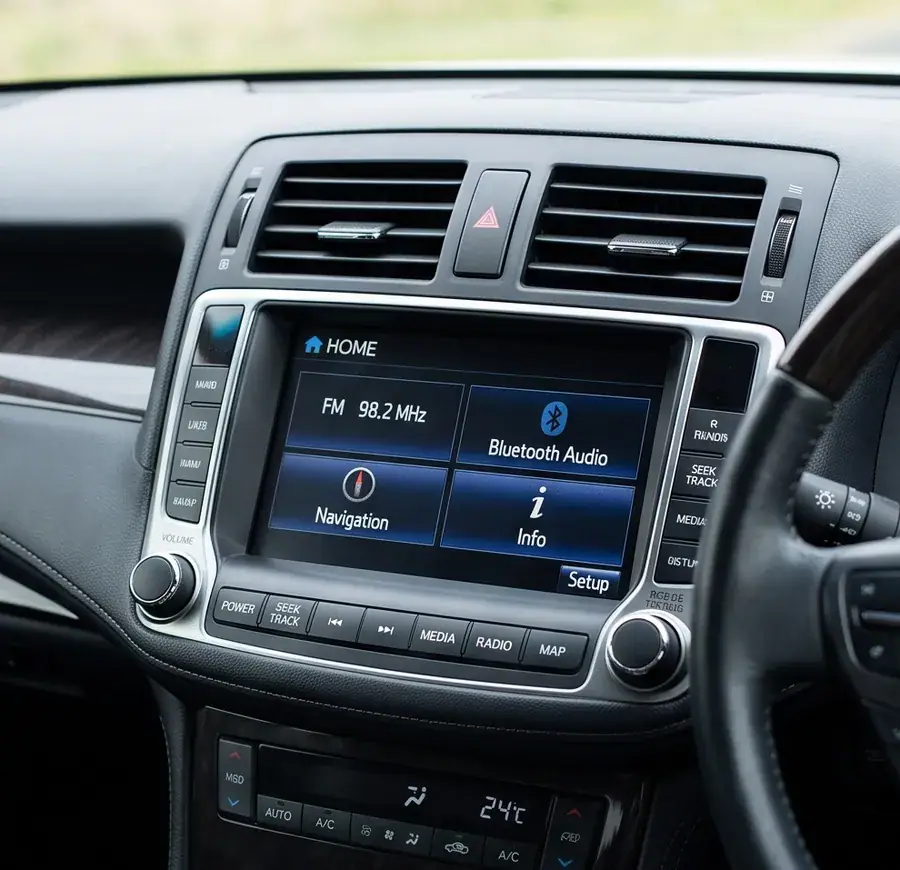
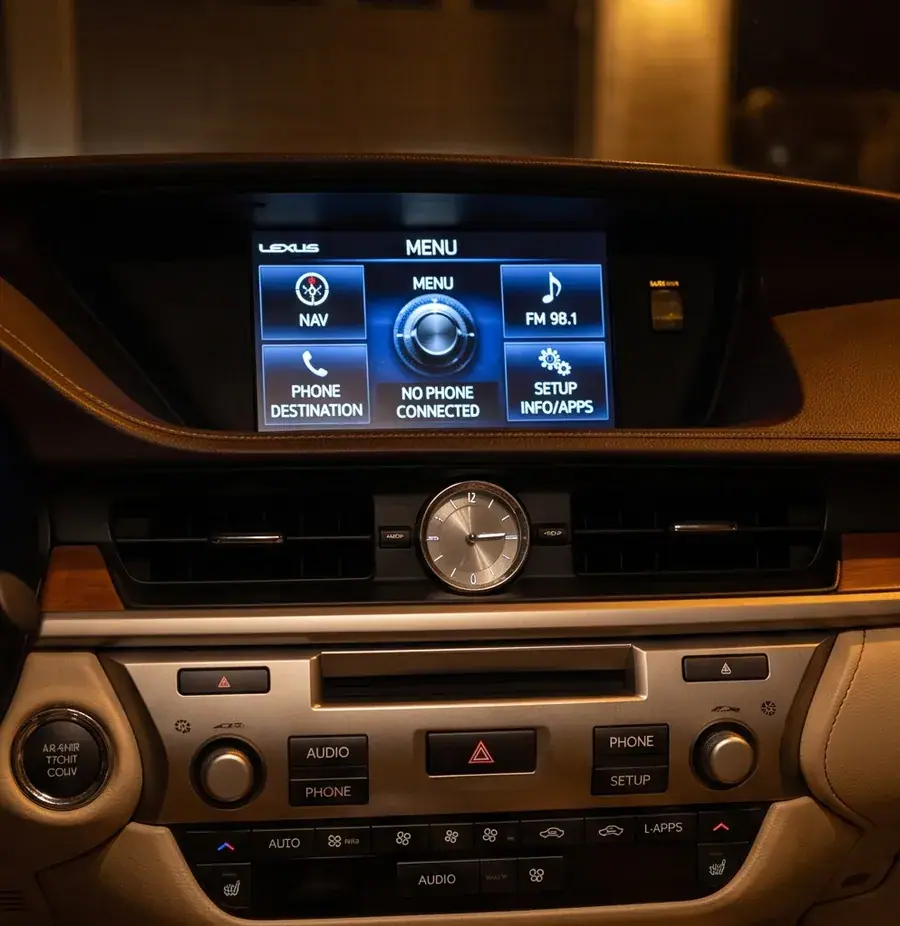
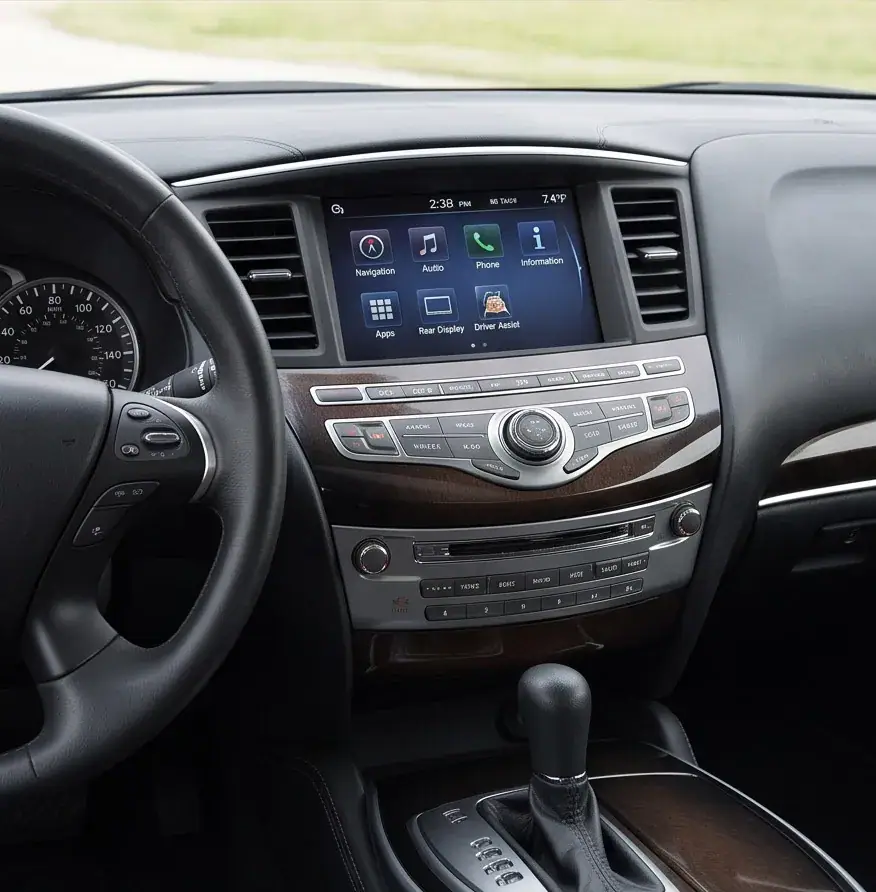
A workshop that needs to identify a Toyota, a Lexus, a Nissan or an Infiniti photographs the head unit, because the screen is the one thing that looks the same on every car of that marque. What the photograph usually shows is a badge: Entune on a Toyota, Enform on a Lexus, NissanConnect on a Nissan, InTouch on an Infiniti. The badge reads like a model name, it is the easiest thing to photograph, and on these three marques it is the one clue that cannot settle which platform code the car needs.
The catalogue behind those codes holds 39 platform codes across 76 code-and-model-line combinations, covering 300+ vehicle models and series from model years 2006 to 2025. Counting each model name once, 50 model names in this catalogue are covered by more than one platform code, and 10 model names whose year windows are identical under two codes cannot be separated by the year at all. The badge sits on top of that structure rather than inside it, which is why a photograph of the screen can look decisive and still leave the order line empty.
What the badge on the screen actually names
Toyota Entune is an integrated multimedia navigation and telematics system, not a name for a head unit. It premiered in 2011 on the Toyota Prius v and was carried forward under the same badge for close to a decade. The Lexus Enform application suite expands on the same technology, so the two marques share one family of connected services behind two different names. The Entune platform was phased out from 2021 in favour of Toyota Audio Multimedia, support for the Entune phone app was discontinued during 2023, and the services the app provided were fully discontinued by Toyota on October 30, 2023.
Nissan sits on the same pattern with a different name. That telematics service began in December 1997 as Compass Link, ran as CarWings for many years, was renamed NissanConnect in 2015, and is also branded Infiniti InTouch on the sister marque. It is a subscription service and an app suite, and the badge on the screen reports which service the car shipped with. The service history is the same on both marques.
None of that is the same thing as a hardware generation. Toyota does name its head unit generations, and those are the codes that appear in service literature: 11CY, 13CY, 13.5CY and 17CY across the mainstream lines, with 15CY on the Land Cruiser and 16CY on the Prius plug-in hybrid and on the later Prius. The badge sits above those names and does not map one to one onto them. A closer look makes the point sharper still: the three head unit trim levels sold under the Entune 3.0 name, Audio, Audio Plus and Premium Audio, are three different head units built by two different manufacturers, and all three carry the same badge. One badge covers hardware with different amplifiers, different navigation arrangements and different fitted modules.
Toyota: the hardware codes under the badge
Toyota ran two head unit lines through the same 2014 to 2018 window. TO-1 is the MPV and truck line, carrying Sienna, Alphard, Prado and Tundra. TO-2 is the crossover and sedan line, carrying Highlander, RAV4, Camry and Crown. Both carry the identical 2014 to 2018 label, so the year written on the box settles nothing between them; the body line does.
The table sets out the Entune hardware generation carried by each of the five model lines in this catalogue that appear in the North American generation table, year by year. It is the point where a buyer usually stops looking, because the hardware code does look like a generation.
| Model line | Platform code | 2014MY | 2014.5MY | 2015MY | 2016MY | 2017MY | 2018MY |
|---|---|---|---|---|---|---|---|
| Sienna | TO-1 | 11CY | — | 13CY | 13CY | 13CY | 17CY |
| Tundra | TO-1 | 13CY | — | 13CY | 13CY | 13.5CY | 13.5CY |
| Camry | TO-2 | 11CY (built Aug–Nov 2013) | 13CY (built Dec 2013 on) | 13CY | 13.5CY | 13.5CY | 17CY |
| RAV4 | TO-2 | 13CY | — | 13CY | 13.5CY | 13.5CY | 13.5CY |
| Highlander | TO-2 | 13CY | — | 13CY | 13.5CY | 13.5CY | 13.5CY |
Read down the columns and the badge route breaks. In 2014, 11CY and 13CY each appear under both platform codes. In 2015, 13CY appears under both. In 2017, 13.5CY appears under both. In 2018, 17CY and 13.5CY each appear under both, which means a 2018 car with a 17CY head unit is either a Sienna on TO-1 or a Camry on TO-2, and the badge cannot say which. Four of the five model years carry a hardware code that appears on both sides of the split.
Only 2016 separates the two, and there the split is of the code rather than of the car: the TO-1 lines run 13CY and the TO-2 lines run 13.5CY, which still leaves the Sienna on the same code as the Tundra and the Camry on the same code as the RAV4. The half-year column is a reminder of how thin the margin is: the generation table records a 2014.5MY entry for the Camry alone, on TO-2.
One detail makes the badge weaker still. The Camry moved from 11CY to 13CY across the 2014 and 2014.5 model years, with cars built between August and November 2013 carrying one code and cars built from December 2013 onward carrying the next. The generation code inside the badge moves with the build month, so the badge plus the model year is not even internally consistent for one car. The build month is what settles it, and the build month is not on the fitment sheet.
The table lists the North American model years. Alphard, Prado and Crown are not in it, because that generation table covers the North American lines and those three are recorded elsewhere in the fitment sheet. The badge on an Alphard is therefore a weaker clue still, not a stronger one.
Lexus: one badge across two codes
Lexus carries Enform, the app suite built on the same technology as Entune, and the badge spans both Lexus codes. LE-1 covers the IS and the CT from 2013 to 2015. LE-2 covers the later window from 2015 to 2020 and extends across the IS, CT, RX, LX, GS, ES and LS lines. The IS and the CT are listed under both, so for those two cars the badge cannot even narrow the field to one candidate, and the model year does not break the tie either, because the two windows meet at 2015.
What breaks it is the controller in the centre console, and that is a separate route from the badge: the earlier cars use a mouse-style Remote Touch unit with a joystick, and the later ones a flat touchpad-style controller. Lexus introduced the touchpad form with the 2015 NX and the 2015 RC F, describing it as a replacement for the previous joystick. The Toyota and Lexus head unit guide works through those dashboard cues and the two photographs that capture them. The Lexus fitment page lists both codes against the lines each one covers.
Nissan and Infiniti: one badge, two revisions
NissanConnect and InTouch are the same service under two names, and the badge appears on both head unit revisions. NI-1 is the earlier revision, fitted across the GT-R and the QX50, QX60, QX70, QX80 and Patrol lines from 2009 to 2018. NI-2 is the later revision, fitted to the later build window of the QX50, QX60, QX70, QX80 and Patrol lines from 2013 to 2019.
Five model names appear under both revisions, and the overlap runs from 2013 to 2018, so a QX-series car from that period sits inside both windows. The badge cannot pick the revision, and the model year cannot either for a car built in the middle of the overlap. The GT-R is the exception in the other direction: it sits entirely inside NI-1, and every year of it in this catalogue runs the earlier revision.
The menu styling differs between the two revisions, which is what the two-photo workflow picks up: one photograph of the main menu and one of the control area. The Nissan and Infiniti guide sets out which lines each revision covers, and the Nissan and Infiniti fitment page carries the same split by module.
Eleven routes to a platform code, and what this one cannot settle
Identifying a head unit generation is a solved problem with a long list of methods, and this catalogue has worked through most of them. The table puts the badge route next to the other ten, because the value of a badge is best judged by what it adds to the list rather than on its own.
| Clue | What it settles | What it cannot settle |
|---|---|---|
| Screen and dashboard cues | The shape of the centre stack and the era of the fascia | The head unit behind a shared fascia |
| Version and settings screen | The marque's own generation string | The fitment line where the code names the body |
| VIN, build plate, parts catalogue | Production date and the head unit part number | A unit replaced by a previous owner |
| Model-year window | Narrows inside a code's own label | Codes that share a year window |
| Diagnostic bus read | The head unit's own part number and software version | The body line behind the unit |
| One code, several generations | That a code is not one car | Which generation is fitted |
| Factory CarPlay date | When a marque added factory CarPlay | The platform of a car that never had it |
| Platform code naming family | Whether a code can be checked on the car | The fitment of a shortened code |
| Chassis designation | The body, below the model name | The codes where no designation is carried |
| Coverage width | How many names a code carries | Which of those names the car is |
| The marque's own badge | That the car belongs to the family | The code, the revision and the body line |
The badge is still worth photographing. It confirms the marque and the generation family in one glance, it is free to check, and it is the first thing a workshop looks for. What it cannot do is carry the order, because on all three of these marques it spans both codes of its own marque. The guide to platform code coverage sets out the other half of that picture, which is how wide each code reaches once the code itself is known, and the guide to what one code covers works through the codes that carry more than one generation.
What the confirmed code buys in the car
With the code settled, the installation is short. The harness plugs into the factory head unit, the display wakes, and the phone appears on the original screen. Nothing on the vehicle side is replaced and nothing is flashed. The table sets out the difference between a decoder module behind the original display and an aftermarket unit that replaces it.
| Point of comparison | Decoder module behind the original display, Linux embedded | Aftermarket Android unit |
|---|---|---|
| Original display and bezel | Kept in the car | Removed and replaced |
| Factory buttons and steering wheel | Kept and still working | Lost with the original unit |
| Reversing camera | Original camera and trigger retained | Depends on the replacement unit |
| Operating system | Linux embedded on an automotive-grade Sunplus chipset | General-purpose Android system |
| Long-term behaviour | No application cache builds up behind the interface | Application cache builds up behind the interface over the years |
| Phone link | 5GHz dual-band WiFi with 2.4GHz fallback, low latency for the video stream | Depends on the unit and on the link it provides |
The module sits between the head unit and the display, and it speaks to the vehicle on the CAN bus for wake and reverse trigger, so the factory screen, the factory buttons, the steering wheel controls and the reversing camera all stay in service. The unit is fed from the factory harness, so the install is plug-and-play with no cutting and no coding. Inside, an embedded Linux configuration on a Sunplus automotive chipset does the work, and the phone pairs over 5GHz dual-band WiFi with 2.4GHz fallback, so a crowded 2.4GHz band in a multi-storey car park does not take the video stream down with it.
Ordering once the code is confirmed
Wholesale from 10 pcs with mixed models accepted, private label at 500 pcs per model, and Full OEM firmware programmes at 1000 pcs per model. Samples ship in 7 to 15 days by DHL or FedEx, and a large-volume order runs 15 to 20 days. Fitment is confirmed within 12 hours of the vehicle list arriving. Payment is 30% deposit with the 70% balance settled against a copy of the bill of lading, by T/T, and the sample fee is credited against the first large-volume order. The wholesale programme page sets out the same terms for private label and Full OEM work.
The vehicle fitment finder walks the same data in three steps, and the Toyota fitment page lists the TO-1 and TO-2 lines against the models each one covers. Send the VIN, a photograph of the powered-on screen, a photograph of the control area and the model with its build year, and the code comes back with the module and the connection it uses.
Frequently asked questions
Does the Entune badge on the screen tell me which Toyota module fits?
No. The badge names the connected service, and in four model years out of five the hardware generation code behind that badge appears under both TO-1 and TO-2. The body line settles it: MPV and truck models run TO-1, while crossover and sedan models run TO-2.
A Lexus shows Enform. Which generation is it?
The Enform badge covers both Lexus codes, and the IS and the CT are listed under LE-1 and LE-2 alike. The two windows meet at 2015, so the year does not break the tie either. The Remote Touch controller does: mouse-style on the earlier cars, flat touchpad-style on the later ones.
Are NissanConnect and Infiniti InTouch different systems?
They are the same service under two names. That service began as Compass Link in December 1997, ran as CarWings, and was renamed NissanConnect in 2015, with the Infiniti badge carried alongside it. It spans both the NI-1 and NI-2 revisions.
Can an order be placed on the badge alone?
No. On Toyota, Lexus, Nissan and Infiniti the badge spans two platform codes of its own marque. It is a useful confirmation photograph and a poor order line, because the number of candidate modules stays at two.
What if the head unit has already been replaced?
The screen will still show the badge of the car, not of the unit in it. That is why a diagnostic read on the vehicle network, or the head unit part number from the parts catalogue, is the check that survives a previous owner.
Which photographs should be sent with a vehicle list?
One photograph of the powered-on main menu, one of the control area, and the VIN together with the model and build year. The menu photograph carries the badge, the control photograph carries the generation on the marques where the controller changed, and the VIN carries the build month where a code moved mid-year.
Next step
Send the vehicle list with the VIN, the build year and the two dashboard photographs, and the platform code comes back with the module and the connection it uses. A quotation follows within 12 hours, and the sample terms are the same for a single car as for a full container.
Request a fitment confirmation and a quotation for any of the 300+ vehicle models and series in the catalogue.
Need the Module From This Guide?
Wholesale from 10 pcs (mixed models OK), samples in 7–15 days (DHL/FedEx express). Fitment confirmation within 12 hours.
Request Pricing Check FitmentRelated Resources
- CarPlay Collections — browse by marque family (German, British, Italian, Japanese, luxury)
- CarPlay Fitment Checker — find the module for your car
- CarPlay Decoder FAQ — 34 answers on compatibility, install and wholesale
- CarPlay Retrofit Buying Guide — platform identification & selection
- Wholesale, Private Label & OEM Program — MOQ, lead times, payment terms
- All installation & technical guides