
Published 2026-10-20 · DIYCarPlay Engineering Team · 10 min read
One Build, Four MIB Generations: Sourcing the VW-1 CarPlay Module for the Tiguan, Touran, Passat and Golf 7
The VW-1 is the Volkswagen build in this range, and it covers the MIB-based cars behind Tiguan, Touran, Passat, Golf 7, Phideon, Lamando and Teramont across 2013–2018 model years. It is a plug-and-play harness into the original LVDS video link and the vehicle network: the factory screen, the rotary controller, the steering-wheel buttons and the original reversing camera all stay in place.
For a distributor sizing the Volkswagen retrofit market, the headline is not the unit count. It is that one platform build covers the model lines carrying most of the retrofit volume in this marque, and that a meaningful share of the same cars needs nothing at all. Apple only reaches these vehicles through a CarPlay-compatible head unit or a retrofit interface the manufacturer supports, and a Tiguan from 2013 has neither.
Which Volkswagen cars the VW-1 covers
Fitment for this marque is decided by head unit generation rather than by badge or trim level. The Volkswagen build listed for this platform covers the model group below, and the shared head unit is what allows a single build to cover all of them.
| Model | Model years | Compatible head unit | Build |
|---|---|---|---|
| Golf 7 | 2013–2018 | VW MIB infotainment | VW-1 |
| Tiguan | 2013–2018 | VW MIB infotainment | VW-1 |
| Touran | 2013–2018 | VW MIB infotainment | VW-1 |
| Teramont | 2013–2018 | VW MIB infotainment | VW-1 |
| Passat | 2013–2018 | VW MIB infotainment | VW-1 |
| Phideon | 2013–2018 | VW MIB infotainment | VW-1 |
| Lamando | 2013–2018 | VW MIB infotainment | VW-1 |
Because the head unit is shared, the harness, the video link and the button mapping are shared with it. That is the commercial point of a single platform: a distributor stocking this build is not holding a separate stock line for each model name, and mixed-model orders are possible from the starting quantity.
The Volkswagen range page lists each platform against the models it covers, and the VW-1 product page carries the full specification, the fitment table and the accessories supplied with the build.
Four MIB generations, and two of them need no module at all
Volkswagen carried the MIB platform in four generations, and they behave very differently for a buyer. The two earliest shipped without any phone integration, and the two latest shipped with wireless phone integration already built in. The table below sets out the generations, using the Golf 7 as the reference point for the year boundaries, because the same platform carries the Tiguan, Touran, Passat, Teramont, Phideon and Lamando.
| MIB generation | Model years (Golf 7 basis) | Typical display | Factory phone integration | Retrofit required for wireless CarPlay |
|---|---|---|---|---|
| MIB1 | 2012–2015 | 5.8" 400×240 | Not supported | Yes |
| MIB2 | 2015 onward | 6.5" / 7" / 8" 800×480 | App-Connect, cable only | Yes |
| MIB2.5 | 2018 onward | 8" / 9.2" HD | Wireless built in | No — already wireless |
| MIB3 | 2020 onward | 9.2" HD | Wireless built in | No — already wireless |
The consequence for stock planning is direct. A MIB2.5 or MIB3 car already carries wireless phone integration from the factory, so ordering a retrofit for it produces a return rather than a sale. The MIB generation guide sets out how each generation can be read from the car itself, and the fitment checker works from the model year and the display size.
Why the model badge does not identify the platform
This is where a Volkswagen order most often goes wrong, because the same badge covers more than one head unit family. The fitment table above groups Tiguan with the 2013–2018 MIB window, and the MIB platform itself also carries the Golf Sportsvan, Passat B8, Tiguan II, Touran II, Arteon, T-Roc and the Transporter T6. Outside that family sit the older RNS and RCD units, which belong to a different platform entirely — the Touareg 7P with RNS-850, for instance, runs the Audi-derived MMI3G hardware and is not part of the MIB family at all. A purchase order that names the model without the platform will eventually be shipped the wrong build, and a returns cycle costs far more than a fitment check.
The check itself takes minutes. The head unit reports its own hardware version in the system information menu, and the dealer service record carries the same information against the VIN. Both are worth having in front of the customer before the order is placed, because a model year on a registration document does not identify the unit in the dashboard.
What the installation involves on an MIB head unit
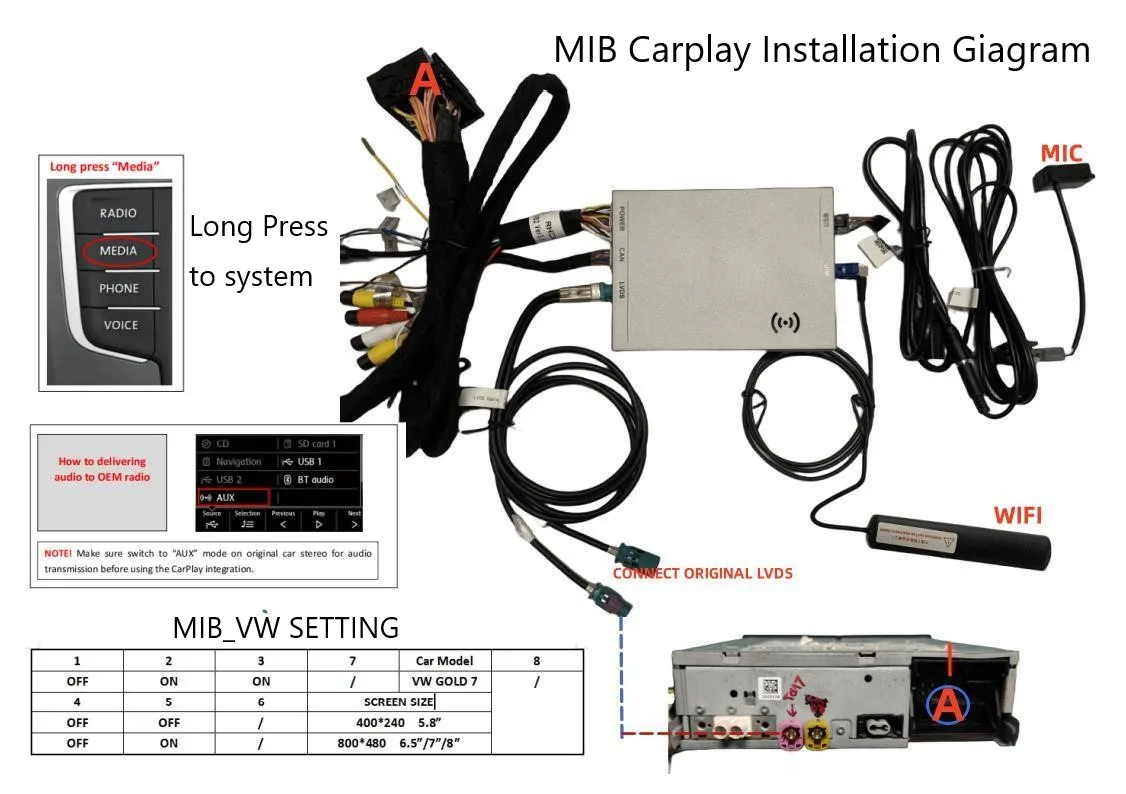
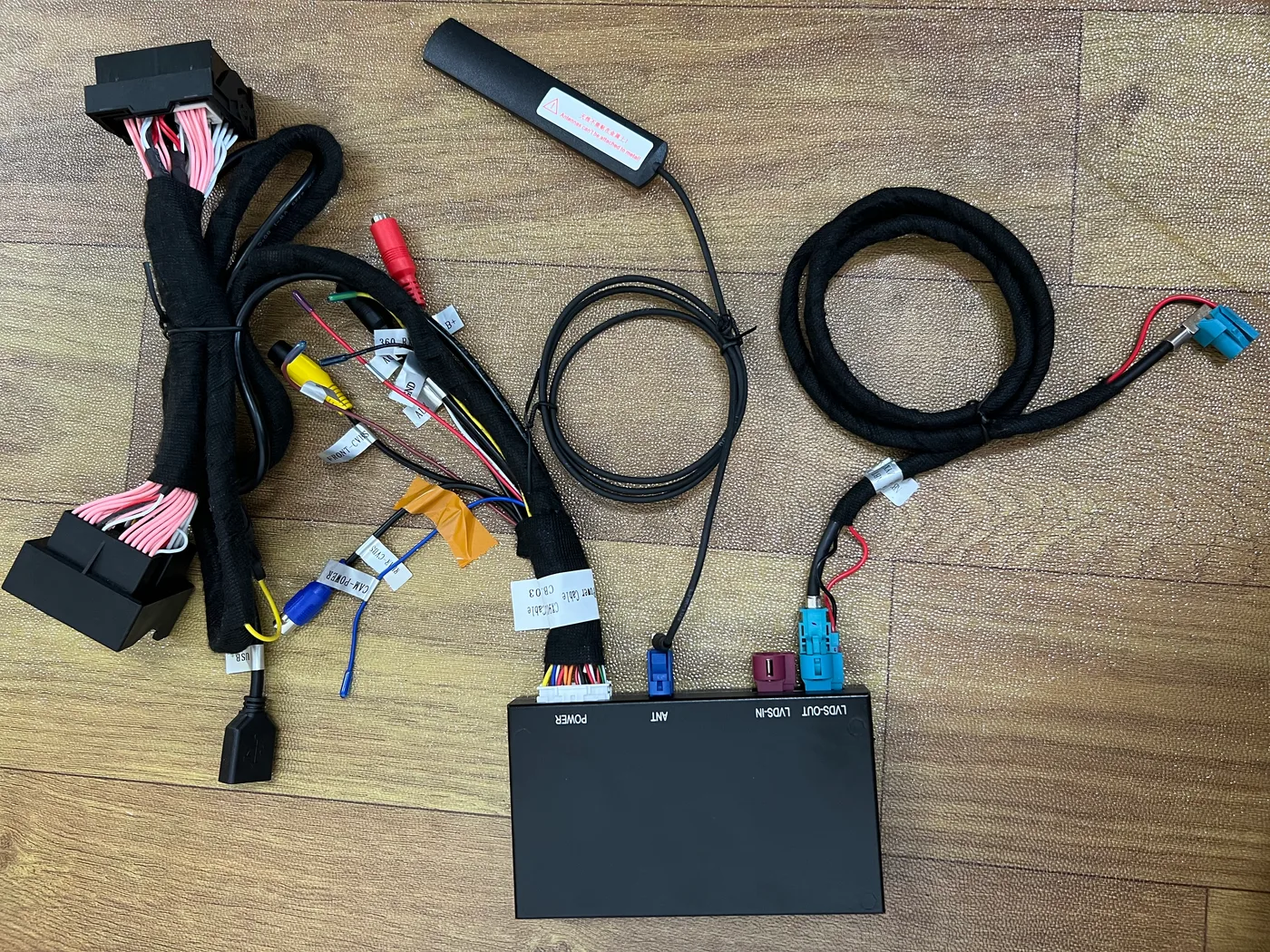
The work is short and the vehicle is not modified. The original LVDS display cable is moved from the head unit to the module harness, the second LVDS plug goes to the factory screen, and the harness joins the existing power, CAN wake and amplifier connections behind the centre trim. Nothing is spliced into an unrelated circuit, and the factory camera path, the steering-wheel buttons and the rotary controller stay connected exactly as delivered.
Two configuration details decide whether the install works on the first attempt. The DIP block on the module carries the platform and screen-size settings, and it has to match the panel in the car: the 5.8-inch 400×240 display and the 6.5, 7 and 8-inch 800×480 displays are set differently, and a block left on the wrong setting is the most common cause of a black screen on a working harness. On an MIB head unit the module menu is reached by a long press on the MEDIA button, and the MIB diagram notes that the original stereo has to be switched to AUX mode before the integration is used, otherwise the audio path stays silent.
Each build ships with a manual and a video guide, and the harness connectors are keyed so they seat one way only. The practical read on bay time is that the centre trim comes off, the connectors move, the block is set and the unit is tested; the factory screen itself is never removed, and the customer keeps the dashboard they bought.
Why the unit stays quick: Linux, Sunplus silicon and a two-band radio
The decoding side runs embedded Linux rather than Android, so there is no application cache to accumulate and no background process to degrade the interface over a few years of daily use. The video work sits on an automotive-grade chipset from Sunplus in Taiwan, the same class of silicon used in factory infotainment, and the headroom for the video pipeline comes from that hardware rather than from a general-purpose operating system.
The wireless link runs on dual-band WiFi, 2.4GHz and 5GHz, with the 5GHz band carrying the picture where conditions allow and the lower band holding the connection in a concrete car park. Antenna placement decides how that behaves in practice: the 5GHz pigtail has to run forward, away from the metal behind the head unit, and the antenna placement guide covers the routing in detail. A build that ships with two external antennas and a keyed harness is what makes the difference predictable rather than accidental.
Ordering terms, minimums and lead times
Commercial terms are the same across the catalogue, and they are quoted at platform level rather than per model name.
| Order type | Minimum quantity | Lead time | Notes |
|---|---|---|---|
| Stock order | 10 pcs, mixed models OK | 7–15 days by DHL or FedEx | Sample cost credited against the first large-volume order |
| Private label | 500 pcs per model | 15–20 days for 500+ pcs | Distributor branding on the device, retail box and manual |
| Full OEM firmware programme | 1000 pcs per model | 15–20 days for 500+ pcs | Custom menu graphics, boot logo, language packs, hardware revision |
Samples ship in 7–15 days by DHL or FedEx, and the sample cost is credited against the first large-volume order. Mass production above 500 pieces runs 15–20 days, and a quotation comes back within 12 hours with the module, the volume tier and the lead time named against the platform. Payment is 30% deposit, with the balance against a copy of the bill of lading by T/T, and PayPal is accepted for samples. The wholesale terms page sets out the same structure across every platform in the range, which spans 300+ vehicle models and series from 2006 to 2025.
The two references worth sending a customer
Two external references settle most of the arguments that come up before a purchase order is signed. Apple's own CarPlay requirements page states what a phone needs and what the car side has to provide, independent of any retrofit supplier, and it is the right document to send a customer who asks whether a 2013 car can be made compatible at all. The Wi-Fi Alliance sets out how the 2.4GHz and 5GHz bands differ in range and congestion, which is the underlying reason a two-band radio falls back to the lower band in a multi-storey car park rather than dropping the link.
Common questions
Is every Tiguan in the fitment range built the same way?
No. Volkswagen used four MIB generations, and the two earliest shipped without phone integration while the two latest shipped with wireless phone integration already installed. The generation is read from the system information menu or from the dealer record for the VIN, and it is the generation rather than the model year that decides what a car needs.
What does a fitment check involve before an order is placed?
Three details: the head unit hardware version from the system information menu, the model year, and the display size. Those three resolve the platform and the screen-size setting, and the fitment checker on this site works from the same data. A customer who cannot supply them is asked for a photograph of the unit and the dashboard instead.
What is the minimum quantity for a first order?
Ten pieces, with mixed models accepted on the same order. Private label starts at 500 pieces per model, and a full OEM firmware programme — custom menu graphics, boot logo, language packs and a hardware revision — starts at 1000 pieces per model. Samples can be sent before that commitment is made.
How long do samples and production runs take?
Samples ship in 7–15 days by DHL or FedEx, with the sample cost credited against the first large-volume order. Production above 500 pieces runs 15–20 days from cleared payment, and a quotation is returned within 12 hours naming the module, the volume tier and the lead time.
What is covered by the warranty?
12 months, with firmware updates included. Modules ship with the current firmware for their head unit generation, so a stock order does not need per-vehicle firmware work before it goes out, and the build stays matched to the platform it was configured for.
The fastest route to a confirmed module is the vehicle list: model, year and the head unit version for every car intended for sale, with quantities per model and the destination port. Send that through the inquiry form and the reply comes back within 12 hours with the module, the volume tier, the lead time and the sample cost. Where a car on the list needs no module at all, that gets stated in the same reply, because it is the part of a purchase order that has to be right.
Need the Module From This Guide?
Wholesale from 10 pcs (mixed models OK), samples in 7–15 days (DHL/FedEx express). Fitment confirmation within 12 hours.
Request Pricing Check FitmentRelated Resources
- CarPlay Collections — browse by marque family (German, British, Italian, Japanese, luxury)
- CarPlay Fitment Checker — find the module for your car
- CarPlay Decoder FAQ — 34 answers on compatibility, install and wholesale
- CarPlay Retrofit Buying Guide — platform identification & selection
- Wholesale, Private Label & OEM Program — MOQ, lead times, payment terms
- All installation & technical guides